Finding the best BPA-free food storage containers isn’t quite as simple as choosing a set with a reassuring label on the packaging. You also need containers that seal properly, keep food fresh, fit comfortably in your refrigerator, and hold up to everyday use.
Whether you’re storing leftovers, preparing meals for the week, organizing pantry ingredients, or freezing homemade meals, the right containers can make a noticeable difference in how efficiently your kitchen works.
The good news is that there are plenty of options. You can choose lightweight BPA-free plastic containers for everyday convenience, glass containers for storing and reheating meals, or stainless steel options if you prefer to avoid plastic food-contact surfaces.
However, one important distinction deserves attention: BPA-free doesn’t automatically mean chemical-free, PFAS-free, or phthalate-free. It simply means the manufacturer claims that the product does not contain bisphenol A (BPA).
For this guide, we’re focusing on established food storage brands, useful container designs, practical capacities, and clearly stated material and care specifications. We’ll also explain what BPA-free means, whether BPA-free plastic is safe for food storage, and how to choose containers for your refrigerator, freezer, pantry, and everyday meal preparation.
How We Selected These BPA-Free Food Storage Containers
We compared established food-storage lines using published manufacturer specifications and practical everyday-use considerations. This is a research-based buying guide, not a laboratory test or a claim of independent chemical testing.
We prioritized products with identifiable container and lid materials and a manufacturer BPA-free statement for the relevant product line.
We considered whether each option is designed for leftovers, meal preparation, reheating, freezing, or dry pantry storage.
We looked at locking systems, airtight closures, leakproof claims, removable gaskets, and how easy the components are to clean.
We compared available sizes and set configurations to identify options for individual portions, family leftovers, and pantry ingredients.
We checked published microwave, freezer, dishwasher, and oven instructions and noted where the base and lid have different restrictions.
We did not conduct laboratory migration tests, chemical analysis, or independent long-term durability testing. Always verify the exact model’s current specifications before purchase.
Best BPA-Free Food Storage Containers at a Glance



| Container material | Lid material | Manufacturer BPA-free statement | Available capacities | Leakproof / airtight | Microwave compatibility | Freezer compatibility | Dishwasher compatibility | Best use | Main disadvantage | ||
|---|---|---|---|---|---|---|---|---|---|---|---|

Rubbermaid Brilliance
Best overall
|
BPA-free Tritan | BPA-free Tritan/plastic | Yes—container line | 0.5, 1.3, 3.2, 9.6 cups | 100% leakproof | Yes; vents/latches open | Yes | Yes; top rack | Everyday leftovers | Plastic food-contact surface | BUY NOW |

Brilliance Glass
Best glass
|
Glass | BPA-free plastic | Yes—line | 1.3, 2, 3.2, 4.7, 8 cups | 100% leakproof | Yes; lids unlatched | Yes | Yes; lids top rack | Glass storage and reheating | Heavy and breakable | BUY NOW |

Pyrex Simply Store
Everyday leftovers
|
Glass | BPA-free plastic | Yes—plastic lids | 1, 2, 3, 4 cups | Snug-fit; no leakproof claim | Yes; loosen lid | Yes | Yes; lids top rack | Mixed-size glass leftovers | Lids are not leakproof | BUY NOW |

Snapware Total Solution
Locking glass
|
Glass | BPA-free plastic | Yes—plastic components | 4 cups | Airtight and leakproof | Yes; vent or remove lid | Yes | Yes; lid top rack | Single-portion transport | One 4-cup container | BUY NOW |

Anchor Hocking TrueSeal
Large-batch glass
|
Glass | BPA-free plastic | Yes—lids | 1, 2, 4, 7 cups | Airtight; leak-resistant | Glass yes; lid ajar, ≤60 sec | Glass and lid freezer-safe | Yes; lids top rack | Large-batch glass storage | Round shapes use shelf space | BUY NOW |

OXO POP
Dry pantry goods
|
BPA-free plastic | BPA-free plastic; resin unspecified | Yes—POP range | 0.4–4.4 qt | Airtight for dry goods | Not for reheating | Yes; lid may lift with temperature swings | Gasket dishwasher-safe; hand-wash lid/body | Dry pantry ingredients | Dry goods only | BUY NOW |

Brilliance Meal Prep
Meal prep
|
BPA-free plastic | BPA-free plastic | Yes—Brilliance line | 2.85 cups each | 100% leakproof | Yes; vents/latches open | Yes | Yes | Portioned meal prep | One fixed, divided capacity | BUY NOW |
Best BPA-Free Food Storage Containers Reviews
1. Best Overall BPA-Free Plastic Containers – Rubbermaid Brilliance
A versatile BPA-free Tritan set for everyday leftovers, meal preparation, and transporting food.
Best for: Everyday food storage, meal preparation, and transporting leftovers.
Material: BPA-free Tritan plastic, according to Rubbermaid.
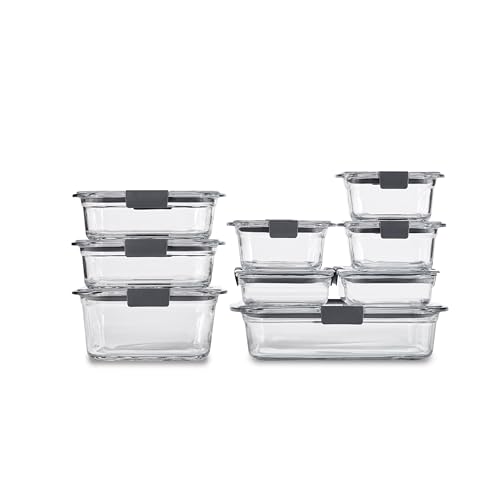
Available capacities: The 14-piece set contains two 0.5-cup, two 1.3-cup, two 3.2-cup, and one 9.6-cup container, plus seven lids.
Why we like this option: Clear containers, secure latches, and practical storage sizes.
If you want one versatile set of BPA-free food storage containers that can handle most everyday kitchen tasks, Rubbermaid Brilliance is an excellent starting point.
The collection uses clear Tritan plastic, allowing you to see what’s inside without opening every container. This is particularly useful when organizing a busy refrigerator or preparing several meals in advance.
One of its strongest features is the locking lid design. The secure latches help create an airtight, leakproof seal, making these containers useful for storing leftovers, packing lunches, and keeping prepared ingredients organized.
The collection also includes different capacities, from smaller containers for sauces and snacks to larger options for family-sized portions.
Another advantage is the modular design. The containers stack neatly, helping you make better use of refrigerator and cupboard space.
Rubbermaid identifies this Brilliance set as BPA-free, microwave-safe for reheating only with the vents open and latches lifted, top-rack dishwasher-safe, and freezer-safe. The set includes two 0.5-cup, two 1.3-cup, two 3.2-cup, and one 9.6-cup container.
- BPA-free Tritan plastic construction.
- Clear design makes identifying food easy.
- Secure locking lids.
- Stain- and odor-resistant construction.
- Available in multiple sizes.
- Freezer- and microwave-safe models.
- Plastic may eventually show wear.
- Locking mechanisms add more parts to clean.
- Not as resistant to scratching as glass.
- Plastic is not suitable for oven use.
Rubbermaid Brilliance is our leading choice for people who want convenient, reusable BPA-free plastic containers. Its combination of visibility, stackability, multiple sizes, and secure lids makes it particularly practical for everyday food storage.
Official specifications: Rubbermaid Brilliance product information.
2. Best Glass BPA-Free Food Storage Containers – Rubbermaid Brilliance Glass
Glass food-contact surfaces paired with secure locking lids make this a strong option for people who prefer storing food in glass.
Best for: Leftovers, meal preparation, and people who prefer glass over plastic.
Material and capacities: Glass bases with BPA-free plastic lids; this 18-piece set contains nine containers in 1.3-, 2-, 3.2-, 4.7-, and 8-cup sizes.
Why we like this option: Glass food-contact surfaces combined with convenient locking lids.
If you prefer storing food in glass rather than plastic, the Rubbermaid Brilliance Glass collection deserves a place near the top of your list.
The main advantage is that food sits directly against glass rather than plastic. Glass doesn’t absorb food odors or stains as readily as many plastic containers, which makes it particularly convenient for storing tomato-based sauces, curries, soups, and other strongly flavored meals.
The glass bases are also oven-safe up to 450°F, according to Rubbermaid, although the plastic lids must be removed before oven use.
The lids are designed to lock securely, helping prevent leaks when transporting food. Rubbermaid also uses vented lids on compatible models for splatter-resistant microwave reheating.
Another useful feature is that the Brilliance collection has a shared lid system across compatible glass and plastic containers. This can make replacing or organizing lids easier.
The glass version is heavier than the plastic collection, so it may not be the first choice for people who frequently carry lunch containers in a backpack.
- Glass food-contact surface.
- BPA-free plastic lids.
- Airtight, leakproof lid design.
- Glass bases are oven-safe up to 450°F.
- Suitable for freezer and microwave use according to product instructions.
- Resistant to food odors and staining.
- Heavier than plastic containers.
- Glass can break or chip if dropped.
- Plastic lids cannot go in the oven.
- More expensive than basic plastic sets.
This is one of the strongest choices if you want BPA-free food storage containers made primarily from glass. It offers the convenience of a modern locking system without requiring you to store food directly in plastic.
Official specifications: Rubbermaid Brilliance Glass specifications.
3. Best for Everyday Leftovers – Pyrex Simply Store Glass
A straightforward glass set for refrigerator storage, everyday leftovers, and preparing meals in different portion sizes.
Best for: Storing leftovers, preparing meals, and organizing refrigerator shelves.
Material and capacities: Tempered glass bases with BPA-free plastic lids; this 12-container assortment includes 1-, 2-, 3-, and 4-cup sizes.
Pyrex Simply Store is a familiar choice for households that prefer glass containers for everyday food storage.
The collection offers different shapes and capacities, making it easier to find containers for individual portions, side dishes, cooked vegetables, and larger leftovers.
Glass is particularly useful when you want to avoid placing food directly against plastic. It also makes cleaning easier after storing foods that typically leave strong odors or stains.
The straightforward design is another advantage. You don’t need complicated locking mechanisms or specialized accessories to use these containers.
However, it’s important to distinguish between different Pyrex collections. Simply Store should not be confused with Pyrex Snapware or other products with locking lids. Lid designs and sealing performance vary between collections.
The glass containers are suitable for microwave, freezer, and dishwasher use. The BPA-free plastic lids are microwave-safe and top-rack dishwasher-safe, but must be removed for oven use. These snug-fit lids are useful for everyday storage, but this Simply Store set should not be described as leakproof for transporting liquids.
- Glass food-contact surface.
- Available in multiple sizes.
- Easy to clean.
- Suitable for everyday refrigerator storage.
- Glass doesn't readily retain food odors.
- Useful for meal preparation.
- Plastic lids are not oven-safe.
- Some models do not have locking lids.
- Glass is heavier than plastic.
- Not every model is designed for leakproof liquid transportation.
Pyrex Simply Store is a practical choice if you mainly need dependable glass containers for leftovers and refrigerator storage. If you regularly transport soups or other liquids, consider a locking-lid alternative.
4. Best Glass Food Storage Containers with Locking Lids – Snapware Total Solution
A practical glass container with a multi-point locking lid for transporting prepared food and storing leftovers.
Best for: Meal preparation, leftovers, and transporting prepared food.
Material and capacity: One 4-cup glass container with a BPA-free polypropylene locking lid.
Why consider it: Four-sided locking lids and practical container shapes.
Snapware Total Solution is worth considering if you want the benefits of glass food storage combined with a more secure lid design.
Unlike basic containers that simply sit over the top of a glass bowl, compatible Snapware models feature locking lids with multiple closure points.
This makes them useful for people who prepare food in advance and want to move containers between the refrigerator, kitchen, and workplace.
The glass versions are particularly appealing because they allow you to store food without direct plastic contact on the main container surface.
The range includes different sizes, so you can choose smaller containers for individual portions or larger ones for leftovers and family meals.
One thing to remember is that the lids contain additional components, including seals, that need proper cleaning. Food residue around the gasket can become unpleasant if it isn’t washed and dried thoroughly.
Also, don’t assume that all Snapware products have identical temperature ratings. Check the instructions for the specific glass or plastic set.
- Available in glass versions.
- Four-sided locking lid design.
- Useful for meal preparation.
- Different shapes and capacities.
- Convenient for refrigerator organization.
- Lids have more components to clean.
- Glass versions are relatively heavy.
- Gaskets need regular cleaning.
- Different sets have different material specifications.
Snapware Total Solution is a good option for anyone who wants glass containers with locking lids. It is particularly useful for preparing lunches and storing leftovers that need a secure closure.
5. Best Large-Batch Glass Food Storage Set – Anchor Hocking TrueSeal
A five-container glass set with BPA-free TrueSeal lids and a useful range of capacities for leftovers and batch cooking.
Best for: Large-batch leftovers, family portions, and people who prefer glass food-contact surfaces.
Material: Tempered glass containers with BPA-free plastic TrueSeal lids.
Capacities: One 1-cup, two 2-cup, one 4-cup, and one 7-cup round container, plus five lids.
Anchor Hocking TrueSeal adds a useful alternative to the Rubbermaid-heavy plastic choices in this roundup. Its main appeal is simple: food sits in glass, while a BPA-free lid creates an airtight seal for refrigerator storage and everyday transport.
The 10-piece set contains five round glass containers in four sizes: one 1-cup, two 2-cup, one 4-cup, and one 7-cup. That mix covers small sides and snacks as well as larger portions of leftovers.
The tempered glass bases resist stains and food odors and are designed for microwave, freezer, dishwasher, and preheated-oven use up to 425°F. As with other glassware, avoid sudden temperature changes and follow the care instructions.
Anchor Hocking describes the TrueSeal lids as BPA-free and designed to prevent spills and leaks. The lids are not oven-safe. The manufacturer’s general guidance allows brief microwave reheating with a steam gap rather than a fully sealed lid, and recommends top-rack dishwasher cleaning.
The trade-off is the round shape, which may not use refrigerator shelf space as efficiently as rectangular containers. The lids also press onto the containers rather than using the four separate side latches found on some competing designs.
If you want a mixed-size glass set with BPA-free lids and an airtight closure, TrueSeal is a useful alternative to buying another Brilliance plastic container. It is not the best fit if you need identical meal-prep portions or a rectangular stack. See Anchor Hocking’s official TrueSeal specifications for the product-family details and care guidance.
- Tempered glass food-contact surfaces.
- Manufacturer identifies TrueSeal lids as BPA-free.
- Airtight lid design intended to prevent spills and leaks.
- Four useful capacities from 1 to 7 cups.
- Glass bases are microwave-, freezer-, dishwasher-, and oven-safe within manufacturer limits.
- Glass resists food stains and odors.
- Round containers may use shelf space less efficiently.
- Plastic lids cannot go in the oven.
- Lids need a steam gap for microwave reheating.
- Glass is heavier and can break if dropped.
Anchor Hocking TrueSeal is a strong choice if you want a practical range of glass containers with BPA-free lids and an airtight seal. Its five-container assortment is more versatile than a single large dish, although the round shape is not as space-efficient as rectangular sets.
6. Best BPA-Free Food Storage Containers for Pantry Organization – OXO Good Grips POP Containers
A modular pantry set designed to keep dry ingredients such as flour, sugar, oats, and cereal organized.
Best for: Flour, sugar, rice, pasta, cereal, and other dry ingredients.
Material: BPA-free plastic container bodies and plastic push-button lids. OXO does not identify the exact resin in this set’s product specifications.
If your main priority is keeping dry ingredients organized rather than storing cooked leftovers, OXO Good Grips POP containers are worth considering.
These containers have a different purpose from traditional refrigerator food storage containers. Their main advantage is the push-button closure, which creates a seal intended to keep dry ingredients fresh.
The modular shapes also make it easier to organize pantry shelves. You can arrange different sizes together and quickly identify ingredients through their transparent walls.
They’re particularly useful for households that purchase ingredients in larger quantities or want to transfer flour, sugar, oats, and cereal from their original packaging into reusable containers.
OXO describes its POP range as BPA-free and designed for dry-food storage. Treat these as pantry organizers rather than general-purpose leftover containers: they are not intended for microwave reheating. OXO says POP containers are refrigerator- and freezer-safe, although the lid may lift after extreme temperature changes. The silicone gasket is dishwasher-safe; hand-wash the other lid and container parts. The official OXO POP product information identifies the range as BPA-free.
- Convenient push-button closure.
- Modular pantry organization.
- Clear walls for identifying ingredients.
- Multiple sizes and shapes.
- Useful for dry-food storage.
- Not designed as general-purpose liquid containers.
- Not intended for microwave reheating.
- More expensive than basic pantry containers.
- Best suited to dry ingredients rather than everyday leftovers.
OXO POP containers are a good choice for organizing pantry ingredients. For refrigerator leftovers or freezer storage, choose a dedicated food storage collection instead.
7. Best for Meal Preparation – Rubbermaid Brilliance 2.85-Cup Containers
A five-container Brilliance set suited to portioning prepared meals, sides, snacks, and individual servings.
Best for: Portioning five individual meals or sides; each container has two compartments and a 2.85-cup capacity.
Meal preparation becomes considerably easier when you have containers in several useful sizes.
Rubbermaid Brilliance sets offer a combination of smaller and larger containers, making them useful for people who prepare multiple meals in advance.
For example, smaller containers can hold chopped fruit, cooked vegetables, sauces, and snacks, while larger ones can accommodate complete meals and leftovers.
The Brilliance meal-prep set uses Rubbermaid’s StainShield plastic rather than the Tritan description used for some other Brilliance products. Its clear, stain- and odor-resistant design makes it easy to identify prepped food, while the five matching containers stack neatly.
The lids feature secure locking mechanisms, and the manufacturer describes the collection as leakproof.
If you regularly prepare food for several days, buying a complete set may be more economical than purchasing individual containers.
One consideration is that plastic containers should be used according to their specific temperature and care instructions. Even when a model is microwave-safe, avoid unnecessary high-temperature exposure and consider transferring food to glass for reheating if that is your preference.
- Multiple capacities in one collection.
- BPA-free plastic.
- Stackable design.
- Secure lids.
- Useful for batch cooking.
- Lightweight and easy to transport.
- Requires storage space for multiple lids.
- Plastic can become scratched.
- Not suitable for oven use.
- Some people prefer glass for reheating.
The 2.85-cup Brilliance containers are a useful choice for portioning prepared meals, sides, and individual servings. The five-container pack gives you several matching containers for weekly meal prep, although it offers one main capacity rather than a mixed-size collection.
What to Look for When Buying BPA-Free Food Storage Containers
Choosing the right BPA-free food storage containers involves more than checking a label. The material, lid design, container capacity, temperature rating, and intended use all matter.
Here are the features worth considering before buying.
A Quick Checklist Before You Buy
-
Identify the full material
Check the body, lid, gasket, and any coating separately.
Look forA manufacturer specification that names the materials used in each component.AvoidAssuming a glass base means every part of the container is glass. -
Confirm the BPA-free claim
Look for a clear statement covering the exact product or collection.
Look forA manufacturer product page or use-and-care document that explicitly says BPA-free.AvoidTreating a recycling code or vague non-toxic label as proof. -
Match the container to its job
A pantry canister, lunch container, freezer box, and reheating dish are not interchangeable.
Look forA product designed for the food and storage conditions you actually use.AvoidUsing dry-food canisters for soups, leftovers, or reheating. -
Check temperature limits
The base and lid may have different microwave, freezer, and oven ratings.
Look forClear instructions for the complete product, including whether the lid must be removed or vented.AvoidAssuming BPA-free means heat-safe. -
Consider cleaning and replacement
Seals and locking mechanisms need regular cleaning and inspection.
Look forAccessible lid channels and removable gaskets where the manufacturer permits removal.AvoidKeeping cracked, warped, or badly worn pieces in use.
1. Check the Material
Food storage containers are available in several different materials. Each has advantages and disadvantages.
| Material | Main advantages | Potential disadvantages |
|---|---|---|
| Glass | Nonporous, easy to clean, doesn’t readily retain odors | Heavy and breakable |
| BPA-free Tritan plastic | Lightweight, clear, convenient | Can scratch and wear |
| Other BPA-free plastic | Affordable and available in many sizes | Quality and heat resistance vary |
| Stainless steel | Durable, no plastic food-contact surface in suitable designs | Usually not microwave-safe |
| Silicone | Flexible, lightweight, useful for some storage applications | Quality and temperature ratings vary |
Our recommendation: Glass is a particularly good choice if you want to minimize direct contact between food and plastic. BPA-free Tritan is a convenient alternative if you prioritize lightweight, transparent containers with secure lids.
2. Choose Containers with Secure Lids
The lid is just as important as the container itself.
A poorly fitting lid can allow air to enter, cause leaks, and make refrigerator organization more difficult.
Look for:
- Airtight seals.
- Secure locking clips.
- Removable silicone gaskets where appropriate.
- Lids that fit multiple containers in the same collection.
- Easy-to-clean corners and edges.
If you frequently store soups, sauces, or other liquids, prioritize containers specifically advertised and tested as leakproof.
3. Consider Extra-Large and Small Capacities
A good storage collection should offer more than one size.
Small containers are useful for sauces, nuts, chopped vegetables, and individual snacks. Medium containers work well for leftovers and lunch portions.
Large BPA-free food storage containers are particularly useful for:
- Cooked rice and pasta.
- Large batches of vegetables.
- Family-sized leftovers.
- Meal preparation.
- Bulk ingredients.
- Prepared salads.
A 9.6-cup container, for example, provides considerably more room than a small lunch container. The Rubbermaid Brilliance set featured above includes one at this size.
Rather than buying the largest set available, think about the foods you store most often.
4. Check Freezer Compatibility
Not every BPA-free container is automatically freezer-safe.
If you regularly freeze homemade meals, look for an explicit freezer-safe label.
Glass containers can be useful for freezing, but they need to be designed for freezer use. Avoid sudden temperature changes, and leave room for food to expand.
Plastic containers should also have an appropriate freezer rating. Very cold temperatures can make some plastics more brittle.
For additional convenience, choose containers with flat sides that stack efficiently. If freezing meals is a regular part of your routine, see our guide to the best freezer containers for food for more options.
5. Consider Microwave Safety Separately
One of the biggest misconceptions about BPA-free food storage is that every BPA-free plastic container is automatically microwave-safe.
That isn’t true.
BPA-free describes a chemical characteristic, not a temperature rating.
If you want containers for reheating food, check the manufacturer’s microwave instructions. Follow any restrictions regarding maximum heating time, temperature, and lid placement.
Glass containers are generally a convenient alternative for reheating because many models are microwave-safe, although the lids may need to be removed.
6. Look for Clearly Stated Chemical Information
If you’re searching for BPA and phthalate free food storage containers, don’t assume that a BPA-free label covers both chemicals.
BPA and phthalates are different substances.
Ideally, look for manufacturers that clearly identify:
- The container material.
- The lid material.
- Whether BPA is present.
- Whether phthalates are intentionally used.
- Whether the product has a PFAS-free claim.
- Its intended food-contact applications.
A manufacturer that provides specific product information is generally easier to evaluate than a seller making broad, unsupported claims about a product being completely non-toxic.
BPA-Free Food Storage Containers for Different Uses
The best container depends on what you’re storing. A container that’s excellent for leftovers might not be suitable for freezing, reheating, or organizing dry pantry ingredients.
BPA-Free Food Storage Containers for the Refrigerator
For refrigerator storage, prioritize containers with airtight lids, stackable shapes, and easy-to-clean surfaces.
Rubbermaid Brilliance is particularly useful if you prefer plastic, while Rubbermaid Brilliance Glass and Pyrex Simply Store are worth considering if you prefer glass.
Choose different capacities for leftovers, chopped ingredients, sauces, and prepared meals.
BPA-Free Food Storage Containers for the Freezer
For freezer storage, the most important feature is an explicit freezer-safe rating.
Good options include:
- Rubbermaid Brilliance plastic containers.
- Rubbermaid Brilliance Glass containers.
- Compatible Pyrex glass storage containers.
- Freezer-rated Snapware containers.
Leave sufficient headspace when freezing liquids because food expands as it freezes. Avoid putting hot glass directly into a cold freezer unless the manufacturer’s instructions specifically permit it.
BPA-Free Glass Food Storage Containers
Glass is an excellent alternative if you prefer not to store food directly against plastic.
Its main advantages include:
- Nonporous food-contact surfaces.
- Easy cleaning.
- Resistance to food odors and stains.
- Compatibility with many microwave and oven applications, depending on the model.
The main disadvantages are weight and breakability.
For most households, a combination of glass containers for leftovers and plastic containers for lightweight food transportation offers a practical balance.
BPA-Free Food Storage Containers for the Pantry
Pantry storage requires slightly different features.
For dry ingredients, look for:
- Airtight closures.
- Wide openings for scooping.
- Stackable designs.
- Transparent walls.
- Appropriate capacities for bulk ingredients.
OXO POP is worth considering for dry ingredients, while larger airtight containers from reputable food storage brands can also work.
Remember that pantry containers are not necessarily suitable for freezing or microwave heating.
Extra-Large BPA-Free Food Storage Containers
Extra-large containers are useful for families, batch cooking, and anyone who regularly prepares meals in advance.
Look for capacities of approximately 8 cups or more, depending on your needs.
The Rubbermaid Brilliance 14-piece set featured in this roundup includes a 9.6-cup container. If you prefer glass, the Anchor Hocking TrueSeal set includes a 7-cup container.
When choosing a large container, pay attention to its footprint as well as its capacity. A container that holds plenty of food but doesn’t fit comfortably on your refrigerator shelves can quickly become inconvenient.
How to Choose Between Glass, Tritan, and Other BPA-Free Plastics
There is no single material that suits every kitchen. The best option depends on whether you value lightweight portability, easy reheating, resistance to staining, or keeping food away from plastic surfaces.
Glass: Glass is nonporous and does not readily absorb food odors or stains. It is particularly useful for saucy leftovers, tomato-based dishes, and meals that you regularly reheat. The trade-offs are weight and breakability. Check the manufacturer’s instructions before putting a glass base in an oven, microwave, freezer, or dishwasher, and remember that the lid may have different limits.
Tritan plastic: Tritan is a clear, lightweight plastic used in some reusable food containers. Rubbermaid identifies its Brilliance plastic range as BPA-free Tritan. It is convenient for packed lunches, refrigerator organization, and meal preparation, but it remains plastic: use it only within the manufacturer’s temperature limits and replace it if it becomes cracked, warped, or badly worn.
Polypropylene and other plastics: Polypropylene is commonly used for reusable food containers and lids. Its heat resistance and intended use vary by product, so the resin name alone is not enough to determine whether a container can go in a microwave or freezer. Check the exact model’s instructions, especially when the lid, seal, and base are made from different materials.
Stainless steel: Stainless steel can be a useful choice when you want a durable container without a plastic food-contact surface. It is generally not suitable for microwave use, and lids or seals may still contain plastic or silicone. Check whether the interior is uncoated and whether the product is intended for food storage.
What Do Plastic Recycling Numbers Mean?
The small number inside the recycling triangle identifies a plastic resin category. It is not a food-safety grade, a BPA-free certification, or a guarantee that a container is microwave-safe.
Three codes shoppers commonly encounter are 1 (PET or PETE), 2 (HDPE), and 5 (PP, or polypropylene). Code 7 is a broad category for other plastics and mixed materials; some polycarbonate products have been classified under this category, but code 7 does not automatically mean a product contains BPA. The code alone cannot tell you the full chemical composition of a finished container.
Use recycling numbers as a material clue, not as your final purchasing decision. For reusable food storage, look for a clear manufacturer statement about the exact product, its intended food-contact use, and its temperature limits. A container marked with a recycling number is not automatically designed for repeated storage or reheating.
How to Verify a BPA-Free Food Storage Claim
Before buying, look beyond a marketplace headline or a generic “non-toxic” label. A useful product description should make it possible to identify what the container is made from and how it is intended to be used.
- Find the exact model number: Similar-looking sets from the same brand can have different materials, capacities, and care instructions.
- Check the base and lid separately: A glass base may be paired with a plastic lid, silicone gasket, or other components.
- Look for a direct manufacturer statement: Prefer a product page or use-and-care document that explicitly identifies the item as BPA-free.
- Confirm food-contact and temperature use: Check whether the container is intended for leftovers, dry goods, freezing, microwave reheating, or oven use.
- Read the care instructions: Dishwasher-safe, microwave-safe, and freezer-safe claims can differ between the base, lid, and seal.
- Be cautious with broad claims: BPA-free does not establish that a product is also BPS-free, phthalate-free, or PFAS-free.
For a useful starting point, compare the product listing with the manufacturer’s own specifications. Rubbermaid, for example, publishes material and care details for its Brilliance containers; OXO identifies its POP container range as BPA-free and intended for dry pantry ingredients.
Food-contact compliance is a separate question. A statement that a product is suitable for food contact does not mean it is BPA-free, BPS-free, phthalate-free, PFAS-free, or free of all chemicals. It means the materials are intended to meet the applicable food-contact requirements for specified conditions of use. In the United States, FDA evaluations consider the substance and its intended conditions of use, so check whether the manufacturer’s instructions cover the foods, temperatures, and uses you have in mind. A BPA-free claim alone does not establish every one of those points.
How to Clean and When to Replace Food Storage Containers
Good cleaning habits matter just as much as the material you choose. Food residue can collect around lid channels, locking tabs, and silicone gaskets, especially after storing sauces, soups, and oily foods.
Wash containers after use and follow the manufacturer’s dishwasher instructions. If the lid has a removable gasket, remove it only if the manufacturer designed it to come apart. Clean the seal and the groove beneath it, rinse away detergent, and let every part dry completely before reassembling. This helps prevent trapped moisture and lingering odors.
Inspect containers regularly. Replace plastic pieces that are cracked, badly scratched, warped, cloudy from wear, or difficult to clean. Replace lids or seals that no longer close properly, and stop using glass containers with chips or cracks. A container that no longer seals reliably is not a good choice for transporting liquids or storing food for longer periods.
Do not assume that an old container is suitable for reheating simply because it has been used for years. If its material or temperature rating is unclear, use it only for a purpose supported by its instructions or replace it with a clearly specified food-storage product.
What Does BPA-Free Mean on Food Storage Containers?
BPA-free means that a product is manufactured without bisphenol A, commonly known as BPA, or is represented by its manufacturer as not containing this chemical.
BPA is an industrial chemical that has been used to manufacture certain plastics and epoxy resins. It has historically been associated with polycarbonate plastics and protective coatings used in some food and beverage packaging.
Interest in BPA-free products increased because researchers have investigated whether BPA exposure can affect human health, particularly because BPA can migrate from certain food-contact materials into food.
The US Food and Drug Administration (FDA) regulates food-contact substances and has published information about its assessment of BPA.
It’s important, however, to understand that BPA-free does not mean that a container contains no chemicals whatsoever.
Plastic products are manufactured using different materials and additives. Removing BPA does not automatically establish that every other chemical used in a product has been eliminated.
This is why it’s useful to evaluate the complete product rather than relying exclusively on a single marketing label.
For additional information, consult the FDA’s questions and answers about BPA in food-contact applications.
Are BPA-Free Plastic Containers Safe for Food Storage?
This is one of the most important questions to ask when choosing BPA-free food storage containers.
The short answer is that BPA-free plastic containers designed and manufactured for food contact can be suitable for their intended uses. However, BPA-free alone is not a complete safety guarantee.
The type of plastic, manufacturing quality, intended temperature range, and condition of the container all matter.
For example, a container designed for refrigerator storage should not automatically be used for microwave reheating.
The US Department of Agriculture’s Food Safety and Inspection Service advises against heating cold-storage packaging that was not designed for microwave use. Such materials may not be heat-stable, and chemicals can migrate into food when packaging melts or warps. See the USDA guidance on chemicals migrating from food packaging.
You should also replace plastic containers when they become heavily scratched, cracked, warped, or noticeably deteriorated.
A few practical precautions can make everyday use easier:
- Use only containers specifically intended for food storage.
- Check microwave and freezer compatibility before use.
- Avoid heating food in damaged plastic containers.
- Follow the manufacturer’s dishwasher instructions.
- Don’t use disposable takeaway packaging as a permanent reusable storage container unless it is specifically designed for reuse.
- Consider glass for frequent reheating.
The FDA’s guidance on food-contact materials is also useful when evaluating claims about food storage products: FDA food packaging and food-contact substances.
BPA-Free vs. BPA and Phthalate-Free Food Storage Containers
BPA and phthalates are not interchangeable terms.
BPA is a bisphenol chemical used in certain plastic manufacturing processes and epoxy resins.
Phthalates are a group of chemicals historically used primarily as plasticizers to make some plastics more flexible.
A product advertised as BPA-free does not automatically qualify as phthalate-free.
If you’re specifically looking for BPA and phthalate free food storage containers, check whether the manufacturer provides information about both substances.
This distinction matters because shoppers often assume that a BPA-free label means the entire product has been tested for every chemical of concern.
It doesn’t.
The FDA provides separate information about phthalates in food packaging and food-contact applications: FDA guidance on phthalates.
BPA-Free vs. BPS-Free: What’s the Difference?
BPS stands for bisphenol S, another chemical in the bisphenol family.
Some manufacturers have used BPS or other alternatives in products marketed as BPA-free.
Consequently, BPA-free does not necessarily mean BPS-free.
If avoiding both chemicals is important to you, look for an explicit manufacturer statement covering both BPA and BPS.
Glass and stainless steel containers with suitable lids are useful alternatives when you want to minimize direct contact between food and plastic.
However, remember that the lids, seals, and other components may still contain plastic or silicone.
Are BPA-Free Containers PFAS-Free?
No. BPA-free and PFAS-free describe different chemical characteristics.
PFAS refers to a large group of per- and polyfluoroalkyl substances.
A manufacturer may advertise a container as BPA-free without making any claim about PFAS.
If you’re specifically searching for PFAS-free food storage containers, look for a separate statement from the manufacturer.
Don’t assume that a product is PFAS-free simply because it is made from glass, stainless steel, or BPA-free plastic. Evaluate the complete product, including any coatings, seals, and lids.
For many shoppers, uncoated glass containers with straightforward lids are a useful option when trying to minimize unnecessary material complexity.
BPA-Free Food Storage Containers: FAQs
What are the best BPA-free food storage containers?
Rubbermaid Brilliance is our leading choice for BPA-free plastic food storage because of its Tritan construction, secure locking lids, and range of sizes.
For glass, Rubbermaid Brilliance Glass, Pyrex Simply Store, and Snapware Total Solution are worth considering.
The best choice depends on whether you prioritize lightweight storage, reheating convenience, or avoiding direct food contact with plastic.
Are Rubbermaid Brilliance food storage containers BPA-free?
Yes. Rubbermaid identifies its Brilliance plastic containers as BPA-free. The manufacturer also describes them as stain-resistant, odor-resistant, freezer-safe, dishwasher-safe, and microwave-safe when used according to its instructions.
The Brilliance Glass collection uses glass bases with BPA-free plastic lids.
You can verify the specifications on the official Rubbermaid Brilliance product page.
What are the best BPA-free food storage containers with lids?
Some good options include:
- Rubbermaid Brilliance for airtight plastic storage.
- Rubbermaid Brilliance Glass for glass containers with locking lids.
- Snapware Total Solution for glass containers with four-sided locking lids.
- Pyrex Simply Store for straightforward glass storage.
Check whether the lids are airtight and leakproof if you intend to transport liquids.
What are the best extra-large BPA-free food storage containers?
The Rubbermaid Brilliance 14-piece set in this roundup includes a 9.6-cup container, making it a useful option for larger portions. Anchor Hocking TrueSeal also includes a 7-cup glass container.
If you need more capacity than that, compare the exact dimensions and capacities of dedicated bulk food storage containers rather than relying on labels such as XL or extra-large.
Can BPA-free plastic containers go in the freezer?
Some can.
Rubbermaid Brilliance plastic containers, for example, are listed as freezer-safe by the manufacturer.
However, not all BPA-free plastics have the same temperature resistance. Always check the freezer rating for the specific container.
Can BPA-free plastic containers go in the microwave?
Some are specifically designed for microwave reheating.
Rubbermaid Brilliance is one example, with built-in vents on compatible lids.
However, BPA-free does not automatically mean microwave-safe. Follow the product's heating instructions and avoid using damaged or unsuitable plastic containers.
Are glass food storage containers better than plastic?
Glass offers several advantages, including a nonporous surface, easy cleaning, and resistance to food odors and stains.
Plastic is lighter, less likely to break when dropped, and often more convenient for transporting food.
If you regularly reheat meals, glass is a particularly practical option. If you prioritize lightweight storage, BPA-free Tritan plastic is worth considering.
Are BPA-free containers also phthalate-free?
Not necessarily.
BPA and phthalates are different chemicals. A BPA-free claim does not establish that a product is phthalate-free.
Check the manufacturer's information if you want to avoid both.
Are BPA-free food storage containers safe for babies and children?
Choose containers specifically intended for food contact and suitable for the child's age and intended use.
For younger children, consider glass containers for adult-supervised food storage and serving, while avoiding breakable containers where they could be dropped.
Always check the manufacturer's temperature and use instructions.
What is the difference between BPA-free and non-toxic food storage containers?
BPA-free means the product is represented as not containing bisphenol A.
Non-toxic is a broader marketing description that can mean different things depending on the manufacturer.
Neither term automatically establishes that a product is free from PFAS, BPS, phthalates, or every other substance consumers may wish to avoid.
Look for specific material disclosures instead of relying on broad marketing language.
Where can I buy BPA-free food storage containers?
You can find BPA-free food storage containers through Amazon, Walmart, and kitchenware retailers.
Popular brands to compare include Rubbermaid, Pyrex, Snapware, and OXO.
For UK shoppers, check Amazon UK and established kitchenware retailers for locally available versions.
Should I replace old plastic food storage containers?
Consider replacing containers that have become cracked, warped, heavily scratched, or difficult to clean.
Also check whether older containers have clear food-contact and temperature-use instructions.
If you are unsure about an older container's material or intended use, replacing it with a clearly specified reusable product is a sensible approach.
Are Tritan food storage containers BPA-free?
Many products made from Tritan are marketed as BPA-free, and Rubbermaid identifies its Brilliance plastic containers as BPA-free Tritan. Still, check the manufacturer’s statement for the exact product rather than assuming every clear plastic container is Tritan or BPA-free.
Can I put hot food directly into BPA-free plastic containers?
Only do so when the manufacturer says the specific container is suitable for the food temperature and intended use. BPA-free is not a heat-resistance rating. For very hot food or frequent reheating, glass may be a more convenient choice. Follow the product’s instructions and allow food and containers to cool as directed.
What do the recycling numbers on plastic containers mean?
They identify the type of plastic resin, not whether a container is BPA-free, microwave-safe, or suitable for repeated food storage. For example, code 5 identifies polypropylene, while code 7 is a broad category for other plastics. Always check the manufacturer’s food-contact and care information.
Are OXO POP containers suitable for storing leftovers?
OXO POP containers are designed primarily for dry pantry ingredients such as flour, cereal, pasta, rice, and snacks. They are not a replacement for leakproof refrigerator containers, and OXO does not recommend microwave use.
OXO’s care instructions state that POP containers can be used in the refrigerator and freezer, although the lid may lift after exposure to extreme temperature changes. For cleaning, the silicone gasket is dishwasher-safe; hand-wash the other lid and container parts.
Are glass food storage containers with plastic lids still BPA-free?
They can be. Several manufacturers identify the plastic lids supplied with their glass storage collections as BPA-free, but this is product-specific. Check the exact model and remember that the glass base and lid are separate materials with different care instructions.
How should I clean food storage container lids and silicone seals?
Follow the manufacturer’s cleaning instructions. If a gasket is designed to be removed, take it out periodically, wash it and the lid grooves, allow all parts to dry fully, and reinstall it correctly. Do not force apart lids that are not designed to disassemble.
Final Verdict: Which BPA-Free Food Storage Containers Should You Buy?
The best BPA-free food storage containers are the ones that suit your cooking habits, storage requirements, and preferred materials.
For most households, Rubbermaid Brilliance is our leading recommendation because it combines BPA-free Tritan plastic, secure lids, transparent construction, and several practical sizes.
If you prefer to avoid storing food directly against plastic, Rubbermaid Brilliance Glass is a particularly attractive alternative. Pyrex Simply Store and Snapware Total Solution are also worth considering for everyday glass storage.
Ultimately, you don’t need to replace every food storage container in your kitchen at once. Start with the sizes and materials you use most often, check the manufacturer’s specifications, and build a collection that makes everyday food storage easier.