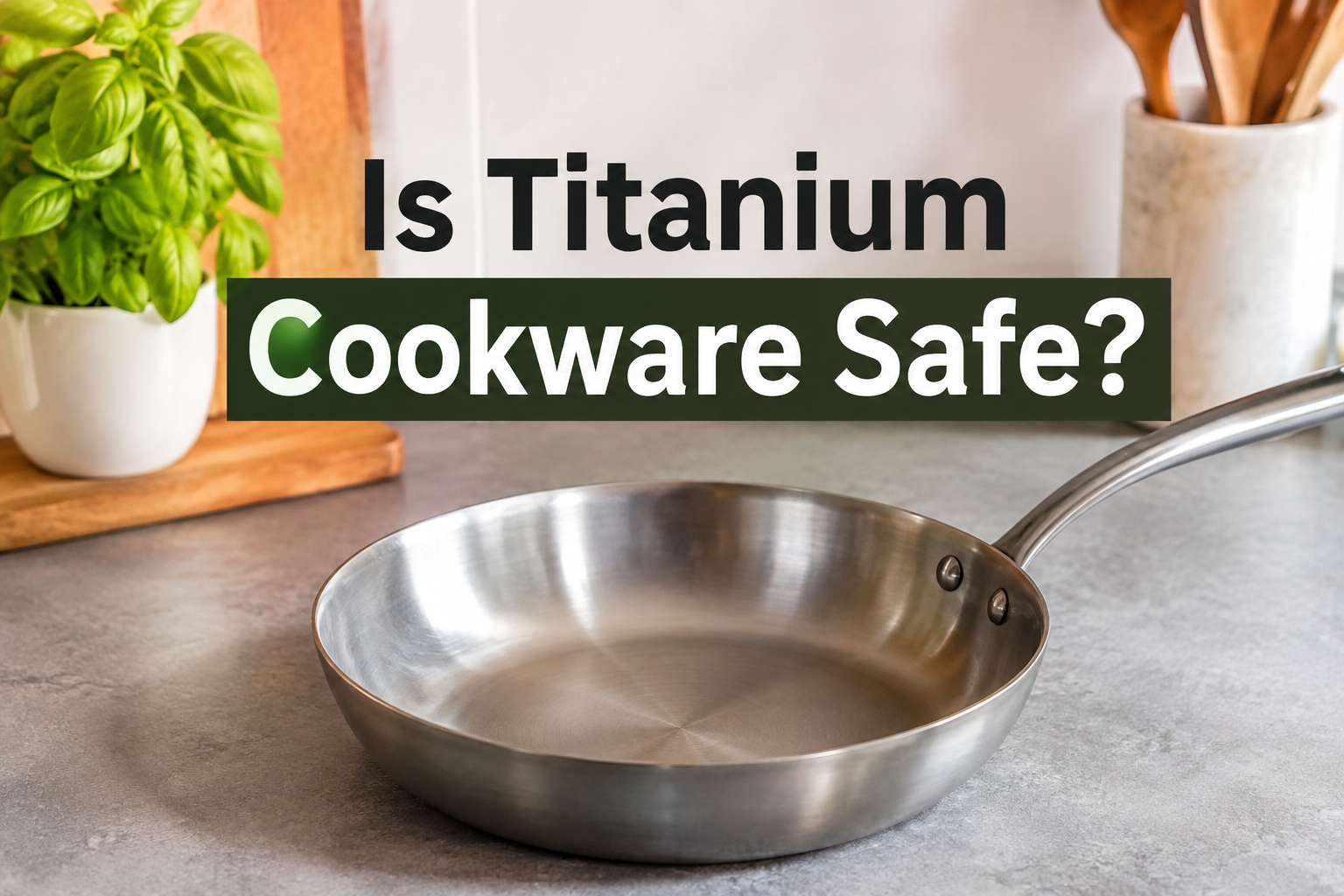
Is Titanium Cookware Safe?
The answer depends on the surface that actually touches your food—not the word “titanium” on the packaging.
Uncoated titanium, titanium-reinforced PTFE, and ceramic coatings are different constructions. This guide separates the evidence for each and explains what to check before buying.
- How to distinguish bare titanium from coated nonstick pans
- What research says about metal migration and titanium dioxide particles
- Why PTFE, PFAS and overheating concerns apply to some pans—not all titanium cookware
- What to verify in a product’s materials and food-contact documentation
The Short Answer
- Bare titanium: A corrosion-resistant metal with promising food-contact evidence; there is no established evidence that a properly made uncoated titanium pan is inherently toxic.
- Titanium-reinforced nonstick: The cooking surface may still be PTFE. Titanium reinforcement does not make it PFAS-free.
- Titanium dioxide: TiO₂ is not the same as titanium metal. EFSA’s E171 assessment does not prove that solid titanium cookware is unsafe.
- What matters most: Verify the exact food-contact surface, the full coating composition, and the manufacturer’s food-contact documentation.
Is Titanium Cookware Safe?
Generally, uncoated titanium is a promising material for cookware, and there is no established evidence that a properly manufactured solid titanium cooking surface is inherently toxic or causes cancer during normal use. Titanium is valued for corrosion resistance, and research has examined its suitability for food-contact applications.
That answer needs an important qualification: many pans advertised as “titanium” are not made with a solid titanium cooking surface. Some use titanium particles to reinforce a conventional nonstick coating; others use a ceramic-based surface or a titanium-containing layer over another metal. The exact construction determines which safety questions are relevant.
If your goal is to avoid PFAS, a titanium-reinforced pan may not meet that goal if its nonstick layer contains PTFE. If your concern is titanium dioxide, research on that compound should not be treated as proof that metallic titanium cookware is dangerous.
What Is Titanium Cookware Actually Made of?
“Titanium cookware” is a broad marketing description, not one standardized construction. Before judging safety, identify the material that forms the actual food-contact surface.
Pure or Uncoated Titanium
With genuinely uncoated titanium cookware, titanium metal forms the cooking surface. There is no conventional PTFE or ceramic nonstick layer covering it. Some products are primarily titanium; others combine a titanium interior with an aluminum heat-spreading core and a stainless-steel exterior.
Titanium’s corrosion resistance is one reason it has been investigated for food-contact uses. An uncoated titanium surface is not automatically nonstick. Food can stick, and performance depends on surface finish, thickness, design, and cooking technique.

Listed as an uncoated titanium cooking surface
The listing claims a pure titanium surface and SGS certification. Do not treat the badge or product-page wording as proof on its own: request the full test report and confirm that it identifies this exact model, the food-contact surface and relevant test conditions.
Titanium-Reinforced Nonstick
In some traditional nonstick pans, titanium-related particles reinforce a separate nonstick coating. The pan may have an aluminum body, while the layer touching food is still a coating—not solid titanium.
If that coating is PTFE, adding titanium does not remove the PTFE. PTFE belongs to the broader PFAS family, so titanium reinforcement does not make the pan PFAS-free. Assess the product using the normal care and overheating precautions for its actual coating.

A nonstick coating reinforced with titanium—not a solid titanium pan
T-Fal’s listing describes a hard-anodized aluminum pan set with a titanium nonstick coating. This distinction matters because the label can be misleading: titanium reinforcement does not identify the coating’s complete chemistry. Check the exact model’s manufacturer documentation if avoiding PTFE or all PFAS is important.
Titanium-Coated and Ceramic-Titanium Cookware
A titanium-coated pan has a base material—often aluminum or another metal—with a titanium-containing surface layer. Ceramic-titanium usually describes a ceramic-based nonstick surface that contains or is marketed with titanium-related materials. Neither term proves that the pan is made from solid titanium.
The term alone does not tell you whether the layer is pure titanium, titanium dioxide, a mixture, or part of a larger coating system. Ask what the food-contact layer is made from, whether another nonstick coating is present, and whether the finished product has relevant food-contact testing. “Ceramic,” “granite,” “stone,” “diamond,” and “titanium” are not enough on their own to establish coating chemistry.
Titanium vs. Titanium Dioxide: Why the Distinction Matters
Titanium metal and titanium dioxide (TiO₂) are different substances. Titanium metal is an element used in solid materials and alloys. Titanium dioxide is a compound of titanium and oxygen, used in applications such as pigments and some consumer-product formulations.
| Material | What it is | Why it matters |
|---|---|---|
| Titanium metal | A metallic element used in solid surfaces and alloys | Its corrosion resistance makes it a candidate food-contact material. |
| Titanium dioxide (TiO₂) | A compound of titanium and oxygen | May be used in pigments and some ceramic formulations; its safety depends on form and exposure. |
| TiO₂ nanoparticles | Very small titanium dioxide particles | Potential exposure depends on particle characteristics and whether particles can migrate from a surface. |
| Titanium-reinforced PTFE | A PTFE coating with titanium-related reinforcement | May still contain PTFE, which is part of the PFAS family. |
What Did EFSA Conclude About Titanium Dioxide?
In May 2021, the European Food Safety Authority (EFSA) concluded that titanium dioxide, used as the food additive E171, could no longer be considered safe as a food additive because a concern about genotoxicity could not be ruled out. Genotoxicity refers to the potential to damage genetic material.
The European Commission subsequently withdrew authorization for E171 in food under Regulation (EU) 2022/63, which entered into force on 7 February 2022. The Commission explains that this decision concerned titanium dioxide’s use as a food additive.
This is not a finding that titanium metal cookware causes cancer or that every titanium-containing surface is unsafe. EFSA’s assessment addressed ingestion of titanium dioxide particles as a food additive.
A solid metallic pan, a ceramic coating, and a food additive involve different materials and exposure routes. The E171 finding should not be generalized to solid titanium, but it should not be ignored when a product specifically uses TiO₂ particles.
Read EFSA’s 2021 assessment summary and the European Commission’s explanation of the E171 withdrawal.
5 Safety Concerns to Understand Before Buying Titanium Cookware
These are five material-specific questions—not five proven health risks caused by titanium itself. Some concern the metal, while others apply only to particular ceramic or PTFE coatings.
A finding about one coating cannot automatically be applied to an uncoated titanium pan.
1. Metal Migration into Food
Food-contact materials can release small amounts of their constituent substances under some conditions. Migration depends on the material, manufacturing quality, food acidity, temperature, contact time, and surface condition.
A 1998 study by Feliciani and colleagues examined titanium’s resistance to aggressive food simulants. The researchers concluded that titanium could be regarded as a candidate food-grade material. This is useful direct evidence, but it is one study—not a current certification of every titanium pan on the market.
The Council of Europe’s EDQM published a second edition of its technical guide, Metals and alloys used in food contact materials and articles, in 2024. It discusses metallic food-contact materials, chemical elements that may be present, specific release limits where appropriate, and testing methods. The guide includes a section on titanium. It is technical guidance for manufacturers and regulators, not blanket approval of every cookware product or brand.
Avoid absolute claims such as “titanium never leaches” or “zero metal migration.” The defensible conclusion is that titanium is corrosion-resistant and has promising food-contact evidence, while finished-product construction and testing still matter.
A 2025 assessment by Germany’s Federal Institute for Risk Assessment (BfR), based on monitoring of 194 metal kitchen items, found that most released only very small amounts of elements; a small number released amounts that could exceed health-based or toxicological reference values.
That investigation was not a titanium-cookware study, but it illustrates why the safety of a finished food-contact article depends on its materials and manufacturing—not just the metal name. Read the 1998 titanium food-contact study, the EDQM metals and alloys guide, and the BfR’s 2025 assessment of metal kitchen utensils.
2. Titanium Dioxide and Nanoparticle Release from Certain Coatings
Some ceramic or nanoceramic cookware contains titanium dioxide or other particles. Researchers have examined whether particles can migrate from certain surfaces when they are washed, scoured, or scratched.
A 2017 study by researchers including scientists at the US National Institute of Standards and Technology examined commercially available nanoceramic cookware under simulated consumer-use conditions. Titanium and silicon concentrations in the food simulant were generally higher after simulated use than in unused products. TiO₂ and SiO₂ nanoparticles were detected under the most aggressive abrasion condition, which used a tungsten-carbide burr.
The limitation is crucial: the most aggressive test was not ordinary gentle cooking or routine washing. The study does not prove that all ceramic pans release harmful quantities of nanoparticles during normal use, and it does not show that solid, uncoated titanium pans have the same issue. See the NIST study on nanoparticle release from nanoceramic cookware.
3. PTFE and PFAS in Titanium-Reinforced Nonstick Pans
Some cookware described as titanium nonstick uses PTFE as its food-contact coating. PTFE is part of the broader PFAS family, and titanium reinforcement does not change that fact.
Do not treat “PFOA-free” as synonymous with “PFAS-free.” PFOA is one specific PFAS; PTFE is another fluorinated material. A product can be PFOA-free and still use PTFE. If you want to avoid PFAS in the cooking surface, look for a clear, model-specific statement that the exact pan is made without PTFE and without PFAS.
4. Overheating a PTFE-Coated Pan
If a titanium-branded pan contains PTFE, it needs the same overheating precautions as other PTFE cookware. In its updated guidance dated 2 July 2025, Germany’s Federal Institute for Risk Assessment (BfR) says PTFE cookware can release gases hazardous to health if it is strongly overheated while empty; decomposition can occur at around 360°C (680°F).
The BfR also says adverse health effects are not expected when PTFE cookware is used as intended. This balanced distinction matters: normal, proper use and severe empty-pan overheating are not the same exposure.
Do not use 360°C as a cooking target or wait for visible smoke. Empty pans can heat rapidly, especially on gas and induction. Avoid preheating PTFE cookware while empty, use low to medium heat unless the manufacturer specifies otherwise, never leave it unattended while heating, and follow the model’s temperature limit.
This warning applies to PTFE—not to titanium metal simply because the word titanium appears in the product name. See the BfR’s updated 2025 PTFE cookware guidance.
5. Scratches, Coating Wear, and Unclear Claims
A scratch does not mean every titanium pan has become toxic. Its significance depends on what has been scratched. A mark on a solid, uncoated titanium surface is different from peeling or flaking in a multilayer nonstick coating.
For PTFE cookware, the BfR says accidentally swallowing small particles from a scratched coating is not currently expected to cause harm because PTFE is inert and passes through the body. That does not mean a badly deteriorated pan should be kept indefinitely: it may no longer perform as intended, and the manufacturer may specify replacement when the coating is damaged.
Be cautious about vague claims such as “medical-grade,” “100% non-toxic,” “chemical-free,” or “titanium technology.” These phrases do not identify the full composition of the food-contact surface or prove that the finished product has passed appropriate migration testing.
Does Titanium Cookware Cause Cancer?
There is no established evidence that cooking with a properly manufactured, uncoated titanium pan causes cancer. The confusion usually comes from treating three different subjects as if they were interchangeable: metallic titanium, titanium dioxide particles, and PFAS-related chemicals that may be used in some nonstick coatings.
EFSA’s 2021 conclusion was that a genotoxicity concern could not be ruled out for titanium dioxide used as the food additive E171. EFSA explicitly assessed TiO₂ as a food additive, not solid titanium cookware or every possible titanium-containing surface. The finding should neither be used to claim that a bare titanium pan causes cancer nor dismissed as irrelevant when a product actually contains TiO₂ particles.
The form of the material and the route and level of exposure matter.
Is Titanium Cookware Safe for Everyday Cooking?
A well-made, clearly specified uncoated titanium cooking surface is a reasonable option for everyday cooking. Titanium’s corrosion resistance and the available food-contact research are encouraging. But “safe” does not mean every product marketed as titanium has been independently assessed, nor does it mean every construction performs the same way.
Pure titanium is not automatically nonstick. Food may stick unless the pan is used with suitable heat, technique, and cooking fat. A thin titanium pan may also heat less evenly than a multilayer design with a conductive aluminum core. These are performance considerations rather than evidence of toxicity.
Titanium vs. Stainless Steel Cookware: Which Is Safer?
Neither material is universally safer in every situation. Properly made, uncoated titanium and stainless steel can both provide durable cooking surfaces without conventional nonstick coatings. Their practical differences come down to construction, weight, heat distribution, alloy composition, and cooking performance.
| Feature | Uncoated titanium | Uncoated stainless steel |
|---|---|---|
| Cooking surface | Titanium metal | Stainless-steel alloy |
| Conventional nonstick coating | None, if genuinely uncoated | None, if genuinely uncoated |
| PFAS inherent to bare surface | No | No |
| Food release | Technique and often oil required | Technique and often oil required |
| Heat distribution | Depends on thickness and construction; a conductive core may help | Depends on construction; clad aluminum or copper cores improve spreading |
| Weight | Often lightweight | Varies; many pans are heavier |
| Key buying check | Verify the food-contact surface is titanium | Check the grade and construction |
Some stainless-steel alloys contain nickel and chromium. Small amounts of metals can migrate under certain conditions, and nickel may matter to people with a known sensitivity. That does not make stainless steel unsafe for most users; it means the specific alloy and the user’s needs can matter.
If your main goal is to avoid PFAS-based nonstick coatings, genuinely uncoated titanium and stainless steel can both meet that goal. For a closer material comparison, read our guide to titanium vs. stainless steel cookware and our breakdown of ceramic vs. stainless steel cookware. If you are comparing complete sets, see our guide to the best cookware sets.
Titanium vs. Ceramic vs. PTFE Nonstick
| Cookware type | Main consideration | What to verify |
|---|---|---|
| Uncoated titanium | Corrosion-resistant metal surface; not naturally slick like PTFE | Material, construction, and food-contact suitability |
| Stainless steel | Durable, versatile uncoated surface | Alloy grade and overall construction |
| PTFE nonstick | Easy food release; overheating is the key misuse concern | PTFE/PFAS disclosure and temperature instructions |
| Ceramic nonstick | Applied coating with formulation and durability that vary | Coating composition, migration information, and wear guidance |
| Titanium-reinforced nonstick | Titanium may reinforce a coating rather than form the surface | Whether the coating contains PTFE or other PFAS |
There is no single best material for every kitchen. If you want to avoid applied nonstick coatings, compare uncoated titanium and stainless steel. If effortless food release matters most, understand the chemistry and care requirements of the coating you choose.
Best Titanium Cookware to Consider
The Our Place Titanium Always Pan Pro is a clearly specified option to compare. According to the manufacturer, it uses a 3 mm fully clad tri-ply body: stainless steel on the exterior, an aluminum core for heat distribution, and a textured titanium food-contact surface. The company describes its NoCo technology as a pressed, coating-free surface and says the pan is made without PTFE and PFAS.
This is materially different from an aluminum pan whose PTFE coating is merely reinforced with titanium.
There is also a practical distinction: this is not a slick applied coating that releases food instantly. Our Place instructs users to preheat gently over low-to-medium heat and use at least a teaspoon of oil or fat to activate the surface; food is expected to release after it has cooked sufficiently.
These are manufacturer claims and care instructions, not independent proof of lifetime durability or a substitute for product-specific food-contact testing. Check the current specifications for the exact size and finish before purchasing. See the Our Place Titanium Always Pan Pro specifications.

A titanium food-contact surface in a fully clad tri-ply pan
Our Place identifies the cooking surface as titanium, with an aluminum core and stainless-steel exterior. The company describes its NoCo surface as coating-free and made without PTFE/PFAS. This is a clearly specified product, but manufacturer claims are not independent proof of long-term durability or migration performance.
How to Choose Safer Titanium Cookware
If you are comparing materials more broadly, see our guide to the best non-toxic pans for options such as stainless steel, cast iron, carbon steel, and ceramic-coated cookware. For titanium-specific performance and trade-offs, read our titanium cookware pros and cons guide as well.
Before buying, ask the manufacturer these specific questions. A clear answer should identify the finished product, not just the brand or a general cookware range.
- What material actually touches the food? Ask whether it is bare titanium, stainless steel, PTFE, a ceramic coating, or a multi-material surface.
- Is any coating or surface treatment applied? If yes, ask for its composition and whether it contains PTFE or any other PFAS. “PFOA-free” alone does not answer this.
- Does the surface contain titanium dioxide particles? Do not assume that a titanium-metal surface and a TiO₂-containing coating are the same thing.
- Has the finished model been tested for migration? Ask for food-contact compliance or migration-test documentation, including the test conditions and whether the report applies to the exact model being sold.
- What happens as the surface wears? Check the manufacturer’s abrasion, cleaning, utensil, and replacement guidance. A test on an unused sample may not answer questions about a worn surface.
- What are the heat and care limits? Follow the exact model’s instructions, especially if the pan uses PTFE or another applied coating.
- Can you verify the seller and model? Buy from a traceable retailer and be cautious of vague “100% non-toxic” claims without material details.
How to Use Titanium and Titanium-Reinforced Cookware Safely
Care depends on the actual surface. Bare titanium does not need the same precautions as PTFE-coated cookware. If you cannot confirm what a pan contains, check with the manufacturer before assuming it is uncoated.
- Never leave an empty PTFE nonstick pan heating unattended.
- Use low to medium heat for conventional PTFE nonstick cookware and follow the manufacturer’s temperature limit.
- Ventilate the kitchen while cooking.
- Inspect coated surfaces and follow the manufacturer’s replacement guidance if they peel, flake, or deteriorate.
- Use utensils appropriate for the surface. Metal utensils may be suitable for some uncoated titanium designs but can damage many coated pans.
- Do not place nonstick cookware under a broiler unless the manufacturer explicitly permits it.
- Clean and store the pan according to its instructions; abrasive pads can damage coatings that are not designed to withstand them.
Is Titanium Cookware Safe for Birds and Parrots?
Bird owners should pay particular attention to PTFE. Overheated PTFE cookware can release fumes that are extremely dangerous to birds and may be fatal. A pan does not become bird-safe simply because its packaging says titanium, ceramic-titanium, or non-toxic.
A genuinely uncoated titanium pan does not have a PTFE nonstick layer. But if the coating composition is unclear, do not assume the pan is safe around pet birds. In homes with birds, the cautious approach is to avoid PTFE cookware, keep birds away from cooking fumes, and maintain good ventilation.
If a bird may have been exposed to overheated nonstick fumes, move it to fresh air and contact an avian veterinarian or emergency veterinary service immediately. See VCA’s veterinary guidance on PTFE poisoning in birds.
Frequently Asked Questions
Is titanium cookware toxic?
There is no good evidence that a properly manufactured, uncoated titanium cooking surface is inherently toxic during normal use. Check the exact product construction because some pans marketed as titanium use separate nonstick coatings.
Are titanium pans safe for everyday cooking?
They can be, when the finished cookware is designed for food contact and used as directed. The key distinction is whether the surface is uncoated titanium, PTFE, ceramic, or another material.
Is pure titanium cookware safe?
Uncoated titanium is a promising, corrosion-resistant food-contact material. Confirm that the pan is genuinely uncoated and that the manufacturer identifies its materials and intended use.
Is titanium nonstick cookware PFAS-free?
Not necessarily. Some titanium-reinforced nonstick pans use PTFE, which belongs to the PFAS family. Look for an explicit model-specific statement that the product is made without PTFE and PFAS.
Does titanium cookware leach metals into food?
Migration depends on the material, construction, food, temperature, and contact time. Titanium is corrosion-resistant and has been studied for food-contact use, but it is not accurate to promise zero migration from every finished product under all conditions.
Can titanium cookware cause cancer?
There is no established evidence that properly made, uncoated titanium cookware causes cancer during normal cooking. EFSA’s concerns about titanium dioxide as food additive E171 should not be confused with metallic titanium cookware.
Is titanium dioxide in cookware dangerous?
The form, particle characteristics, coating composition, and potential migration matter. Research has detected TiO₂ nanoparticles from certain nanoceramic cookware under aggressive abrasion conditions, but this does not prove that all titanium cookware is dangerous.
Is titanium cookware safer than stainless steel?
Neither is universally safer. Properly made, uncoated titanium and stainless steel can both be durable cooking surfaces without conventional nonstick coatings. Construction, alloy, and personal needs matter.
Is titanium cookware safe for parrots and other birds?
A pan containing PTFE can release fumes that are dangerous to birds if overheated. Do not assume a titanium-branded pan is bird-safe unless its exact coating composition is confirmed to be PTFE-free.
Are titanium-reinforced pans the same as pure titanium pans?
No. Titanium may reinforce a separate nonstick coating, while a pure or uncoated titanium pan has titanium as the food-contact surface. The distinction affects both care and material considerations.
Final Verdict: Should You Buy Titanium Cookware?
Titanium cookware can be a sensible choice, but the label alone is not enough to judge it. A properly manufactured, uncoated titanium cooking surface is promising because titanium is corrosion-resistant and has been studied for food-contact use. There is no established evidence that solid titanium cookware causes cancer during normal cooking.
The important caveat is that some “titanium” pans are conventional nonstick products with titanium reinforcement, and some ceramic-titanium products use entirely different surface formulations. A titanium-reinforced PTFE pan is still a PTFE pan. Titanium dioxide research should be considered on its own terms, not used to make unsupported claims about solid titanium metal.
For most shoppers, the practical decision is straightforward: buy based on the verified cooking surface, not the titanium label. A clearly specified bare-titanium pan can be a reasonable coating-free option, while titanium-reinforced PTFE is still a PTFE pan and should be treated accordingly.
- Consider buying: when the manufacturer identifies the exact food-contact material, provides credible food-contact documentation, and explains how the surface should be used and maintained.
- Think twice: when the product relies on vague “titanium,” “granite,” or “non-toxic” claims but does not disclose whether the cooking surface contains PTFE, other PFAS, or a ceramic coating.
- Choose stainless steel instead: if you want a widely understood, durable uncoated surface and do not need the specific properties or price point of titanium cookware.
Scientific Sources and Further Reading
- Feliciani et al. (1998): Titanium as a candidate food-contact material — study of titanium resistance to aggressive food simulants.
- EDQM (2024): Metals and alloys used in food-contact materials and articles — technical guidance on metallic food-contact materials and release testing.
- BfR (2025): Metal kitchen utensils: Do substances transfer into food? — monitoring and risk assessment of element release from 194 metal kitchen items; not a titanium-specific study.
- Addo Ntim et al. (2017): Nanoparticle release from nanoceramic cookware — research on migration under simulated use and abrasion.
- EFSA (2021): Titanium dioxide E171 no longer considered safe as a food additive — assessment of TiO₂ used as a food additive.
- European Commission: Re-evaluation of food additives — explains withdrawal of E171 authorization in food.
- BfR (updated 2025): PTFE nonstick cookware safety — normal-use and overheating guidance.
- Health Canada: Safe use of cookware and bakeware — practical temperature and use recommendations.
- VCA Animal Hospitals: PTFE poisoning in birds — veterinary information about overheated nonstick fumes.
- Our Place: Titanium Always Pan Pro specifications — manufacturer description of tri-ply construction and titanium interior.