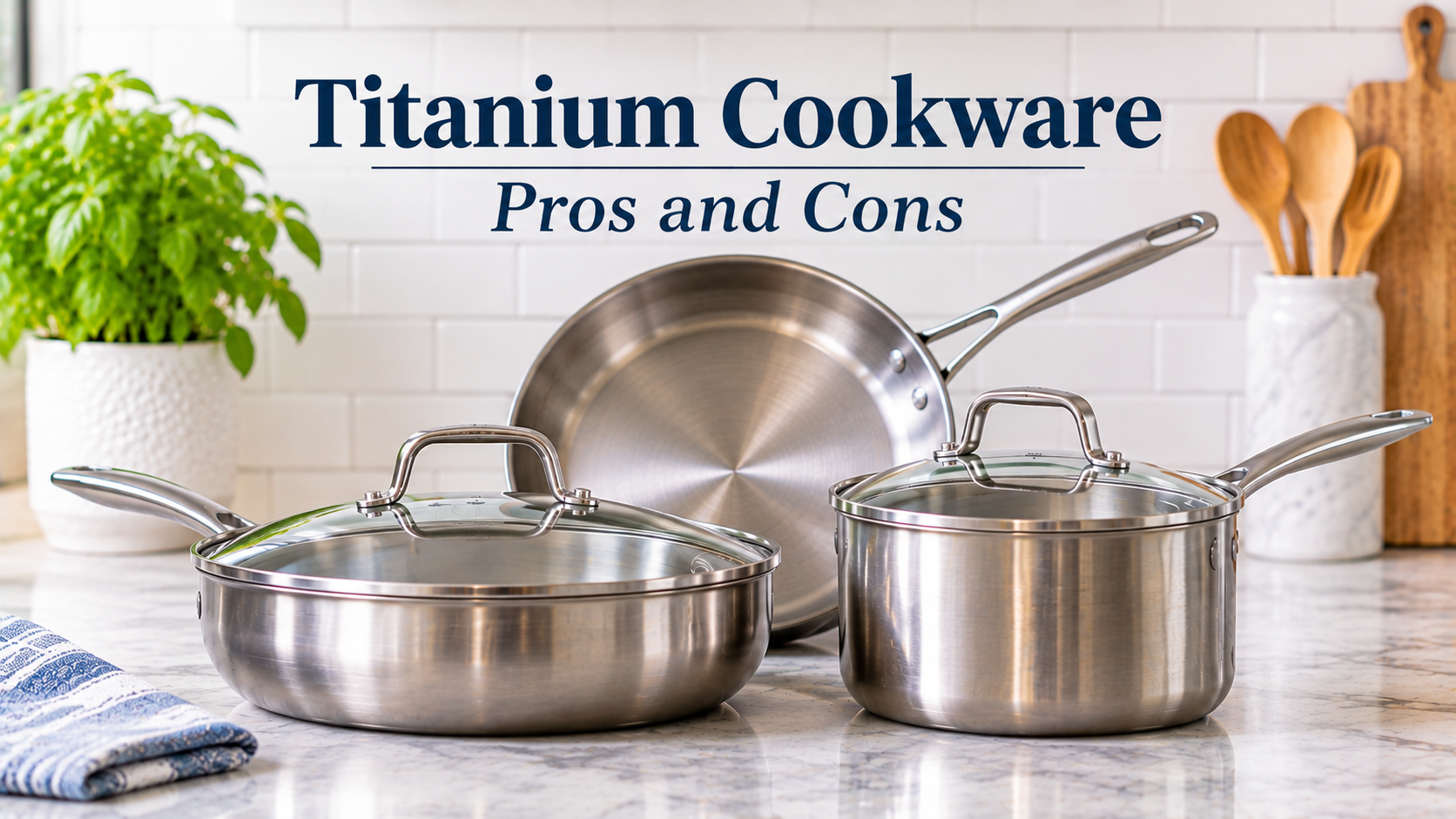
Titanium cookware has a compelling pitch: a durable metal cooking surface, no conventional nonstick coating, excellent corrosion resistance, and a lighter feel than many stainless steel pans. But the word titanium is used for several very different products. A pan with a solid titanium cooking surface is not the same as a PTFE pan reinforced with titanium particles, a titanium-treated stainless steel pan, or a tri-ply skillet with a formed titanium interior.
That distinction changes almost everything that matters to a buyer: food release, heat distribution, durability, PFAS claims, induction compatibility, and price. It also explains why some titanium pans cook more like stainless steel while others are marketed as no-coating nonstick cookware.
The short answer: Genuine uncoated titanium cookware can be a durable option for people who want to avoid conventional nonstick coatings, but pure titanium is not automatically nonstick and it is not a superior heat conductor. The best-performing designs use a carefully engineered layered construction. For most households, quality clad stainless steel remains the more established value; titanium is worth considering when its specific surface technology and coating-free construction justify the premium.
Titanium Cookware Pros and Cons at a Glance
The advantages are real, but they depend on the type of titanium cookware. The table below refers mainly to cookware with an uncoated titanium cooking surface, not ordinary nonstick pans that merely use titanium in their marketing.
- Excellent corrosion resistance on a genuine titanium food-contact surface
- Can avoid conventional PTFE or ceramic nonstick films when genuinely uncoated
- Low material density gives titanium a strength-to-weight advantage
- Does not need cast-iron-style seasoning
- Can be suitable for acidic foods
- Not naturally as nonstick as PTFE
- Titanium itself has low thermal conductivity
- Premium pricing can be difficult to justify
- Induction requires a magnetic base
- Product labels blur pure titanium, bonded surfaces, and reinforced coatings
Our verdict: Titanium is a credible coating-free cookware option, not a miracle material. Buy it for a clearly specified cooking surface and well-designed construction—not because a brand promises that titanium is indestructible, naturally nonstick, or automatically healthier than every alternative.
What Does “Titanium Cookware” Actually Mean?
Before comparing brands, identify what touches the food. Product names and words such as “titanium,” “granite,” “diamond,” “reinforced,” and “non-toxic” are not sufficient descriptions of a pan’s construction.
1. Solid or Pure Titanium Cooking Surface
In this design, the food-contact surface is commercially pure titanium, often identified by a grade such as Grade 1 or Grade 2. It may be a single sheet of titanium or the top layer of a clad pan. A clad design can combine titanium on the inside with aluminum layers for heat spreading and stainless steel on the outside for durability and induction compatibility.
“Pure titanium surface” does not necessarily mean the entire pan is made from titanium. In fact, a well-designed multi-layer pan deliberately uses other metals because titanium by itself is not an especially effective way to spread heat across a wide cooking surface.
2. Titanium-Textured or Formed Titanium Surfaces
Some newer pans use a pressed, hammered, etched, or otherwise patterned titanium surface. The manufacturer claims that the texture helps food release by reducing contact or helping oil spread across the surface. Examples include Taima’s SlipScale, Our Place’s NoCo design, and the surface technology used in Viking PureGlide Pro.
These products are not identical. The exact material, surface treatment, bonding process, and cooking instructions differ. A textured metal surface can improve food release, but it should not be assumed to behave exactly like a fresh PTFE pan. Independent tests are more useful than the word “nonstick” on a product page.
3. Titanium-Bonded Stainless Steel
Hestan NanoBond is an important example. Its name refers to a molecular titanium surface treatment bonded to stainless steel. It is not a pan made from a thick sheet of pure titanium. The underlying cookware uses clad stainless steel and an aluminum heat-conducting core, while the titanium-based surface treatment is intended to improve hardness and resistance to staining and scratching.
This is a different engineering approach from a pan whose food-contact layer is solid commercially pure titanium. It may still be an attractive premium metal cooking surface, but buyers should compare it as titanium-bonded stainless steel—not as a pure titanium pan.
4. Titanium-Reinforced Nonstick Coatings
Many familiar “titanium nonstick” pans use an aluminum body with a conventional nonstick coating that has been reinforced with titanium-containing particles or marketed as titanium-enhanced. The food-contact layer is still a coating. Depending on the product, it may be PTFE-based or another nonstick formulation.
Do not assume a titanium-reinforced pan is PFAS-free, PTFE-free, or coating-free. Check the exact model’s material disclosure. “PFOA-free” alone does not mean “PFAS-free,” and “titanium” alone does not tell you what the coating contains.
The Real Pros of Titanium Cookware
1. Excellent Corrosion Resistance
Commercially pure titanium forms a stable oxide layer that helps protect it from corrosion. This is one reason titanium is used in demanding industrial and medical applications. In cookware, corrosion resistance is useful when preparing acidic ingredients such as tomatoes, lemon juice, vinegar, and wine.
That does not mean every component in a multi-layer pan is equally corrosion-proof. The exposed cooking surface, rim, base, handle attachment, and any bonded layers all matter. It is also not a reason to leave salty or acidic food sitting in any pan indefinitely.
2. A Genuinely Uncoated Surface Can Avoid Conventional Nonstick Coatings
If the cooking surface is truly uncoated titanium, there is no conventional PTFE or ceramic nonstick film to peel, blister, or gradually lose its release performance. This is the clearest practical advantage for shoppers who want a metal cooking surface without a sprayed or applied nonstick layer.
Be precise about the claim: “no coating” is different from “no PFAS detected in a test,” and both are different from a general “non-toxic” marketing statement. Ask what the food-contact surface is made from and whether the manufacturer provides material or migration testing for the finished cookware.
3. Titanium Is Lightweight for Its Strength
Commercially pure titanium has a density of about 4.5 g/cm³, lower than common stainless steel. That gives it a useful strength-to-weight advantage. A thin titanium pot can be noticeably lighter than a similarly sized steel pot, which is one reason titanium is popular in backpacking cookware.
Do not use density alone to predict the weight of a home cookware set. A thick tri-ply pan includes aluminum and stainless steel layers, a handle, and often a lid. Compare the finished pan’s listed weight and dimensions rather than assuming every titanium pan is light.
4. No Seasoning Routine Is Required
Pure titanium does not need the seasoning layer used by cast iron or carbon steel. Wash it according to the manufacturer’s instructions and dry it before storage. Some textured titanium brands recommend warming the pan with a little oil before first use or before cooking; that is a care or cooking instruction, not the same as building a cast-iron seasoning layer.
5. It Can Be a Long-Term Alternative to Coated Pans
A well-made uncoated metal surface avoids the normal end-of-life question associated with a worn nonstick coating. If the pan’s body, bonded layers, base, and handle remain sound, the cooking surface may remain usable for many years.
But “lifetime cookware” is a marketing phrase, not a guarantee that every pan will last forever. Warping, delamination, handle failure, and poor heat performance are still possible. A long warranty is useful only when its exclusions and return process are clear.
6. It Can Work Well With Acidic Foods
A suitable titanium food-contact surface is highly resistant to many corrosive food conditions. That makes it a reasonable choice for tomato sauces, citrus-based dishes, and deglazing with wine or vinegar. It is a material advantage, not proof that every pan sold under a titanium label has a titanium surface.
The Cons of Titanium Cookware Buyers Should Not Ignore
1. Pure Titanium Is Not Naturally Nonstick Like PTFE
This is the most important expectation to set. A bare titanium surface is not inherently as slippery as a new PTFE-coated pan. Eggs, fish, pancakes, and lean proteins can stick if the pan is not prepared correctly or if the surface design does not provide enough food release.
Some formed or textured titanium surfaces perform better than a plain sheet of metal, especially when a little oil is used. But the result varies by design. A brand’s claim that a pan is “naturally nonstick” should be checked against tests that disclose the food, temperature, preheating method, and amount of fat used.
2. Titanium Is Not a High-Conductivity Metal
Commercially pure Grade 2 titanium has thermal conductivity around 16.4 W/m·K at room temperature, according to a technical datasheet. That is in the same general low-conductivity range as common stainless steel—not remotely comparable with aluminum or copper. The practical takeaway is simple: a thin, single-layer titanium pan is not automatically an even-heating pan.
Look at the complete construction. An aluminum core or spreader can improve heat distribution; thickness and the diameter of the heating element also matter. A multi-ply pan can perform very differently from a thin titanium camping pot. Do not repeat the claim that titanium is the “most efficient heat conductor” or that titanium alone guarantees even heating.
3. Premium Prices Are Difficult to Justify for Every Kitchen
Specialized titanium surfaces, multi-layer bonding, and premium positioning can make these pans expensive. At the same price, a buyer may be able to purchase a complete set of high-quality clad stainless steel cookware with a long track record and broad independent testing.
Paying more makes sense only if the specific surface technology solves a problem you care about. If your main goal is dependable searing and even heat, compare the titanium pan against well-made stainless steel before spending extra.
4. The Cooking Technique Still Matters
Uncoated titanium generally asks more of the cook than a conventional nonstick pan. Preheating, moderate heat, a suitable amount of oil, and waiting for proteins to release naturally can make a meaningful difference. Turning the burner to maximum heat to force food to release is more likely to cause burning or discoloration than to solve sticking.
5. Not Every Pure Titanium Pan Works on Induction
Titanium is not ferromagnetic. A pan made only from titanium will not normally work directly on an induction cooktop. Induction-compatible models need a magnetic layer, commonly stainless steel, incorporated into the base or clad construction. Check the exact model rather than assuming that all titanium cookware works on induction.
6. Some Pans Can Discolor or Warp
High heat can change the appearance of titanium’s oxide layer, creating blue, gold, or rainbow tones. That discoloration does not automatically mean the pan is unsafe. Warping is a separate mechanical problem and can be more serious, particularly on flat glass and induction cooktops where stable contact matters.
Thickness, construction, heating rate, burner size, and thermal shock all influence warping risk. Avoid heating an empty pan on maximum power and do not plunge a very hot pan into cold water unless the manufacturer specifically allows it.
7. “Titanium” Marketing Makes Comparisons Confusing
A titanium-reinforced PTFE coating, a pure titanium surface, a titanium-bonded stainless steel pan, and a titanium-silica fused surface are not interchangeable. Their food-contact materials, care requirements, food release, and wear mechanisms differ. A product comparison that treats them as one category can mislead readers.
Is Titanium Cookware Safe? Health Risks and PFAS Explained
For a properly manufactured pan with an uncoated commercially pure titanium food-contact surface, the metal’s corrosion resistance is a favorable material property. However, a cookware safety conclusion must apply to the finished product—not just to titanium in isolation. The alloy grade, other exposed metals, surface treatments, manufacturing residues, and any coating all matter.
Does Pure Titanium Cookware Leach Metals?
Titanium is generally resistant to corrosion in ordinary food conditions, but avoid absolute claims such as “zero leaching under all conditions.” The relevant question is whether the finished cookware meets applicable food-contact requirements and whether migration testing was conducted using appropriate food simulants and conditions.
The Council of Europe’s EDQM technical guide on metals and alloys used in food-contact materials explains why metal release, impurities, and specific release limits matter for consumer protection. It is a technical framework for evaluating materials; it is not a certification of every pan sold as titanium.
Does Titanium Cookware Contain PFAS or PTFE?
A genuinely uncoated titanium cooking surface does not need a PTFE nonstick film. Some manufacturers also state that their titanium surface systems are made without PFAS. Those claims should be checked against the exact model’s material disclosure and, ideally, independent test reports.
By contrast, a titanium-reinforced conventional nonstick pan may still use PTFE. “PFOA-free” is not the same as “PFAS-free,” and “titanium reinforced” does not establish that a pan is coating-free. If avoiding PFAS is your priority, choose a model whose manufacturer clearly identifies the food-contact surface and explicitly addresses PTFE and PFAS.
What About Titanium Dioxide Nanoparticles?
Titanium metal and titanium dioxide (TiO₂) particles are different materials. A 2017 peer-reviewed study examined certain food-contact nonstick coatings containing TiO₂ particles embedded in a silicone-polymer matrix and investigated possible particle release under laboratory migration and wear conditions. That research is relevant to those specific particle-containing coatings; it does not demonstrate that a solid, uncoated titanium pan behaves the same way.
The distinction matters because a product described as “titanium cookware” may be a metal surface, a titanium-bonded stainless surface, or a coating containing titanium compounds. Do not use research on one construction to make blanket claims about all the others.
Is Titanium Cookware Safer Than Stainless Steel?
There is no sound basis for saying that every titanium pan is automatically safer than every stainless steel pan. Both can be durable food-contact materials when properly manufactured. Stainless steel composition varies, and some people need to consider nickel sensitivity; titanium products also vary in construction and testing. Choose a clearly specified, reputable product rather than relying on broad “toxin-free” claims.
Titanium Cookware vs. Stainless Steel: Which Is Better?
For most home kitchens, this is the comparison that matters most. Both can provide durable metal cooking surfaces without a conventional nonstick coating. Neither is naturally as slippery as PTFE, and both benefit from good temperature control.
| Feature | Uncoated titanium surface | Clad stainless steel |
|---|---|---|
| Corrosion resistance | Excellent | Very good to excellent, depending on grade and care |
| Food release | Varies by surface texture; oil and technique still matter | Requires preheating and cooking fat |
| Heat conductivity of surface metal | Low; about 16.4 W/m·K for Grade 2 | Low; depends on stainless grade |
| Heat distribution | Depends on core, thickness, and construction | Often improved by aluminum or copper cladding |
| Weight | Titanium itself is relatively light; finished pans vary | Usually heavier, but varies by design |
| Induction | Needs a magnetic base | Many models work; verify the base |
| Price and availability | More limited; often premium-priced | Wide selection at many price levels |
| Long-term track record | Newer surface systems have less independent history | Well-established across professional and home kitchens |
Which Heats More Evenly?
Do not decide based on the metal name alone. Pure titanium and stainless steel are both relatively poor conductors compared with aluminum and copper. A thin titanium pan may heat unevenly; a well-designed titanium-aluminum-stainless construction can spread heat more effectively. The same principle explains why fully clad stainless steel pans use an aluminum or copper core.
Which Is Better for Eggs and Delicate Foods?
A traditional PTFE pan is still the easiest choice for low-fat eggs. Among the newer metal-surface systems, performance varies. Independent testing by Prudent Reviews found that Our Place Titanium Always Pan Pro and Viking PureGlide Pro released a dry egg better than the Taima pan in that reviewer’s test. Taima performed well with a small amount of fat, but its egg stuck badly without fat. Those are test-specific observations, not a guarantee for every kitchen or production batch.
Which Is the Better Buy?
Choose clad stainless steel if you want proven versatility, broad choice, strong searing performance, and better value. Consider titanium if you specifically want its food-contact surface or surface technology, are comfortable with its cooking behavior, and can justify the premium. A titanium label by itself is not a reason to replace a good stainless steel pan. For a deeper side-by-side comparison, read our Titanium vs. Stainless Steel Cookware guide.
Is Titanium Cookware Nonstick?
The accurate answer is: some titanium-surface designs can offer useful food release, but pure titanium is not inherently nonstick in the same way as PTFE. Manufacturers use different surface patterns and bonding methods, and their results are not identical.
When assessing a “nonstick titanium” claim, ask four questions: Was the pan tested with oil or without it? What temperature was used? Was the surface preheated? Was the test repeated after scratching or extended use? A demonstration with oil on a freshly cleaned pan is not enough to establish long-term nonstick performance.
Titanium Cookware Reviews: Products Worth Comparing
These products do not all use the same construction. We are including them because they represent distinct approaches to titanium cookware—not because they are interchangeable or all independently proven to be the best. Manufacturer specifications are identified as manufacturer claims; independent test results are attributed to the reviewer who performed them.


How the Three Designs Differ
|
Best test balance
Viking PureGlide Pro
|
Best versatile pan
Our Place Titanium Pro
|
Premium bonded surface
Hestan NanoBond
|
|
|---|---|---|---|
|
|
|
|
|
| Food-contact surface | Fused titanium-silica | Formed titanium | Titanium-bonded stainless |
| Body construction | 3-ply steel/aluminum | 3 mm tri-ply | Clad steel/aluminum |
| Dry-egg test in cited review | Minor sticking | Clean release | Stuck like stainless |
| Induction | Yes | Yes | Yes |
| Check current price | Check current price | Check current price |
Kaizen Signature Titanium Cookware Set
Best for: Shoppers considering a coordinated cookware set with a pure titanium food-contact surface.
Kaizen’s Signature range is marketed around an uncoated pure titanium cooking surface and a layered construction intended to combine that surface with better heat spreading and induction compatibility. Its product pages describe titanium, aluminum, and stainless steel layers and advertise third-party PFAS testing. The exact number and thickness of layers should be checked on the specific set or pan being purchased, because product families and generations can differ.
What looks promising: The brand clearly identifies a titanium food-contact surface and uses aluminum in the construction rather than relying on a thin titanium sheet alone. A set can also be convenient for someone who wants several matching pieces.
What gives us pause: The premium set price makes independent cooking-performance evidence important. Third-party PFAS testing does not establish that eggs will release easily, that heat distribution is excellent, or that a pan will never warp. We would want to see the full test report, test scope, surface-abrasion data, and independent long-term owner feedback before treating every performance claim as proven.
Verdict: Kaizen is a serious option to investigate if a pure titanium cooking surface is your priority. Compare the exact set’s layer specification, trial period, warranty exclusions, shipping and return terms, and independent performance evidence before committing.
See the Kaizen Complete Signature set specifications and its published materials and testing information. If you are searching for a Kaizen cookware review on Reddit, treat individual posts as owner anecdotes rather than controlled tests.
Look for detailed, dated comments about food release, warping, cleaning, shipping, returns, and warranty support—and compare several owners rather than relying on one enthusiastic or negative thread.
Taima Titanium Classic Pan
Best for: Buyers interested in a Grade 1 titanium cooking surface and a textured food-release design.
Taima describes its pan as a Grade 1 titanium surface with a proprietary SlipScale pattern. Its product page says the surface is not a conventional nonstick coating and recommends a brief oil-warming step before use. The brand also advertises induction compatibility and a multi-ply construction. These are manufacturer specifications and claims, not our own test results.
What independent testing found: In a multi-month comparison, Prudent Reviews tested Taima alongside Our Place Titanium Always Pan Pro, Viking PureGlide Pro, Hestan NanoBond, Heritage Steel Titanium, and a stainless steel control. In the reviewer’s egg test, Taima released about 99% of the egg with a small amount of oil and butter, but the egg stuck badly when cooked without fat. The reviewer also measured a 140°F center-to-edge temperature difference after two minutes, compared with 35°F for Viking PureGlide Pro in the same test.
The same reviewer reported that the pan’s bottom bowed after a few uses, that its cooking surface fell to 101°F five minutes after being heated to 400°F and removed from the burner, and that aggressive scratch tests left marks. The reviewer did find strong corrosion resistance in an intentionally harsh salt test. These findings apply to the sample and test conditions in that review; they should not be presented as a universal defect rate.
Verdict: Taima’s corrosion resistance and food release with a little fat are positives, but the reported heat-distribution, heat-retention, and warping problems are substantial concerns at a premium price. We would not rank it as the default recommendation without more evidence that the construction or current model has addressed those weaknesses. Read the Taima product specifications alongside the independent Taima comparison and test results.
Our Place Titanium Always Pan Pro
Best for: Buyers who want a versatile titanium-surface pan with a tri-ply body and an emphasis on food release.
Our Place describes the Always Pan Pro as a fully clad tri-ply pan with a stainless steel exterior, aluminum core, and titanium interior. Its NoCo surface is formed into the titanium rather than applied as a conventional nonstick coating, according to the manufacturer. The brand lists induction compatibility and recommends using at least a teaspoon of high-smoke-point oil to activate the nonstick effect.
Prudent Reviews reported that the Our Place pan released a dry egg cleanly in its test—an unusually strong result for a metal-surface pan. That is useful independent evidence, although it is still one reviewer’s controlled comparison rather than a guarantee that every egg will slide around in every home kitchen.
Trade-offs: It is a premium single-pan purchase, its cooking experience depends on following the oil and heat instructions, and the multi-function design may not replace a dedicated saucepan, skillet, or stockpot for every cook. The 3 mm tri-ply construction and included accessories also affect its weight and price.
Verdict: One of the more compelling options in this category because its construction is clearly described and it performed well in the cited independent egg test. It is a pan to compare closely with Viking, not an automatic replacement for a full stainless steel set. See the manufacturer’s Titanium Always Pan Pro specifications.
Formed titanium NoCo surface over a 3 mm tri-ply body.
A versatile pan with a titanium interior and stainless steel/aluminum construction. The independent comparison reported clean dry-egg release on the tested sample; follow the maker’s oil and care instructions.
Viking PureGlide Pro
Best for: Buyers who want a titanium-based food-release surface in a conventional clad-pan format.
Viking describes PureGlide Pro as three-ply cookware with a stainless steel exterior, aluminum core, and a fused titanium-and-silica cooking surface. The company says the surface is made without PFAS, PTFE, and PFOA and advertises metal-utensil durability testing. This is not a solid pure-titanium pan; it is a distinct fused surface system over a layered cookware body.
In Prudent Reviews’ side-by-side testing, Viking performed especially well. It released the egg in the reviewer’s dry-egg test with only minor sticking, had a 35°F center-to-edge temperature gap at the two-minute measurement, and showed no damage in the reviewer’s listed scratch tests. Those results make it a notable competitor, although a single review cannot establish lifetime durability.
Trade-offs: It is a relatively new surface system, so long-term ownership evidence is still developing. Buyers should check the exact pan size, care instructions, warranty, and current product disclosure rather than assuming that every Viking nonstick collection uses the same technology.
Verdict: Based on the available independent comparison, Viking PureGlide Pro is one of the strongest titanium-surface options to shortlist, particularly if food release and heat distribution matter more to you than owning a pure titanium sheet. See Viking’s PureGlide Pro construction and product range.
Fused titanium-and-silica surface with a three-ply body.
A notable option in the independent side-by-side test: it showed a small center-to-edge temperature gap and very good egg release. Long-term ownership evidence is still developing.
Hestan NanoBond
Best for: Buyers who want premium stainless steel cookware with a titanium-based bonded surface treatment.
Hestan NanoBond belongs in the comparison because it uses molecular titanium bonded to stainless steel. It should not be described as a pure titanium pan. The cookware combines a clad stainless steel body and an aluminum heat core with a titanium-based surface treatment designed to improve surface hardness and resistance to staining and scratching.
Trade-offs: NanoBond is expensive, and its cooking behavior is closer to premium metal cookware than to a conventional PTFE pan. It is not the same construction as a solid titanium cooking surface, so it should not be selected by shoppers whose strict requirement is a pan made with pure titanium touching the food.
Verdict: A relevant premium alternative, but compare it as titanium-bonded stainless steel. It is not a direct substitute for a pure titanium pan. See Hestan’s NanoBond collection.
A titanium-treated stainless steel surface—not a pure titanium pan.
A premium alternative for shoppers interested in a hard, titanium-bonded stainless cooking surface. Choose it for the NanoBond construction, not because it is pure titanium cookware.
What About CAROTE Titanium Cookware?
CAROTE sells several nonstick cookware collections and uses different surface descriptions across its product range. Do not assume that a CAROTE pan is pure titanium because a listing, seller, or comparison page uses the word “titanium.” Confirm the exact model number and the manufacturer’s description of the food-contact layer.
For shoppers searching for CAROTE titanium cookware pros and cons, the first step is to identify the exact model. If a particular listing uses a titanium-reinforced nonstick coating, potential advantages include easy food release while the coating is intact, an aluminum body that is often relatively light, and a lower price than specialist pure-titanium cookware. The trade-offs are that it is not pure titanium, the coating composition must be checked, and the release performance can decline as the coating wears. These are category-level considerations, not a verdict on every CAROTE pan.
If the specific CAROTE model uses a titanium-reinforced nonstick coating, evaluate it as coated nonstick cookware: identify whether the coating is PTFE-based or ceramic, check its care limits, and understand that food release depends on the coating remaining in good condition. We would not include a generic CAROTE pan in a pure-titanium product ranking without documentation proving the cooking surface construction.
Titanium Pan Reviews and Complaints: What the Evidence Actually Shows
Online complaints can be useful signals, but isolated comments are not proof of a widespread defect. The strongest evidence comes from reviews that identify the exact model, explain the test method, show the results, and distinguish a product defect from technique or misuse.
Food Sticking Despite “Nonstick” Marketing
This complaint is plausible for uncoated titanium because it is not inherently as slippery as PTFE. The Taima test illustrates the distinction: good release with a little fat, but poor dry-egg release. Viking and Our Place performed better in that particular dry-egg comparison. A buyer should look for the exact cooking instructions and independent tests rather than expect all titanium surfaces to behave alike.
Uneven Heating and Weak Heat Retention
These are construction questions, not an unavoidable feature of every titanium pan. Taima’s reported 140°F center-to-edge gap and 101°F five-minute retention reading are a warning about that tested pan’s thin 2 mm construction. Viking’s smaller measured temperature gap in the same comparison shows why one should not generalize from a single brand to the entire category.
Warping and Spinning on a Flat Cooktop
A pan that rocks or spins on a flat cooktop is more than a cosmetic annoyance: it can reduce stability and compromise contact with the heating surface. The Taima reviewer documented this issue on the tested sample after a few uses. Before buying any premium pan, check return terms and warranty coverage for warping, and avoid rapid temperature changes.
Scratches and Surface Wear
“Metal utensil safe” does not mean “impossible to scratch.” The Prudent Reviews tests found that Taima resisted ordinary ladle and spatula scraping but was marked by a serrated knife and abrasive pad. Viking, Our Place, and Hestan performed better in some of those specific tests. Cosmetic marks, deep gouges, coating damage, and loss of food-release performance are different outcomes and should not be lumped together.
Warranty, Delivery, and Customer Service
For newer direct-to-consumer brands, review the actual return window, who pays return shipping, whether trial cookware must be returned in a particular condition, and what the warranty excludes. Do not rely on a lifetime-warranty headline without reading the full terms. We do not treat unverified social-media anecdotes as established brand-wide complaint patterns.
How to Choose the Best Titanium Cookware
1. Identify the Food-Contact Surface
Look for an explicit description: commercially pure titanium, titanium formed or fused into a surface, titanium-bonded stainless steel, or titanium-reinforced PTFE/ceramic coating. If the manufacturer will not tell you what touches the food, do not assume the most favorable interpretation.
2. Check the Layer Stack and Thickness
For a home skillet, look for a clearly disclosed heat-spreading core, overall thickness, and whether the pan is fully clad or only has a bonded base plate. The word “five-ply” alone is not a performance guarantee; the thickness and material of each layer matter.
3. Verify PFAS and PTFE Statements
If avoiding PFAS is important, look for a model-specific statement covering PTFE and PFAS, not just PFOA. Ask whether the statement applies to the complete cooking surface and whether a third-party report is available. A test report should identify the laboratory, methods, substances tested, detection limits, and product sample.
4. Look for Independent Cooking Tests
Useful tests should disclose pan size, burner type, preheat time, surface temperature, food quantity, oil quantity, and measurement method. Look for heat distribution, heat retention, dry and oiled food-release tests, warping, and abrasion. A manufacturer’s demonstration can show how a product is intended to work, but it is not independent verification.
5. Check Induction Compatibility and Oven Limits
Pure titanium is not magnetic, so induction-compatible models need a magnetic base. Also check the temperature limit for the pan, lid, handle, and any accessory separately. The lowest-rated component determines the safe oven limit for the complete set.
6. Compare Warranty and Return Terms
Check the coverage for warping, handle damage, bonded-layer separation, and manufacturing defects. Confirm whether normal wear, misuse, overheating, or cosmetic discoloration are excluded. For direct-to-consumer purchases, factor in return shipping and international delivery costs.
How to Cook With Uncoated Titanium
Uncoated titanium should be approached more like stainless steel than like a fresh PTFE pan. Follow the individual manufacturer’s instructions, but these general habits help avoid sticking and overheating.
- Preheat gradually: Start around medium or medium-low rather than immediately using maximum heat.
- Add cooking fat: Use the amount recommended by the manufacturer. A little oil or butter can make a substantial difference.
- Let food release: Meat and fish often release more easily after a crust forms. Avoid forcing them off the surface too early.
- Avoid overheating: High heat does not make a titanium surface more nonstick and can burn oil or discolor the metal.
- Prevent thermal shock: Let a hot pan cool before washing unless the manufacturer specifically permits rapid cooling.
- Follow the care guide: Do not assume every titanium surface can tolerate abrasive pads or metal utensils just because another brand says it can.
Titanium Cookware FAQs
What are the biggest pros and cons of titanium cookware?
The main advantages are corrosion resistance, a potentially durable coating-free cooking surface, and low material density. The main disadvantages are premium pricing, variable food release, and heat performance that depends heavily on construction. Titanium is not automatically nonstick or evenly heating.
Is pure titanium cookware safe?
A properly manufactured uncoated titanium food-contact surface is generally considered a suitable material, but the finished product’s composition and testing matter. Check the exact model’s material disclosure and food-contact documentation rather than relying on a broad “non-toxic” claim.
Does titanium cookware contain PFAS?
Genuinely uncoated titanium does not need a PFAS-based nonstick coating. Some products marketed as titanium cookware are still conventional coated pans and may use PTFE. Verify the specific model and do not treat “PFOA-free” as proof that a product is free of all PFAS.
Is titanium cookware nonstick without oil?
Not consistently. Some textured titanium systems release food well with little oil, and a few performed well in independent dry-egg tests. Other titanium pans behave much more like stainless steel. Results depend on the surface design, temperature, food, and cooking technique.
Is titanium cookware better than stainless steel?
Not for everyone. Titanium can offer a distinctive coating-free surface and lower material density, but quality clad stainless steel is more widely available and has a longer track record. For most households, stainless steel is the better-value default; titanium is a specialist alternative.
Does titanium cookware work on induction?
Pure titanium is not magnetic. A titanium pan needs a magnetic stainless steel or other compatible base to work on induction. Always check the exact model’s compatibility statement.
Can titanium cookware rust?
Commercially pure titanium has excellent corrosion resistance and does not rust like ordinary carbon steel. A multi-layer pan may still contain other metals, so care for the complete product according to the manufacturer’s instructions.
Is titanium cookware safe for acidic foods?
A genuine titanium food-contact surface is highly corrosion-resistant and is generally suitable for acidic ingredients. Do not extend that statement to every pan marketed as titanium; the actual cooking surface and other exposed materials matter.
Is Kaizen titanium cookware worth it?
Kaizen is worth comparing if you want a cookware set with a manufacturer-specified pure titanium cooking surface and layered construction. Before buying, verify the exact set’s construction, inspect the third-party test report, and compare the price and warranty with established clad stainless steel and other titanium-surface pans.
Is Taima titanium cookware worth it?
Taima has a genuine titanium surface and showed good egg release with a small amount of fat in Prudent Reviews’ test. The same review reported uneven heating, weak heat retention, scratching under aggressive tests, and warping on the sample tested. Those are meaningful trade-offs to consider at its price.
Is CAROTE titanium cookware pure titanium?
Do not assume so. CAROTE sells multiple cookware collections, and titanium-related wording may refer to a reinforced nonstick surface rather than a pure titanium food-contact layer. Check the exact model’s materials and coating details.
Sources and Testing Notes
This guide separates manufacturer specifications from independent product testing. We have not personally tested these pans, and we do not present another publisher’s measurements as our own. Product specifications and prices can change, so check the linked manufacturer’s page before purchasing.
- Prudent Reviews: Taima Titanium Review and comparative cooking tests — independent egg-release, heat, scratch, corrosion, and warping observations across several pans.
- Council of Europe EDQM: Metals and Alloys Used in Food Contact Materials and Articles — technical guidance for evaluating metal food-contact materials and migration.
- Commercially Pure Titanium Grade 2 Technical Datasheet — density and thermal conductivity data.
- Golja et al. (2017): Characterisation of food-contact non-stick coatings containing TiO₂ nanoparticles — research on specific particle-containing coatings, not solid titanium cookware.
- Kaizen Complete Signature Titanium Cookware Set — manufacturer specifications.
- Taima Titanium Pan — manufacturer specifications and care instructions.
- Our Place Titanium Always Pan Pro — manufacturer construction and use information.
- Viking PureGlide Pro — manufacturer construction and surface claims.
- Hestan NanoBond — manufacturer information about its titanium-bonded stainless steel technology.
Final Verdict: Are the Pros of Titanium Cookware Worth the Cons?
Titanium cookware has real advantages, but the best buying decision starts with the construction—not the label. A genuinely uncoated titanium surface offers corrosion resistance and avoids a conventional nonstick film. A titanium-based surface system can also deliver useful food release when paired with a well-designed aluminum core and stainless steel body.
The drawbacks are just as real: titanium itself is not a high-conductivity metal, food release varies, premium pans can be expensive, and independent long-term evidence is still limited for many brands. The Taima testing is a useful reminder that a pure titanium surface does not guarantee good heat distribution or a flat base.
Our recommendation: For most home cooks, start with quality clad stainless steel. If you specifically want titanium, compare Viking PureGlide Pro and Our Place Titanium Always Pan Pro for their tested food-release performance, consider Kaizen if you want a complete set with a pure titanium surface, and approach Taima with the documented heat and warping concerns in mind. Treat Hestan NanoBond as titanium-bonded stainless steel, not pure titanium cookware. Buy only after checking the exact surface, layer construction, independent evidence, warranty, and return policy.