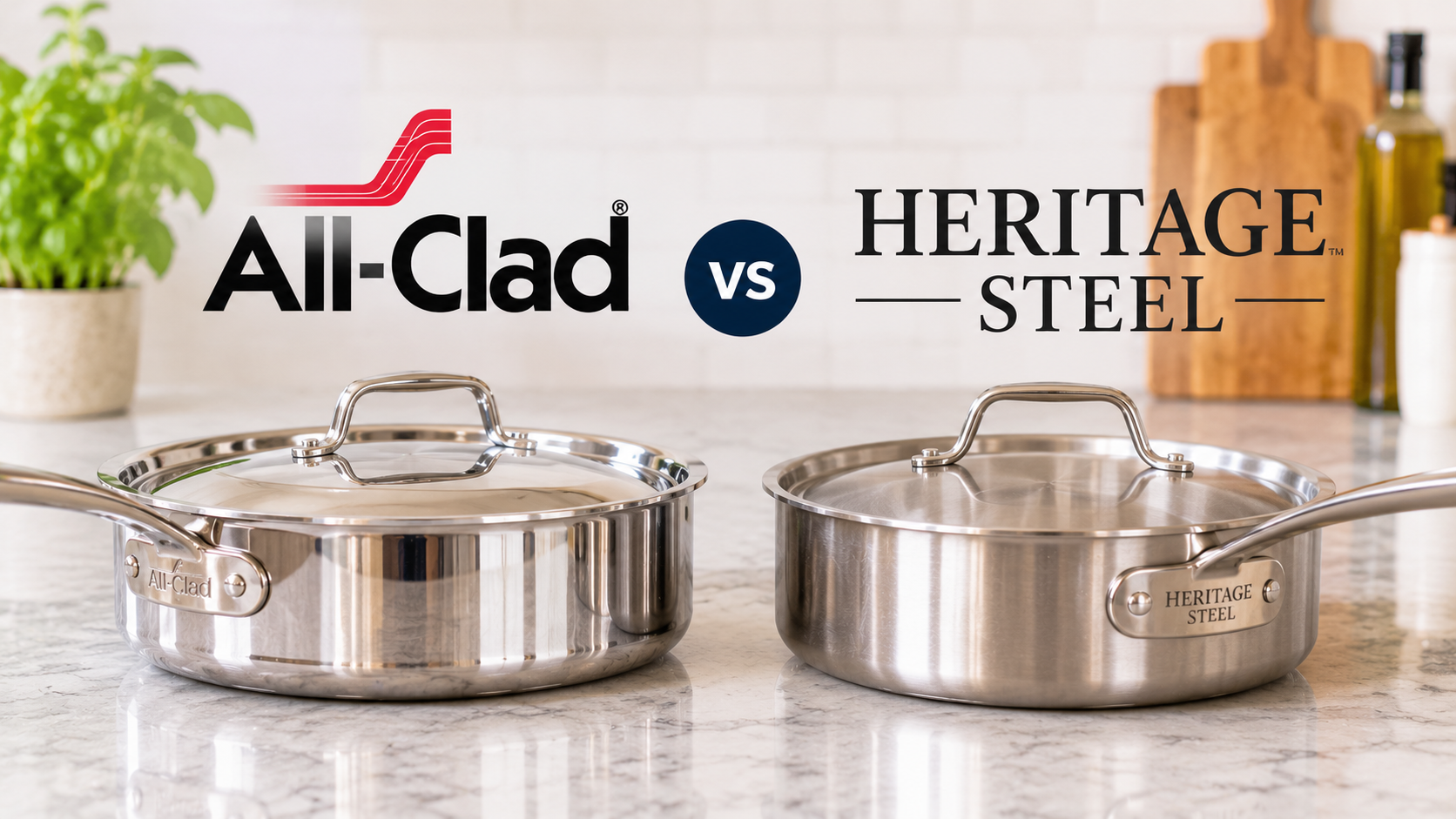
All-Clad and Heritage Steel both make premium fully clad stainless steel cookware, but they take different approaches to materials and construction. All-Clad D3 uses a three-ply design with an aluminum core and an 18/10 stainless steel cooking surface.
Heritage Steel’s Titanium Series uses five-ply construction and a 316Ti stainless steel cooking surface. The Heritage Steel Eater Series is another important option: it also has five-ply construction, but uses 304 stainless steel rather than 316Ti.
That distinction matters. The fairest head-to-head comparison is All-Clad D3 vs. Heritage Steel Titanium, with the Eater Series considered separately as a lower-priced alternative. This guide compares construction, cooking performance, stainless steel alloys, handles, oven use, maintenance, warranty, manufacturing, and value so you can decide which cookware is worth buying.
Quick Verdict: All-Clad vs. Heritage Steel
Choose All-Clad D3 if you want proven tri-ply cookware, responsive everyday performance, a familiar design, and a broad product range. It is a sensible choice for cooks who want premium stainless steel without paying extra for a specialty alloy.
Choose Heritage Steel Titanium if you specifically value a 316Ti cooking surface, five-ply construction, and Heritage Steel’s rounded handle design. Its material specification is distinctive, but the extra layers and alloy do not automatically make it cook better in every situation.
Consider Heritage Steel Eater if you like the brand’s five-ply construction but do not need the Titanium Series’ 316Ti surface. Eater uses 304 stainless steel and is generally positioned below Titanium in price.
All-Clad D3 vs. Heritage Steel Titanium vs. Eater
|
All-Clad D3
|
Heritage Steel Titanium
|
Heritage Steel Eater
|
|
|---|---|---|---|
 |
 |
 |
|
| Construction | 3-Ply Fully Clad | 5-Ply Fully Clad | 5-Ply Fully Clad |
| Cooking Surface | 18/10 Stainless Steel | 316Ti Stainless Steel | 304 Stainless Steel (18/10) |
| Heat-Conducting Core | Aluminum Core | Multi-Layer Clad With Aluminum-Based Core | Multi-Layer Clad With Aluminum-Based Core |
| Handle Design | Classic Contoured Stainless Steel | Rounded Hollow Handle | Angular Hollow Handle |
| Cooktop Compatibility | Including Induction | Including Induction | Including Induction |
| Oven Rating | Up to 600°F; Check Lid Limits | Check Current Product and Lid Specifications | Check Current Product and Lid Specifications |
| Best Fit | Straightforward Premium Everyday Cookware | Buyers Prioritizing the 316Ti Surface | Buyers Wanting Heritage Steel’s Five-Ply Design Without 316Ti |
| BUY NOW | BUY NOW | BUY NOW |
The number of layers is only one part of cookware performance. Core thickness, metal composition, pan geometry, total mass, and bonding quality all influence how a pan heats and responds. A well-designed three-ply pan can perform extremely well; five-ply is not automatically better.
Understanding the Two Cookware Brands
All-Clad: A Broad Range of Bonded Cookware
All-Clad is an established cookware brand known for bonded-metal construction. Its D3 collection is built around three bonded layers: stainless steel, an aluminum core, and a stainless steel cooking surface. The aluminum extends through the pan body, not just across a disc attached to the bottom.
D3 is one of several All-Clad collections. The wider lineup includes D5, Copper Core, and other stainless and nonstick ranges. Those collections use different constructions, so this article focuses on D3 rather than treating every All-Clad pan as identical.
All-Clad’s fully bonded cookware is manufactured in the United States using domestic and imported materials. Its D3 collection is designed for use on induction and conventional cooktops, and the stainless steel range is oven- and broiler-safe up to the manufacturer’s stated temperature limit.
Heritage Steel: Two Stainless Steel Series to Distinguish
Heritage Steel is a family-owned American cookware manufacturer. Its two stainless steel lines most relevant to this comparison are Eater and Titanium. Both use five-ply construction, but their cooking surfaces and design details differ.
- Eater Series: 304 stainless steel cooking surface, five-ply construction, brushed finish, and angular hollow handle.
- Titanium Series: 316Ti stainless steel cooking surface, five-ply construction, mirror-polished finish, and rounded hollow handle.
Heritage Steel says its cookware and lids are made in Clarksville, Tennessee, using materials sourced in the United States and internationally. Its published materials information identifies cladded steel sourced from South Korea. The company is therefore American-made in terms of cookware manufacturing, but it does not claim that every raw material originates in the United States.
Construction: Three-ply vs. Five-ply
How All-Clad D3 Is Built
All-Clad D3 has three bonded layers. Stainless steel forms the exterior and the food-contact surface, while aluminum sits between them. Stainless steel is durable and corrosion-resistant but is not as conductive as aluminum. The aluminum core helps the pan heat more efficiently and spread heat beyond the center of the burner.
Because the layers extend up the sides, D3 is fully clad. That is different from cookware that has a stainless steel body with only a thick aluminum disc attached to the bottom. Fully clad construction can help reduce large temperature differences between the base and the sides of a pan.
A dependable tri-ply set for everyday cooking
This fully clad three-ply set pairs an aluminum core with an 18/10 stainless steel cooking surface. It is the most straightforward all-round choice here, especially if you want responsive everyday cookware without paying extra for a specialty alloy.
- Fully clad three-ply construction with an aluminum core.
- 18/10 stainless steel cooking surface for everyday stainless-steel cooking.
- Induction compatible; D3 stainless cookware is oven- and broiler-safe up to 600°F.
- Broad collection with a useful range of cookware shapes and sizes.
- Limited lifetime warranty.
- The traditional handle shape is not comfortable for every user.
- All-Clad recommends handwashing.
- The set can be expensive at full retail price.
- It does not have the 316Ti cooking surface offered by Heritage Steel Titanium.
All-Clad D3 is the easiest recommendation for most cooks who want premium fully clad stainless steel without paying for a specialty alloy. Its aluminum-core construction is a proven everyday design, and its broad lineup makes it easier to build a matching cookware collection. It offers the strongest value when the set is discounted and its included pieces match your needs.
Best for: Home cooks who want premium stainless steel cookware with proven tri-ply construction and straightforward everyday performance.
How Heritage Steel Five-ply Construction Differs
Heritage Steel uses five bonded layers in both its Eater and Titanium collections. The additional layers create a more complex clad structure, while the cooking surface alloy distinguishes the two series. Titanium uses 316Ti; Eater uses 304 stainless steel.
More layers do not necessarily mean more aluminum, faster heating, or better cooking. The performance depends on the thickness and arrangement of the conductive layers, the stainless steel layers, and the finished pan’s dimensions. Without comparing exact pan weights and layer thicknesses under controlled conditions, ply count alone is not a reliable performance ranking.
Five-ply construction without the 316Ti premium
Eater combines five-ply fully clad construction with a 304 stainless steel cooking surface. It is worth considering if you want Heritage Steel’s construction and U.S. manufacturing without paying specifically for the Titanium Series’ 316Ti alloy.
- Five-ply fully clad construction.
- 304 stainless steel cooking surface for conventional stainless-steel cooking.
- Made in Clarksville, Tennessee, using domestic and imported materials.
- Offers Heritage Steel’s five-ply design without the Titanium Series’ 316Ti surface.
- Does not have the 316Ti cooking surface of the Titanium Series.
- The angular handle design differs from the Titanium Series’ rounded handle.
- Five layers do not automatically mean better cooking performance than a well-made tri-ply pan.
- Set value depends on the current price and included pieces.
Eater is the more straightforward Heritage Steel choice for buyers who want the company’s five-ply construction with a conventional 304 stainless steel cooking surface. Compare it with All-Clad D3 on actual set price, included pieces, and handle comfort. Its five-ply build is a design difference, not proof that it will outperform a well-made tri-ply pan.
Best for: Buyers interested in Heritage Steel’s five-ply design who do not consider the 316Ti alloy essential.
Which Construction Should You Choose?
D3’s three-ply design is a proven, relatively straightforward approach that balances heat transfer and durability. Heritage Steel’s five-ply construction appeals to buyers who prefer its particular layered design and product details. Neither construction is inherently the winner for every recipe.
Practical takeaway: Do not pay a premium solely because a pan has five layers. Consider the cooking-surface alloy, weight, handle comfort, dimensions, price, and the way you cook.
Stainless Steel Cooking Surface: 18/10 vs. 316Ti
All-Clad D3: 18/10 Stainless Steel
All-Clad D3 uses an 18/10 stainless steel cooking surface. The designation describes a steel alloy containing approximately 18% chromium and 10% nickel. Chromium contributes corrosion resistance, while nickel helps improve corrosion resistance and supports the alloy’s overall properties.
18/10 stainless steel is widely used in premium cookware. It is not a nonstick coating; it is the metal surface that comes into contact with food. It is suitable for browning, sautéing, boiling, and preparing acidic ingredients when the cookware is used and maintained properly.
Heritage Steel Titanium: 316Ti Stainless Steel
Heritage Steel Titanium uses 316Ti stainless steel. This alloy belongs to the 316 family and includes molybdenum, with titanium added to help stabilize the alloy. The 316 family is valued for improved resistance to certain corrosive environments, including chloride-related pitting, compared with many common stainless steel grades.
Heritage Steel highlights the corrosion-resistance characteristics of 316Ti, particularly its resistance to salt pitting. This is a meaningful material distinction, but it should be understood in context: it does not make the pan nonstick, scratch-proof, or immune to every form of corrosion.
A specialty five-ply set with a 316Ti cooking surface
The Titanium Series pairs five-ply construction with a 316Ti stainless steel cooking surface and a rounded handle design. Its strongest reason to buy is the specific alloy and series details—not an assumption that five layers automatically cook better.
- Five-ply fully clad construction.
- 316Ti stainless steel cooking surface, the defining material distinction of this series.
- Rounded hollow handle design.
- Made in the United States using domestic and imported materials.
- Lifetime warranty coverage.
- Typically positioned above Eater and may cost more than All-Clad D3.
- The 316Ti alloy may not provide a meaningful everyday cooking advantage for every home cook.
- Five-ply construction alone does not establish superior heat performance.
- The lineup is narrower than All-Clad’s broader cookware range.
Heritage Steel Titanium makes sense when you specifically want its 316Ti cooking surface, five-ply build, and rounded handle design. Those features create a distinct premium proposition, but they do not make All-Clad D3 or Eater automatically inferior for everyday cooking. Compare current prices and the exact set contents before paying the premium.
Best for: Buyers who specifically value a 316Ti cooking surface, five-ply construction, and Heritage Steel’s Titanium-series design.
Does 316Ti Make Cookware Safer?
The presence of titanium in the alloy does not mean that ordinary 18/10 stainless steel cookware is unsafe. Both are stainless steel materials used in food-contact applications. The main reason to consider 316Ti is its alloy composition and corrosion-resistance properties, not a claim that other quality stainless steel cookware is inherently dangerous.
Neither alloy guarantees zero metal transfer under every possible condition. As with any stainless steel cookware, avoid prolonged storage of very salty or acidic foods in the pan, follow the manufacturer’s care instructions, and replace cookware if it becomes structurally damaged.
Is the 316Ti Upgrade Worth Paying for?
It may be worthwhile if you specifically value the material specification and want the Titanium Series. For ordinary home cooking—searing meat, sautéing vegetables, boiling pasta, or making pan sauces—the 316Ti surface alone should not be expected to produce a dramatic difference in the finished food.
Material advantage: Heritage Steel Titanium. Everyday practicality: Both are capable stainless steel cooking surfaces.
Heat Distribution and Cooking Performance
Heating Speed and Responsiveness
Aluminum is the key heat-conducting component in both cookware designs. All-Clad D3’s aluminum core transfers heat efficiently and gives the pan a responsive feel as burner settings change. Heritage Steel’s five-ply construction also uses a layered conductive core, but the exact cooking behavior depends on the complete pan design rather than the number of layers alone.
A pan’s responsiveness matters when you move between high and low heat. It can help when searing meat, reducing a sauce, or cooking ingredients that scorch easily. The burner itself, pan size, food load, and preheating technique also affect the result.
Heat Retention
Heat retention depends on the pan’s total mass, thickness, and materials. A heavier pan generally stores more heat, which can help maintain temperature when cold food is added. The trade-off is that a pan with more thermal mass may take longer to respond when you lower the heat.
Neither brand should be described as automatically superior at heat retention without comparing specific pans of similar dimensions and weight. A large sauté pan and a small frying pan from the same collection will not behave identically.
What Independent Testing Tells Us
I could not verify a publicly documented, controlled test comparing current All-Clad D3 and Heritage Steel pans of matched size, weight, and construction under identical conditions. Without those details, it would be misleading to declare one brand the faster-heating or more even-heating choice.
The practical conclusion is that ply count alone cannot establish cooking performance. A meaningful comparison needs the exact pan dimensions, burner, heat setting, water volume, and test method. Results from one pan should not automatically be generalized to every piece in either brand’s range.
Cooking with Stainless Steel
Both collections require the same basic stainless steel technique. Preheat the pan over moderate heat, add an appropriate amount of oil or cooking fat, and allow food to release naturally as browning develops. Trying to move meat or fish too early can make it stick. Very high heat is rarely necessary for routine cooking and can cause discoloration or burnt residue.
Performance verdict: All-Clad D3 is a strong everyday performer with a straightforward aluminum-core design. Heritage Steel Titanium offers a different layered construction and alloy, but the additional layers alone do not establish superior cooking performance.
Handle Design and Everyday Comfort
All-Clad D3 Handle
All-Clad D3 uses a recognizable stainless steel handle with a long, contoured shape and riveted attachment. Some cooks like the defined grip and traditional professional appearance. Others find the contour near the base uncomfortable, particularly when lifting a full pan or holding it for an extended period.
Heritage Steel Titanium Handle
Heritage Steel Titanium uses a rounded hollow handle. Its shape feels different from All-Clad’s and may suit cooks who prefer a smoother, rounder grip. The hollow design is intended to help manage heat during stovetop use, but stainless steel handles can still become hot depending on burner size, flame position, cooking time, and oven use.
The Eater Series has a different, more angular handle design. If handle comfort is a deciding factor, compare the exact series rather than assuming all Heritage Steel pans have the same grip.
Which Handle Is Better?
There is no objective winner for comfort because hand size, grip style, and personal preference matter. If possible, hold both designs before buying. Heritage Steel is worth considering if you dislike the traditional All-Clad handle; All-Clad may feel familiar if you already enjoy that style.
Oven Safety and Cooktop Compatibility
All-Clad D3
All-Clad states that its D3 stainless steel cookware is oven- and broiler-safe up to 600°F. Its stainless steel lids are also rated up to 600°F, while glass lids have a lower temperature limit. Always check the instructions for the specific pan and lid, especially when combining pieces from different collections.
Heritage Steel
Heritage Steel lists its stainless steel cookware as oven-safe up to 800°F and suitable for broiler use. That is a higher stated cookware limit than All-Clad D3’s 600°F rating. Check the instructions for the exact pan, lid, and accessory before using the full temperature range; do not assume every component has an identical limit.
Induction Compatibility
Both brands offer induction-compatible stainless steel cookware. If you are buying a specific piece, verify its product listing rather than relying only on the brand name. Also make sure the pan’s base is appropriately sized for the induction zone on your cooktop.
Verdict: Heritage Steel publishes an 800°F oven rating for its cookware, compared with All-Clad D3’s 600°F rating. That gives Heritage Steel the higher stated heat limit on paper, although most home cooks will rarely need either maximum. Check the specific lid and accessory instructions before high-temperature oven or broiler use.
Cleaning, Maintenance, and Long-term Durability
Cleaning All-Clad D3
All-Clad recommends handwashing its stainless steel cookware. Let the pan cool before washing, then use warm water, dish soap, and a non-abrasive sponge. For stuck-on food, soak the pan or use a suitable stainless steel cleaner. Rainbow discoloration and heat tint can occur on stainless steel and are generally cosmetic.
Cleaning Heritage Steel
Heritage Steel also recommends handwashing. The company cautions that some dishwasher detergents can be corrosive and may damage the cookware’s finish over time. Follow the care instructions supplied with the exact collection you purchase.
Which Is More Durable?
Both brands use fully clad stainless steel construction rather than relying on a nonstick coating that gradually wears away. Heritage Steel Titanium’s 316Ti surface has enhanced corrosion-resistance characteristics, but that alone does not prove the entire pan will last longer than All-Clad D3. Bonding quality, handles, rivets, pan thickness, cooking habits, and maintenance all contribute to long-term durability.
Neither pan is scratch-proof. Metal utensils can be used on stainless steel, but rough handling can leave marks. For everyday care, avoid thermal shock, do not leave an empty pan over high heat, and clean salt residue rather than allowing it to sit for long periods.
Price and Value: Which Brand Gives You More?
Both brands sell premium cookware, and prices vary by collection, set size, retailer, and promotion. Heritage Steel’s published comparison information has listed its 10-piece Titanium set above its Eater 10-piece set. All-Clad D3 pricing also varies substantially, especially during sales. Treat manufacturer prices as reference points and check the current price and exact contents before purchasing.
How the Three Cookware Collections Compare on Price
|
All-Clad D3
|
Heritage Steel Eater
|
Heritage Steel Titanium
|
|
|---|---|---|---|
|
|
|
|
|
| Relative Price Positioning | Premium; frequently discounted by retailers | Below Titanium within Heritage Steel’s lineup | Premium tier within Heritage Steel |
| What You Are Paying For | Three-ply fully clad construction and an 18/10 cooking surface | Five-ply construction and a 304 stainless steel cooking surface | Five-ply construction and a 316Ti cooking surface |
| BUY NOW | BUY NOW | BUY NOW |
All-Clad D3 Value
D3 can be a strong value when its price is meaningfully lower than Heritage Steel Titanium. It offers fully clad construction, an aluminum core, an established stainless steel cooking surface, induction compatibility, and a limited lifetime warranty. For cooks who simply want capable stainless steel cookware, the extra cost of a specialty alloy may not be necessary.
Heritage Steel Eater Value
Eater deserves consideration because it gives buyers Heritage Steel’s five-ply construction without the Titanium Series’ 316Ti cooking surface. Its 304 stainless steel surface is in the same broad stainless steel category as the 18/10 surface used in D3. It may be the better Heritage Steel purchase if the Titanium alloy is not a priority.
Heritage Steel Titanium Value
Titanium is the premium choice for buyers who specifically want 316Ti and the Titanium Series design. The price premium is easiest to justify when those features are important to you. If you are mainly looking for a pan that sears, sautés, and makes sauces well, compare actual sale prices before deciding.
Value summary: All-Clad D3 is attractive when discounted; Heritage Steel Eater is the more affordable route into Heritage Steel’s five-ply lineup; Heritage Steel Titanium is the specialty-material option.
Warranty and Where the Cookware Is Made
All-Clad
All-Clad offers a limited lifetime warranty on its cookware. Its manufacturing information describes fully bonded cookware as bonded, engineered, and assembled in the United States using domestic and imported materials. All-Clad is part of Groupe SEB, an international cookware and appliance group.
Heritage Steel
Heritage Steel is a family-owned American cookware business. The company states that its cookware and lids are made in Clarksville, Tennessee, using materials sourced domestically and internationally. It offers lifetime warranty coverage and reviews claims involving problems that occur during normal cooking, with repair or replacement available when appropriate under its terms.
Which Warranty Is Better?
Both brands offer long-term warranty coverage, but the terms and exclusions are not identical. Read the current warranty documents before buying, particularly to understand what counts as a manufacturing defect, what damage is excluded, and what proof of purchase is required.
Heritage Steel may appeal to buyers who prefer a smaller family-owned manufacturer; All-Clad may appeal to those who prefer a larger and more established product ecosystem.
Which Cookware Should You Buy?
Choose All-Clad D3 If…
- You want premium stainless steel cookware without paying extra for a specialty alloy.
- You value a responsive aluminum-core tri-ply design.
- You want a well-established brand with a broad range of cookware pieces.
- You find a D3 set at a competitive sale price.
- You are comfortable with All-Clad’s traditional handle design.
For many home cooks, D3 provides everything needed for everyday stainless steel cooking. It is a particularly sensible choice when the price difference versus Heritage Steel Titanium is substantial.
Choose Heritage Steel Titanium If…
- You specifically want a 316Ti stainless steel cooking surface.
- You value the alloy’s corrosion-resistance characteristics.
- You prefer the Titanium Series’ five-ply construction and rounded handle.
- You want cookware manufactured by a smaller, family-owned American company.
- The price premium is reasonable for the features you value.
Titanium is a more specialized purchase. Its strongest case is for buyers who understand and actually value the differences, rather than those who assume that a higher ply count always means better cookware.
Choose Heritage Steel Eater If…
- You like Heritage Steel’s five-ply construction.
- You do not need the 316Ti cooking surface.
- You prefer the brushed finish or angular handle.
- You want to compare a lower-priced Heritage Steel option against All-Clad D3.
Eater may be the most practical Heritage Steel option for buyers who want the brand’s construction and manufacturing approach without paying for the Titanium Series alloy.
All-Clad vs. Heritage Steel FAQs
Is Heritage Steel better than All-Clad?
Not in every category. Heritage Steel Titanium has a 316Ti cooking surface and five-ply construction, while All-Clad D3 uses a three-ply aluminum-core design and an 18/10 stainless steel surface. The better choice depends on your priorities, budget, handle preference, and the specific cookware pieces being compared.
Is Heritage Steel Titanium better than All-Clad D3?
Heritage Steel Titanium has the advantage in its cooking-surface alloy specification and number of layers. Those differences do not automatically translate into better cooking results. All-Clad D3 remains a capable option for everyday stainless steel cooking.
Is 316Ti better than 18/10 stainless steel?
They are different stainless steel alloys. 316Ti is designed for enhanced resistance to certain corrosive environments, including chloride-related pitting. 18/10 stainless steel is also widely used in premium cookware and offers good corrosion resistance for ordinary kitchen use. The best choice depends on whether the specific properties of 316Ti are important to you.
Is five-ply cookware better than three-ply cookware?
Not automatically. Layer count alone does not determine cooking quality. Core thickness, metal composition, bonding, total pan mass, and geometry all affect heat distribution and responsiveness.
Is All-Clad D3 fully clad?
Yes. D3 uses fully bonded tri-ply construction, with the aluminum core extending through the body of the cookware rather than being limited to a base disc.
Is Heritage Steel cookware made in the USA?
Heritage Steel states that its cookware and lids are manufactured in Clarksville, Tennessee. The company also says that it sources materials from both the United States and other countries.
Is All-Clad D3 induction compatible?
Yes. All-Clad D3 stainless steel cookware is compatible with induction cooktops as well as gas, electric, and other conventional cooking surfaces.
Does Heritage Steel make cookware without titanium?
Yes. The Heritage Steel Eater Series uses a 304 stainless steel cooking surface rather than the 316Ti surface used in the Titanium Series. Both collections use five-ply construction.
Which brand is easier to clean?
Neither has a major advantage. Both are stainless steel cookware and both manufacturers recommend handwashing. Proper preheating and cooking technique can also reduce stuck-on food.
Can you use metal utensils with All-Clad and Heritage Steel?
Both have stainless steel cooking surfaces rather than conventional nonstick coatings. Metal utensils can be used, although avoiding unnecessary scratching and rough handling helps preserve the cookware’s appearance.
Final Verdict: All-Clad D3 or Heritage Steel Titanium?
All-Clad D3 and Heritage Steel Titanium are both premium stainless steel cookware options, but they serve slightly different priorities. All-Clad D3 is the more straightforward recommendation for most home cooks. Its fully clad tri-ply construction, aluminum core, 18/10 stainless steel surface, and broad product range make it a practical choice for everyday cooking. When discounted, it can offer particularly strong value.
Heritage Steel Titanium is more compelling for buyers who specifically want its 316Ti cooking surface, five-ply construction, and rounded handle design. It offers a distinctive material specification, but those differences should not be confused with proof that it will outperform All-Clad in every recipe.
Do not overlook Heritage Steel Eater. It keeps the five-ply construction while using a conventional 304 stainless steel cooking surface, making it a useful middle-ground option for buyers who do not need 316Ti.
Our recommendation: Buy All-Clad D3 if you want dependable premium stainless steel cookware and find it at a good price. Choose Heritage Steel Titanium if its 316Ti construction is a meaningful priority. Compare Eater before paying extra for Titanium—you may find that it offers the combination of construction and price you actually need.