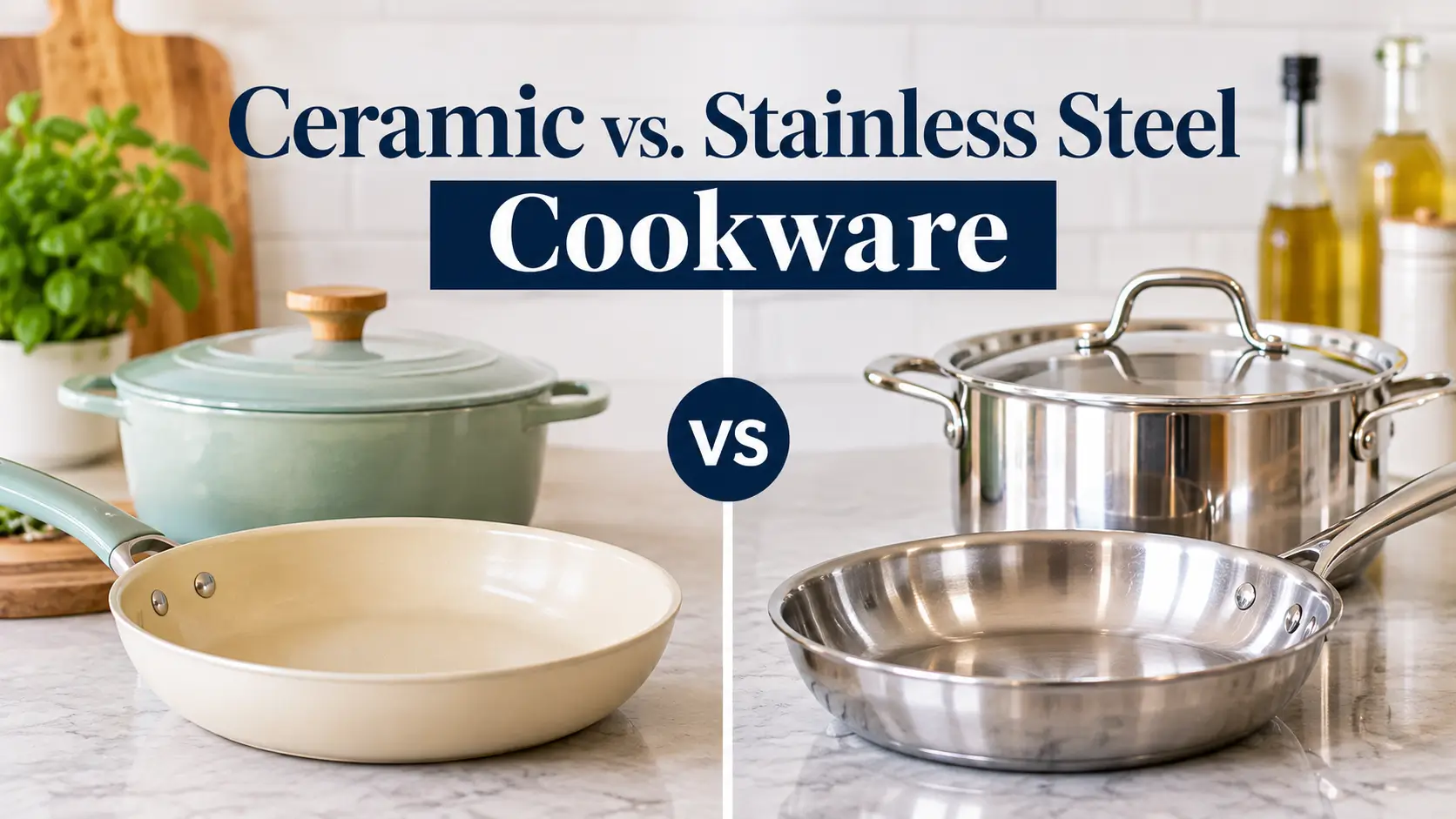
Choosing between ceramic and stainless steel cookware sounds simple until you start comparing product labels. One pan promises effortless food release; another promises decades of service.
Then come the claims about non-toxic materials, PFAS, aluminum, nickel and “healthy” cooking. Which differences actually matter?
For most kitchens, stainless steel is the better all-purpose and long-term investment.
It handles searing, browning, simmering and acidic sauces, and a well-made pan can last for many years. Ceramic-coated cookware is more convenient for foods that tend to stick, especially eggs and delicate fish, but its nonstick performance gradually wears down.
The healthiest choice is not decided by the word “ceramic” or “stainless” on the box; construction, coating chemistry, cooking habits and individual sensitivities matter.
There is one distinction to make before comparing them: most modern “ceramic cookware” is not a solid ceramic pot. It is usually an aluminum or other metal pan covered with a thin ceramic-like nonstick coating.
This guide explains that difference, compares real cooking performance and looks carefully at the health and toxicity questions without treating marketing claims as scientific proof.
Recommended Ceramic and Stainless Steel Cookware Sets


Ceramic vs. Stainless Steel Cookware: Quick Comparison
| Feature | Ceramic-coated cookware | Stainless steel cookware |
|---|---|---|
| Cooking surface | Ceramic-like sol-gel nonstick coating over a metal body | Uncoated stainless steel cooking surface |
| Food release | Very good when new; declines with wear | Food can stick without correct preheating and fat |
| Best cooking tasks | Eggs, pancakes, delicate fish and quick low-to-medium-heat cooking | Searing, browning, sautéing, pan sauces, boiling and simmering |
| High heat | Generally better at low to medium heat; follow the maker’s temperature limit | Well suited to high-heat cooking within the pan and handle limits |
| Durability | Coating gradually loses its release properties | Very durable; surface can scratch or discolor but does not rely on a nonstick film |
| Metal exposure | Depends on coating integrity and the metal body beneath it | Small amounts of nickel and chromium can migrate under some conditions |
| Cleaning | Usually easy while the coating is in good condition | May need soaking or deglazing for stuck-on food |
| Utensils | Use the utensils recommended by the manufacturer; avoid damaging the coating | Metal utensils are generally acceptable, though they can mark the surface |
| Induction | Only if the base contains a compatible magnetic layer | Only if the steel construction includes a magnetic grade/base |
| Long-term value | Often needs replacement when food release deteriorates | Usually stronger for long-term everyday use |
The short answer: Choose stainless steel if you want cookware for nearly everything and expect it to last.
Choose ceramic-coated cookware if easy food release is your priority and you are comfortable replacing the pan when its coating wears.
Many home cooks are best served by using both: stainless steel pots and pans for most meals, plus one small ceramic-coated skillet for eggs.
- Easy food release for eggs, pancakes and delicate fish, especially when the coating is new.
- Usually needs less oil for foods that tend to stick.
- Quick cleanup when the cooking surface is in good condition.
- Many products are sold with clearly stated PTFE-free or PFAS-free coating claims; check the exact product.
- The nonstick surface gradually loses its release performance with use.
- Generally less suited to high-heat searing and prolonged high-temperature cooking.
- The coating needs gentler utensils and cleaning to reduce wear.
- Usually needs replacing sooner than a well-made stainless steel pan.
What Is Ceramic Cookware?
The term “ceramic cookware” is used for more than one product. It can describe solid ceramic vessels, ceramic bakeware, or metal cookware finished with a ceramic-like nonstick coating. Those products have different properties, so it is important to know which one you are buying.
Ceramic-coated cookware
Most ceramic nonstick frying pans and cookware sets sold today have a metal body, often aluminum, with a thin coating made through a sol-gel process.
The coating is commonly based on silica and related compounds that form a hard, glass-like surface. It provides food release without using a traditional PTFE nonstick layer, but the exact formulation varies by brand and product.
The aluminum body is important. Aluminum transfers heat efficiently, while the coating provides the cooking surface.
A pan described as ceramic does not automatically have a ceramic body, and it does not automatically heat better or more evenly than every stainless steel pan.
The base thickness and construction determine much of the heat performance.
Solid ceramic cookware
Solid ceramic cookware is made from ceramic material rather than a metal pan with a thin coating. It is a different category from ceramic nonstick skillets.
Its weight, heat response, durability, and suitability for a particular stovetop depend on the product.
Check the manufacturer’s instructions before using solid ceramic cookware on a burner, under a broiler, or in an oven; not every ceramic vessel is designed for every heat source.
What Is Stainless Steel Cookware?
Stainless steel cookware has a metal cooking surface made from a corrosion-resistant steel alloy.
Common cookware grades include 304 (often marketed as 18/8 or 18/10) and other grades selected for their corrosion resistance and magnetic properties.
The numbers 18/10 refer approximately to chromium and nickel percentages in the alloy; they are not a guarantee of a particular pan’s overall quality.
Stainless steel cookware is often made in one of two constructions. A disc-bottom pan has a thick heat-conducting base, commonly with an aluminum or copper layer, attached to the bottom.
Fully clad cookware sandwiches an aluminum or copper core between layers of stainless steel, sometimes extending the conductive core up the sides. Both can work well.
Fully clad construction generally spreads heat over more of the pan, while a well-designed disc base can offer excellent value.
Stainless steel is not naturally nonstick. Food can attach to the surface if the pan is too cool, too hot, overcrowded, or not properly prepared. With a little technique, however, it is excellent for browning and building flavor.
10 Important Differences Between Ceramic and Stainless Steel Cookware
1. Nonstick performance and food release
This is the most noticeable difference during everyday cooking. A new ceramic-coated pan releases eggs, pancakes and tender fish with relatively little effort. That convenience is the main reason people choose it. It can make breakfast easier and reduce the amount of oil needed for some recipes.
Stainless steel requires a different approach. Preheat the pan gradually, add cooking fat, and give food time to release naturally before turning it. Proteins often stick at first and loosen as a browned crust forms.
This technique takes practice, but it also makes it easier to develop fond—the browned bits that add flavor to a pan sauce.
There is an important catch: ceramic nonstick performance is not permanent.
A 2024 comparative study of commercial coatings found that the tested fluoropolymer coatings released food more effectively than the tested sol-gel ceramic coatings, with ceramic performance varying by formulation.
A 2025 study also found meaningful differences in how individual ceramic coatings retained their nonstick properties through repeated use.
These studies do not test every pan on the market, but they show why “ceramic” alone is not a performance guarantee.
2. Heat distribution and temperature control
Neither material automatically guarantees even heating. A thin aluminum pan can develop hot spots; a thin stainless steel pan can do the same. What matters is the body beneath the cooking surface.
Many ceramic-coated pans use aluminum because it heats quickly and spreads heat reasonably well. Stainless steel cookware can also perform very well when it has an aluminum or copper core.
For an everyday pan, look for a substantial base and clear construction details rather than choosing by surface material alone.
Stainless steel is generally more forgiving for recipes that move from stovetop browning to oven finishing, provided the handles, lid and pan are rated for the temperatures involved.
Ceramic-coated pans should be used within the maker’s stated heat limits. Repeatedly heating an empty nonstick pan or using maximum burner settings can shorten coating life.
3. Durability and lifespan
Stainless steel wins for long-term durability. Its cooking surface is part of the pan rather than a nonstick layer that must retain its release properties.
It can develop scratches, heat tint, stains or discoloration, but these usually affect appearance more than basic function. A quality stainless steel pan can remain useful for many years.
Ceramic-coated cookware has a limited working life. The surface can lose its easy-release quality through repeated heating, cleaning, abrasion and normal wear. A pan may still be structurally sound even after eggs begin sticking.
That is why a ceramic pan can look perfectly acceptable but no longer perform like it did when new.
4. Health, safety and toxicity
Neither material should be described as automatically “toxic” or automatically “non-toxic.” A more useful comparison looks at what touches the food, how the pan is used and whether the user has a relevant sensitivity.
A properly manufactured, intact ceramic sol-gel coating is designed for food contact, but the word ceramic is not a complete ingredient list.
Formulations differ, and broad claims such as “chemical-free” are not meaningful: all materials are made of chemicals.
Look for clear manufacturer information about the coating, food-contact compliance in the market where the pan is sold, and care instructions. Avoid pans with badly damaged, flaking or deteriorating surfaces.
Stainless steel is widely used for food preparation, but studies show that small amounts of nickel and chromium can migrate into food under certain conditions.
Migration tends to be higher with new cookware, acidic foods, longer cooking times and some steel grades.
A 2017 study of 18/10 grade 316 pots found that measured releases during its tested everyday cooking conditions were below known allergy-triggering thresholds for most people, while noting that highly sensitive individuals may still need to be cautious.
That is a more accurate conclusion than saying all stainless steel cookware is dangerous—or that no metal can ever migrate.
For most people, good-quality stainless steel and intact, reputable ceramic-coated cookware can both be reasonable choices when used according to instructions.
If you have a diagnosed nickel allergy or a history of reactions to nickel-containing foods, discuss cookware choices with a qualified healthcare professional rather than relying on a general product label.
5. PFAS, PTFE and the meaning of “PFOA-free”
These terms are often mixed together in cookware marketing, but they do not mean the same thing. PTFE is a fluoropolymer used in many traditional nonstick coatings.
PFOA was historically used in the manufacture of some fluoropolymers but is not the nonstick coating itself. PFAS is a broad family of substances that includes many different compounds.
Many ceramic-coated pans are marketed as PTFE-free or PFAS-free, but check the exact product specification and the scope of the claim.
“PFOA-free” by itself does not mean “PTFE-free” or “PFAS-free.” If avoiding fluorinated coatings is important to you, look for an explicit statement about PTFE and PFAS, not just PFOA.
The U.S.
Food and Drug Administration explains that certain PFAS are authorized for nonstick food-contact applications in the United States and that the polymerized coatings used on pots and pans are tightly bound to the cookware, with available studies showing negligible migration of PFAS from those coatings to food.
That is a statement about specific authorized applications and available evidence, not a blanket guarantee about every coating or every product worldwide.
It is also separate from the question of whether a consumer prefers to avoid PFAS as a precaution.
6. Cooking acidic foods
Stainless steel is a practical choice for tomato sauce, lemon-based dishes, wine reductions and other acidic recipes. It is nonreactive enough for normal cooking, although metal migration can increase with prolonged contact, particularly in new cookware and under more acidic conditions.
Ceramic-coated cookware can also be useful for acidic foods while its coating is intact, but a nonstick skillet is rarely the best tool for a long-simmered sauce. A stainless steel saucepan or Dutch oven is usually more versatile for that job.
7. High-heat searing and browning
Stainless steel is the better choice for searing steak, browning chicken, sautéing mushrooms and developing a flavorful crust.
It can tolerate the higher cooking temperatures commonly used for these tasks, within the manufacturer’s limits, and the browned bits left in the pan can be turned into a sauce.
Ceramic nonstick pans are better treated as low-to-medium-heat cookware. High heat can shorten the life of the coating and is unnecessary for most foods cooked on a nonstick surface. If you regularly cook over high heat, stainless steel is the more sensible main pan.
8. Cleaning and maintenance
Ceramic-coated pans are usually easier to clean when the coating is new and in good condition.
Let the pan cool, wash it with a soft sponge and mild dish soap, and avoid abrasive pads unless the manufacturer specifically permits them. Even if a product is labeled dishwasher-safe, hand-washing can help preserve its finish.
Stainless steel can need more work when food sticks, but it is also more tolerant of scrubbing. Soak the pan, add water and gently simmer to loosen stuck-on residue, or deglaze it while cooking.
Stainless steel can develop rainbow-like heat tint or mineral spots; these are usually cosmetic and can often be removed with a suitable stainless steel cleaner.
9. Price and long-term value
Entry-level ceramic-coated pans can be inexpensive, and premium ceramic sets can cost considerably more. The price does not remove the basic limitation that the nonstick surface will gradually wear. Consider ceramic a convenience purchase rather than a lifetime investment.
Stainless steel ranges from budget disc-bottom cookware to expensive multi-ply sets. A well-made midrange pan can offer better lifetime value than repeatedly replacing nonstick skillets.
You do not need to buy a large set immediately; one good skillet and one saucepan can cover a surprising number of meals.
10. Induction compatibility
Induction cooktops require a magnetic layer in the cookware base. Stainless steel is not automatically induction-compatible because some stainless alloys are not magnetic. Many stainless pans are designed for induction, but check the product specification or test the base with a magnet.
Ceramic is not what makes a pan induction-ready. A ceramic-coated pan works on induction only when its metal base includes a compatible magnetic layer. Look for the induction symbol or an explicit compatibility statement before buying.
Which Is Healthier: Ceramic or Stainless Steel Cookware?
There is no universal winner based only on the material name.
Ceramic-coated cookware avoids a PTFE cooking surface when the manufacturer explicitly confirms that it is PTFE-free, which may appeal to people who want to avoid fluoropolymer nonstick coatings.
Stainless steel has no nonstick coating to wear away, but it can release small amounts of metals under certain cooking conditions.
For a typical home cook without a relevant metal sensitivity, both can be suitable when the cookware is well made and used correctly.
If you want to minimize uncertainty, focus on transparent product specifications, a sound cooking surface, sensible heat levels and the intended use of each pan.
No pan should be overheated empty or used after its cooking surface has become badly damaged.
For people with significant nickel sensitivity, stainless steel deserves extra consideration because nickel can be part of the alloy and may migrate into food.
The amount varies with grade, pan condition, food acidity and cooking time. A clinician or dietitian familiar with nickel sensitivity can help decide whether a different material is appropriate.
Ceramic-Coated vs. Stainless Steel Cookware: Which Is Better for Different Foods?
| Food or cooking task | Better choice | Why |
|---|---|---|
| Fried or scrambled eggs | Ceramic-coated | Easy release with little sticking, especially when the pan is new |
| Pancakes and crepes | Ceramic-coated | Convenient release and quick cleanup |
| Steak and burgers | Stainless steel | Better suited to high-heat browning and fond |
| Chicken thighs or cutlets | Stainless steel | Good browning and pan-sauce potential |
| Delicate fish | Ceramic-coated | Less likely to tear during turning, provided the surface is in good condition |
| Tomato sauce | Stainless steel | Versatile for simmering and acidic ingredients |
| Vegetables | Either | Depends on whether you want easy release or browning |
| Pan sauces and deglazing | Stainless steel | Browned bits can be lifted from the pan to build flavor |
| Long simmering | Stainless steel | More versatile for extended stovetop cooking |
Ceramic vs. Stainless Steel vs. Traditional Nonstick Cookware
Traditional nonstick usually refers to cookware coated with PTFE, while ceramic nonstick generally refers to a sol-gel coating. Both are designed to release food easily, but their performance and care requirements differ.
| Type | Main advantage | Main limitation | Best use |
|---|---|---|---|
| Ceramic-coated | Easy food release; many products are marketed as PTFE-free | Release performance can decline with use | Eggs, pancakes and delicate foods |
| PTFE nonstick | Very effective food release and low-effort cleanup | Needs careful temperature control and a sound coating | Eggs, fish and low-to-medium-heat cooking |
| Stainless steel | Durability, versatility and browning | Requires cooking technique to limit sticking | Everyday cooking, searing and sauces |
Independent coating studies have found that the tested PTFE coatings generally maintained stronger nonstick performance than the tested ceramic sol-gel coatings over repeated cycles.
That does not mean every PTFE pan is better than every ceramic pan, but it does challenge the idea that ceramic is automatically the more durable nonstick option.
Follow the manufacturer’s instructions for any coated pan, and replace it when the coating is visibly deteriorating or no longer performs as intended.
Aluminum vs. Stainless Steel vs. Ceramic Cookware
These materials are not always competing categories. Aluminum is often the metal body beneath ceramic nonstick cookware, and it is also used as the heat-conducting core inside stainless steel cookware.
- Aluminum: Lightweight and an efficient heat conductor. It is often anodized, coated or built into a layered pan. Bare aluminum can react with some acidic or salty foods, so the surface treatment and product construction matter.
- Stainless steel: Durable and corrosion-resistant, but not as conductive as aluminum or copper. Multi-layer construction improves heat distribution while keeping stainless steel in contact with food.
- Ceramic-coated: Usually describes the nonstick surface rather than the body metal. Check what the pan underneath the coating is made from.
For even heating, compare the pan’s thickness and layered construction. A well-designed aluminum-core stainless steel pan can distribute heat more evenly than a thin ceramic-coated pan, while a heavy-gauge aluminum pan with a quality coating can also perform well.
Ceramic vs. Cast Iron vs. Stainless Steel Cookware
Cast iron belongs in this comparison because it offers a different combination of heat retention and surface behavior. It is heavy, holds heat well and can develop a naturally slick seasoning layer when maintained properly.
It is excellent for searing and oven cooking, but it needs drying and occasional seasoning, and acidic foods can be challenging in a poorly seasoned pan.
Stainless steel is easier to maintain and more versatile for acidic sauces. Ceramic-coated cookware is easier for delicate foods but has a shorter-lived nonstick surface.
If you enjoy high-heat cooking, cast iron and stainless steel are stronger choices than ceramic nonstick. If you want an easy egg pan, ceramic-coated cookware is convenient.
What About Granite and Titanium Cookware?
“Granite cookware” is often a marketing term for a speckled nonstick coating. It does not necessarily mean the pan is made from granite stone.
Some granite-style pans use PTFE-based coatings, while others use different nonstick formulations. Read the manufacturer’s material and coating details instead of assuming the word granite identifies a specific chemistry.
“Titanium cookware” can also mean different things. Some products are made from titanium metal, while others are aluminum or another metal with a titanium-reinforced nonstick coating.
Titanium reinforcement does not mean the pan’s cooking surface is solid titanium. Compare the actual body material, coating and care instructions.
In other words, ceramic, granite and titanium labels can describe a finish, reinforcement or base material. They are not always direct alternatives to stainless steel.
How to Choose a Ceramic or Stainless Steel Cookware Set
Before buying a full set, think about the pans you actually use. A large set can look like better value but may include duplicate sizes or pieces that rarely leave the cupboard. Start with a skillet, saucepan and larger pot that match your cooking habits.
What to look for in ceramic-coated cookware
- Clear disclosure that the cooking surface is ceramic-based and whether the product is explicitly PTFE-free or PFAS-free, if those claims matter to you.
- A sturdy metal body and a base compatible with your cooktop.
- Specific oven-temperature and dishwasher guidance.
- Care instructions that explain which utensils and cleaning tools are permitted.
- A realistic warranty and accessible replacement options.
What to look for in stainless steel cookware
- Clear construction details, such as tri-ply or five-ply cladding, or a thick encapsulated base.
- A magnetic base if you use an induction cooktop.
- Comfortable, securely attached handles and well-fitting lids.
- A cooking surface and alloy specification disclosed by the manufacturer.
- Oven and broiler limits that match the way you cook.
For a closer look at a premium stainless steel alternative, read our All-Clad Copper Core cookware review, which examines the construction and performance of one of the brand’s higher-end lines.
Recommended Ceramic and Stainless Steel Cookware Sets
A full ceramic-coated set for cooks who want easy food release
This set includes three frypans, two saucepans, a sauté pan, a stockpot and a grill pan. It is listed as induction-compatible and oven-safe to 600°F, with lids rated to 425°F. GreenPan describes the Thermolon coating as PFAS-free. As with any ceramic nonstick surface, follow the care instructions to help preserve food release.
A ceramic-coated set for everyday low-to-medium-heat cooking
The listed set includes three frying pans, two saucepans, a Dutch oven and trivets. Its ceramic-coated aluminum body is designed for quick, even heating, and the manufacturer states that the coating is made without PFAS. This version is specified for gas, electric and glass cooktops, so it is not the right choice if you need induction compatibility.
A durable fully clad set without the premium All-Clad price
This 12-piece set combines stainless steel with an aluminum core for heat distribution. The listing specifies induction compatibility, oven safety to 500°F and a lifetime warranty. It is a sensible starting point for buyers who want stainless steel for searing, sauces and everyday cooking.
A premium fully bonded tri-ply set for frequent home cooks
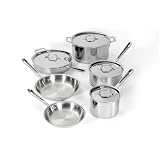
The D3 set has stainless steel layers around an aluminum core and includes two frypans, two saucepans, a sauté pan and a stockpot. It is induction-compatible and oven- and broiler-safe to 600°F. It costs considerably more than the value picks, and All-Clad recommends hand-washing.
A design-focused ceramic set with storage accessories
Caraway’s set includes a 10.5-inch frying pan, 3-quart saucepan, 4.5-quart sauté pan and 6.5-quart Dutch oven, along with magnetic pan racks and a lid holder. The ceramic-coated cooking surface is designed for easy food release, and the listing states that the cookware is made without PFAS, PFOA, lead or cadmium. It is a premium-priced option, so its strongest appeal is the combination of appearance, storage and convenient nonstick cooking. Use moderate heat and follow the care instructions to preserve the coating.
A smaller fully clad set for kitchens that do not need 12 pieces
This set includes two frying pans, two covered saucepans and a covered Dutch oven. Its tri-ply construction sandwiches an aluminum core between stainless steel layers, helping distribute heat across the cooking surface. It works on induction, gas and electric cooktops and is a sensible choice if you want durable stainless steel without buying a larger set. Check the current listing for the exact included pieces and care guidance.
Fully clad tri-ply construction at a more approachable price than premium sets
The MultiClad Pro uses a pure aluminum core bonded between stainless steel layers, extending through the sides for more even heating than a basic disc-bottom design. It is a strong alternative to premium fully clad cookware for home cooks who want stainless steel versatility without paying All-Clad prices. Compare the included pieces and current warranty details before choosing between this set and Tramontina.
How These Ceramic and Stainless Steel Sets Compare
| Cooking surface | Set size | Induction | Oven rating | Best for | ||
|---|---|---|---|---|---|---|

GreenPan Valencia Pro
Ceramic overall
|
Ceramic nonstick | 11 pieces | 600°F (lids 425°F) | Versatile ceramic set | View current price | |

Caraway 12-Piece
Premium ceramic
|
Ceramic nonstick | 12 pieces | 550°F | Premium design and storage | View current price | |
Calphalon Ceramic
Ceramic value
|
Ceramic nonstick | 12 pieces | 450°F | Gas/electric kitchens | View current price | |

Tramontina 12-Piece
Stainless value
|
Stainless steel | 12 pieces | 500°F | Everyday stainless value | View current price | |

Tramontina 8-Piece
Compact stainless
|
Stainless steel | 8 pieces | 500°F | Smaller kitchens | View current price | |

Cuisinart MultiClad Pro
Midrange stainless
|
Stainless steel | 12 pieces | 500°F | Fully clad value | View current price | |
All-Clad D3
Premium stainless
|
Stainless steel | 10 pieces | 600°F | Premium construction | View current price |
If you are comparing complete sets, see our guide to the best cookware sets, including stainless steel, ceramic and nonstick options. Compare the pieces included and the construction of each pan rather than choosing by the number of items in the box.
How to Make Ceramic-Coated Cookware Last Longer
Ceramic nonstick cookware lasts longer when it is not treated like stainless steel. Use low or medium heat for most cooking, avoid preheating an empty pan for extended periods, and add a little oil when the recipe calls for it.
Let the pan cool before washing, use a soft sponge, and avoid stacking pans without a protector between them. Follow the specific maker’s instructions, since temperature limits and utensil guidance differ.
Do not continue using a pan if its coating is flaking or visibly breaking down. Scratches do not all mean the same thing, but deep damage, peeling or exposed underlying material are good reasons to retire it rather than trying to restore the nonstick surface.
How to Cook with Stainless Steel Without Food Sticking
Stainless steel becomes easier to use once you understand temperature and timing. Start with a clean, dry pan and preheat it over medium or medium-low heat. Add oil or another suitable cooking fat and let it warm.
Add food when the pan is ready, but do not crowd it; overcrowding lowers the temperature and encourages steaming.
When searing meat or fish, resist the urge to move it immediately. Food often releases more easily after a browned crust forms. If it is firmly stuck, give it a little more time rather than forcing it.
For eggs, use moderate heat, enough fat and a pan that is properly preheated; if you want the easiest possible release, keep a small nonstick skillet for that task.
What Do Home Cooks Say About Ceramic vs. Stainless Steel?
In online cooking discussions, the same practical trade-off comes up repeatedly: stainless steel is valued for longevity, browning and versatility, while ceramic-coated pans are appreciated for quick cleanup and easy eggs.
The experiences are not identical because pan quality, cooking technique and expectations differ.
A ceramic pan that is used gently for breakfast may remain useful for quite a while; one used daily over high heat and cleaned abrasively may lose its release much sooner.
These personal experiences can help identify everyday frustrations, but they are not controlled tests of coating chemistry or health risk.
When a discussion makes a safety claim, look for the product’s exact coating information and independent research rather than treating an individual comment as proof.
Is ceramic cookware better than stainless steel?
For most kitchens, stainless steel is the stronger main cookware choice, with ceramic as a useful specialty pan.
Which is healthier, ceramic or stainless steel cookware?
Stainless steel is also widely used, but small amounts of nickel and chromium can migrate into food under certain conditions. People with significant nickel sensitivity should seek individualized advice.
Is ceramic cookware toxic?
Choose a reputable product with clear food-contact and coating information, use it within its temperature limits, and stop using it if the coating is peeling or badly damaged.
Does ceramic cookware contain PFAS or PTFE?
Many ceramic nonstick pans are marketed as PTFE-free and PFAS-free, but do not assume every product has the same formulation. Check the exact manufacturer statement. PFOA-free alone does not establish that a pan is PTFE-free or PFAS-free.
Does stainless steel cookware leach nickel?
Research on 18/10 stainless steel found that releases under tested everyday conditions were below known allergy-triggering thresholds for most people, though highly sensitive individuals may need extra care.
Can you cook tomatoes in stainless steel?
If you have a significant nickel sensitivity, ask a healthcare professional about your cookware options.
Is ceramic cookware safe when scratched?
A light surface mark does not necessarily mean a pan is unsafe, but deep scratches, peeling or flaking indicate that the coating is deteriorating. Follow the manufacturer’s replacement guidance and do not keep using a pan with a visibly breaking-down cooking surface.
Can ceramic-coated cookware be used on induction?
Yes, if the pan has a magnetic base designed for induction. The ceramic coating itself does not make cookware induction-compatible. Check the product specifications before buying.
Is stainless steel better than ceramic for everyday cooking?
For a single pan that needs to handle many jobs, stainless steel is generally better. It can sear, brown, sauté, simmer and move from stovetop to oven when rated for it. Ceramic-coated cookware is more convenient for delicate foods but is less suited to high heat and has a limited coating life.
Should I buy a ceramic or stainless steel cookware set?
Choose stainless steel for a main cookware set if you want long-term versatility. Choose a ceramic-coated set if easy-release cooking is your highest priority and you are comfortable with more careful maintenance and eventual replacement. A mixed collection is often the most practical option.
Final Verdict: Ceramic or Stainless Steel—Which Should You Buy?
For most home kitchens, stainless steel is the better overall cookware choice. It is durable, versatile, suitable for high-heat browning and useful for everything from vegetables to sauces.
A well-constructed stainless steel pan can serve you for many years, making it a sensible foundation for a cookware collection.
Ceramic-coated cookware is worth having when convenience matters most. It is particularly useful for eggs, pancakes and delicate foods that are frustrating in an uncoated pan.
Just remember that its nonstick performance gradually declines, so it should not be treated as a lifetime purchase or routinely exposed to high heat.
If you are starting from scratch, buy a good stainless steel saucepan and skillet first, then add one ceramic-coated frying pan if you regularly cook foods that need easy release.
That combination offers the durability of stainless steel without giving up the convenience of a nonstick surface when you need it.
Sources and Further Reading
- U.S. Food and Drug Administration: Authorized Uses of PFAS in Food Contact Applications.
- Guarneri et al. (2017): Release of nickel and chromium in common foods during cooking in 18/10 stainless steel pots, Contact Dermatitis.
- Kamerud et al. (2013): Stainless Steel Leaches Nickel and Chromium into Foods During Cooking, Journal of Agricultural and Food Chemistry.
- Guerrero-Vacas et al. (2024): Evaluation of the effectiveness and durability of commercial non-stick coatings, Journal of Food Engineering.
- Guerrero-Vacas et al. (2025): Towards a greener kitchen: Can sol-gel ceramic non-stick coatings replace polytetrafluoroethylene?, Results in Engineering.