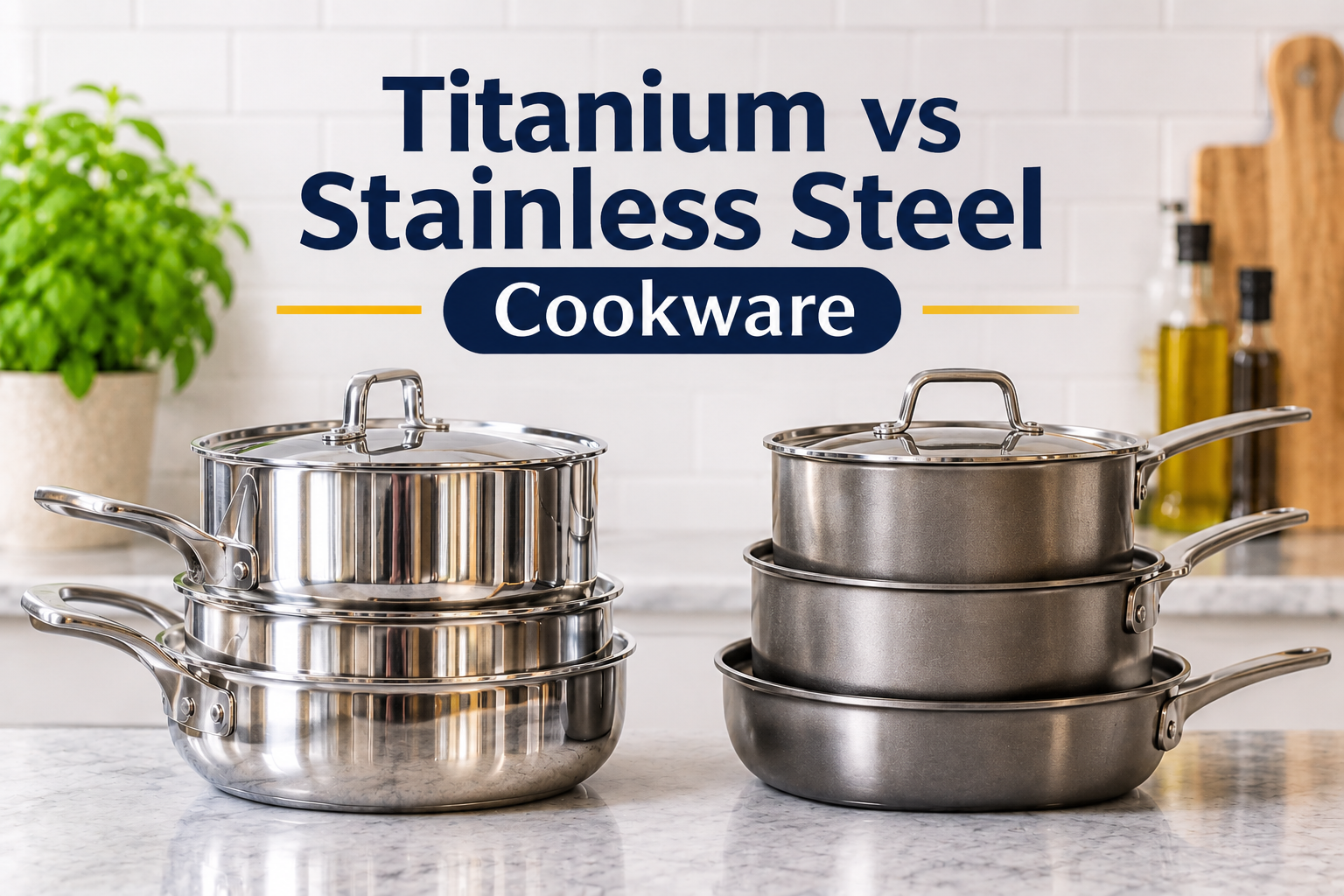
Titanium cookware is lighter and highly corrosion-resistant, while stainless steel is usually more versatile and better value for everyday cooking.
But the label “titanium” can describe very different products: a bare titanium cooking surface, a titanium-treated surface, or ordinary nonstick cookware reinforced with titanium.
This comparison focuses on what actually touches the food, how the pan is constructed, what the available safety research does and does not show, and whether titanium’s advantages justify its usually higher price. One important point from the start: neither bare titanium nor uncoated stainless steel is naturally nonstick.
Quick verdict: For most home kitchens, fully clad stainless steel is the more practical buy. Titanium is worth considering when low weight, a nickel-free food-contact surface or corrosion resistance is a specific priority—not simply because the word titanium sounds more advanced.
Titanium vs Stainless Steel Cookware: Quick Comparison
| Factor | Titanium | Stainless steel |
|---|---|---|
| Density of common material grades | About 4.51 g/cm³ for commercially pure Grade 2 titanium | About 8.0 g/cm³ for 304 stainless steel |
| Weight at equal material volume | About 44% lighter than 304 stainless steel | About 77% heavier than titanium |
| Food-contact surface | May be bare titanium—or a coating marketed with titanium | Usually stainless steel, often 18/10 or 18/8 |
| Food release | Not naturally nonstick | Not naturally nonstick |
| Thermal conductivity (typical values) | About 16–17 W/m·K for Grade 2 titanium | About 16 W/m·K for 304 stainless steel |
| Heat distribution in a pan | Needs thoughtful thickness or a conductive core | Clad aluminum or copper cores improve performance |
| Corrosion resistance | Excellent | Excellent in normal use, but can pit |
| Nickel | Pure titanium contains no nickel | Many common grades contain nickel |
| Induction | Needs a magnetic base | Depends on grade and base |
| Price | Usually higher | Wide range, often better value |
What the Material Numbers Actually Tell You
The weight difference is real, but it needs context. Commercially pure Grade 2 titanium has a density of about 4.51 g/cm³, while 304 stainless steel is about 8.0 g/cm³. Compare equal volumes and titanium weighs roughly 44% less.
That is a material-level comparison—not a promise that a finished titanium frying pan will weigh 44% less than a similarly sized stainless pan.
Heat conduction is a much closer contest. The Grade 2 titanium datasheet reports typical conductivity around 16–17 W/m·K, while the 304 stainless-steel datasheet gives a typical value around 16 W/m·K. Exact values vary with grade and condition, but neither metal is a fast heat spreader.
What this means in the kitchen: Titanium’s clearest material advantage is lower density, not dramatically faster or more even heating. A well-designed pan’s core, thickness and construction matter more to cooking performance than the name of its outer metal.
What Does “Titanium Cookware” Actually Mean?
Before comparing safety or performance, identify what the pan is made of. The term can describe several different products:
- Bare titanium cooking surface: Food touches titanium metal. The pan may still have an aluminum core or stainless exterior.
- Titanium-reinforced nonstick: A conventional nonstick coating is reinforced or marketed with titanium. The food-contact surface is still a coating, not bare titanium.
- Titanium-treated stainless: The pan is fundamentally stainless steel with a surface treatment.
- Titanium camping cookware: Usually very thin and light, designed mainly for boiling water and simple camp meals rather than everyday frying.
Check the exact food-contact material, core, exterior and whether a coating is present. A product title that simply says “titanium” does not tell you enough.
These two examples illustrate different ways manufacturers build titanium into cookware: one uses a titanium interior in a tri-ply pan, while the other bonds a molecular titanium surface to a stainless-steel body.
Titanium Cookware Pros and Cons
- A genuine bare titanium cooking surface has no polymer nonstick coating to peel or wear away.
- Titanium is highly corrosion-resistant and performs well in contact with many foods.
- Commercially pure titanium is much lighter than 304 stainless steel at the same material volume.
- Commercially pure titanium contains no intentionally added nickel, which may matter to buyers avoiding nickel at the food-contact surface.
- A well-designed titanium-surface pan can combine the titanium cooking surface with an aluminum core for better heat spreading.
- Bare titanium is not naturally nonstick; eggs and other delicate foods can stick without suitable preheating, fat and technique.
- Titanium conducts heat at roughly the same low rate as common stainless steel, so pan construction and any aluminum core matter.
- Genuine titanium-surface cookware is often more expensive than conventional stainless steel.
- A finished pan is not automatically lightweight: its core, magnetic base, thickness and handle add weight.
- Pure titanium is not magnetic, so a titanium pan needs a compatible magnetic base to work on induction.
- The word titanium is used for different products, including titanium-reinforced nonstick coatings; the label alone does not identify the food-contact surface.

A titanium-surface pan with fully clad tri-ply construction
The most direct titanium-focused example in this comparison. Our Place describes a titanium interior combined with stainless steel and aluminum. Its coating-free nonstick claims are manufacturer claims, so buyers should still review the cooking and care guidance rather than expect conventional coated-pan behavior.

A titanium food-contact surface bonded to a stainless-steel body
Hestan describes NanoBond as stainless-steel cookware with a molecular titanium cooking surface. That distinction matters: it is not a solid titanium pan, but neither is it simply a conventional stainless skillet with a generic titanium-colored coating. Hestan states that its titanium cooking surface is made without nickel, PFAS, lead or cadmium; those are manufacturer specifications, not independent clinical proof. It is a premium option for shoppers interested in a titanium food-contact surface with stainless-steel construction.
Titanium vs Stainless Steel: Cooking Performance
Heat distribution and temperature control
Pure titanium and common austenitic stainless steel conduct heat at broadly similar, relatively low rates. Typical figures are around 16–17 W/m·K for commercially pure Grade 2 titanium and roughly 16 W/m·K for 304 stainless steel. Both are far behind aluminum, which is why a thin single-layer pan made from either metal can develop hot spots.
This is where pan construction changes the comparison. Fully clad stainless cookware sandwiches a conductive aluminum or copper core between stainless layers. Some titanium-surface pans also use an aluminum core. In those designs, the core does much of the heat-spreading work; the surface metal is what contacts the food.
Do not buy a titanium pan expecting it to heat dramatically faster or more evenly than stainless steel. Compare the core, thickness, base design and how far the conductive layer extends up the sides.
Is titanium or stainless steel more nonstick?
Neither bare titanium nor uncoated stainless steel is naturally nonstick. Eggs, fish and delicate foods can stick if the pan is too cold, too hot or used without enough fat. A textured surface does not automatically make a bare-metal pan equivalent to a coated nonstick pan.
For either material, preheat gradually, add oil or butter, let it warm and allow food to release before trying to move it. Stainless steel is particularly useful for developing browned bits for pan sauces.
A bare titanium pan also takes practice; do not buy one expecting effortless egg release unless the model has a separate nonstick coating.
Which is better for searing?
A substantial, fully clad stainless skillet is a dependable searing choice because its mass helps it hold temperature when food is added, while the aluminum core spreads heat. A lighter titanium-surface pan can sear too, but a thin pan may lose more temperature when you add a cold steak or crowd the cooking surface.
For browning, the finished pan matters more than the metal’s reputation. Look at pan weight, thickness, base diameter and core construction. The All-Clad D3 is a useful conventional stainless benchmark: its tri-ply design uses an aluminum core between stainless layers.
It is not the only way to build a good pan, but it illustrates why comparing only the food-contact metals misses an important part of the story.

A familiar tri-ply stainless skillet with an aluminum core
A useful benchmark for traditional stainless cookware. Its aluminum core helps spread heat between stainless-steel layers, illustrating why pan construction matters more than comparing the metals in isolation. It is versatile for searing, sautéing and pan sauces, but still requires proper preheating and cooking technique.
Titanium vs Stainless Steel Cookware: Health Risks and Safety
There is no strong clinical evidence showing that cooking with titanium instead of stainless steel improves health outcomes for the general population. The more useful question is what the food-contact surface is made of and what research says about substances that may migrate into food during normal use.
Is titanium cookware safe?
Commercially pure titanium is highly corrosion-resistant because it forms a stable, protective oxide layer. The Council of Europe’s 2024 technical guide on metals and alloys used in food-contact materials describes titanium as practically inert under the guide’s assessment framework.
The guide does not set a specific release limit for titanium in the same way it does for certain other metals.
That is reassuring material-level guidance, but it is not a blanket certification of every product sold as titanium cookware. A finished pan may combine titanium with stainless steel, aluminum, coatings, adhesives or other components.
The guide also should not be misread as proof that no titanium can ever migrate under every possible condition.
The guide also should not be misread as proof that no titanium can ever migrate under every possible condition.
For buyers, the sensible approach is to verify the actual food-contact surface, buy from a manufacturer that identifies its materials clearly, and follow the care instructions. A pan marketed as “titanium-reinforced nonstick” is not the same thing as an uncoated titanium cooking surface.
Can stainless steel release nickel and chromium into food?
Many common stainless cookware grades contain chromium and nickel. In 304 stainless steel, for example, nickel is commonly present at around 8–10.5%, while chromium helps create the passive surface layer that resists corrosion. The presence of these metals in the alloy does not mean the same amount transfers to food.
The 2013 study by Kamerud, Hobbie and Anderson found that cooking tomato sauce in stainless steel increased nickel and chromium concentrations.
In their tests, the amount released depended on the steel grade, cooking time and previous use; new cookware and longer cooking produced higher release.
The 2017 study examined 18/10 (grade 316) stainless pots under more everyday cooking conditions, including tomato sauce and lemon marmalade cooked for one hour.
Nickel and chromium release increased with time, low pH and unused pots, but the measured amounts were below known allergy-triggering thresholds in the experiments.
These studies are not contradictory so much as different in cookware grade, recipe, duration and test conditions. They show that some migration can occur; they do not establish that normal stainless-steel cookware use is dangerous for everyone.
What if you have a nickel allergy?
Nickel sensitivity deserves a more cautious answer than general cookware safety. Health Canada advises people with a nickel allergy not to use cookware containing nickel. Pure titanium does not use nickel as an intentional alloy ingredient, which can make a verified titanium food-contact surface an attractive option.
However, check the complete product specification: a pan described as titanium may still contain stainless steel or other materials in its base, exterior or hardware.
Not every person with nickel sensitivity reacts to the small amounts that may migrate from stainless cookware, and the 2017 study found release below known thresholds in its test conditions. But people with diagnosed or severe sensitivity should follow their clinician’s advice rather than treating a general study as a personal safety guarantee.
Is titanium healthier than stainless steel?
For someone specifically trying to avoid nickel at the food-contact surface, genuine unalloyed titanium has a clear compositional advantage. For someone without that concern, the available evidence does not establish that titanium is healthier than good-quality stainless steel.
Stainless remains a widely used food-contact material, and the presence of nickel in an alloy is not the same as a harmful dose reaching the food.
One final distinction: titanium metal is not titanium dioxide. They are different substances with different properties and uses. Research or regulatory discussion about titanium dioxide should not automatically be applied to a solid titanium cookware surface.
Titanium vs Stainless Steel: Which Is Stronger?
Titanium is often described as stronger than steel, but that comparison is too broad to be useful. Commercially pure titanium, titanium alloys and different stainless grades have different tensile strength, yield strength, stiffness and hardness.
Titanium’s best-known advantage is its strength-to-weight ratio: it can provide useful strength at a much lower density, but it is not automatically stronger or stiffer than every stainless steel.
For cookware, the practical question is whether the finished pan resists warping, denting and damage. Thickness, shape, alloy, bonding and manufacturing quality all matter. A thin titanium camping mug may dent more easily than a thick stainless saucepan, even though titanium has an excellent strength-to-weight ratio in engineering applications.
Bottom line: Titanium generally wins on low weight. Stainless steel can be stiffer or stronger in some grades and constructions. Compare the actual cookware, not a blanket metal-versus-metal claim.
Weight, Durability and Corrosion Resistance
Titanium’s lower density is its clearest everyday advantage. At equal material volume, Grade 2 titanium weighs about 44% less than 304 stainless steel.
But a finished pan is not a solid block of one metal: a thick base, magnetic stainless layer, aluminum core and handle can narrow the difference.
A well-made stainless pan can last for decades. A premium titanium-surface pan may also last, but its higher price should buy a benefit you will notice—usually lower weight or a particular material preference.
Does Titanium or Stainless Steel Work on Induction?
Pure titanium is not magnetic, so a pan made entirely from titanium will not work directly on a typical induction cooktop. It needs a compatible magnetic base or layer. Stainless steel is not automatically induction-compatible either: common 304 stainless is generally nonmagnetic.
Many pans solve this with a magnetic stainless exterior or bonded base.
Aluminum vs Titanium vs Stainless Steel Cookware
Aluminum is an excellent heat conductor and is commonly used as the core in premium multi-ply cookware. That does not mean food must touch aluminum. In clad stainless cookware, aluminum is usually enclosed between stainless layers. Some titanium cookware also uses an aluminum core to improve heat distribution.
Bare aluminum is more reactive with acidic and salty foods than stainless steel or titanium. Anodized aluminum has a hardened surface that reduces transfer when intact, while coated aluminum relies on its coating for food release. The practical question is whether aluminum is the exposed cooking surface or enclosed inside a layered pan.
Titanium vs Stainless Steel Camping Cookware
For backpacking, titanium often makes more sense because every gram matters. Ultralight titanium pots are easy to carry and work well for boiling water, rehydrating meals and simple one-pot cooking. Thin walls can create hot spots, making them less forgiving for frying or simmering thick foods.
Stainless camping cookware is heavier but can be more affordable. For car camping, where weight matters less, stainless may offer better value. For long-distance backpacking, titanium’s low weight is a real advantage.
What Reddit Users Say About Titanium vs Stainless Steel
Owner discussions tend to focus on practical trade-offs rather than laboratory properties: titanium’s low weight and premium price, stainless steel’s familiar cooking behavior, and confusion over what manufacturers mean by “titanium.”
Some users are comparing ultralight camping pots with heavy kitchen skillets, while others are comparing titanium-surfaced multi-ply pans with conventional stainless. Those are very different comparisons.
These discussions help identify buyer concerns, but they are personal experiences—not controlled tests. A single report that a pan sticks, cleans easily or feels more durable is not proof that every pan of that material behaves the same way. Construction and cooking technique matter.
How to Choose the Right Cookware for Your Kitchen
The better material depends on what you cook, how you use your pans and which trade-offs matter most. Start with the cooking surface and construction rather than relying on a product title or a broad “non-toxic” claim.
Choose based on your cooking habits
If you regularly sear meat, sauté vegetables, make pan sauces and cook a wide range of dishes, a fully clad stainless-steel skillet is a practical everyday choice. Look for an aluminum or copper core that extends through the sides, not just a thin disc attached to the base.
If you carry cookware on hiking trips or want a lighter pan, titanium has a clearer advantage. Thin titanium camping pots are excellent for boiling water and simple meals, but they are less forgiving for frying and temperature-sensitive cooking.
Check the food-contact surface and core
Ask what actually touches the food. A pan described as titanium may have bare titanium, a titanium-treated stainless surface or a conventional nonstick coating reinforced with titanium. Then check whether the pan has an aluminum core, a magnetic stainless base and any bonded layers that affect care or durability.
Consider nickel sensitivity and induction
If you have a diagnosed nickel allergy, verify that the food-contact surface is nickel-free rather than assuming the entire pan is made from one material. For induction cooking, confirm compatibility for the exact model: pure titanium is not magnetic, and not every stainless-steel grade works on induction without a magnetic base.
Compare total value, not just the purchase price
Stainless steel is available across a wide range of prices and can offer excellent long-term value. A premium titanium-surface pan may be worth paying more for if its lighter weight or material specification solves a real need.
Neither material guarantees easy food release, so do not pay a premium expecting a bare-metal pan to behave like coated nonstick cookware.
Which Is Better: Titanium or Stainless Steel Cookware?
Choose stainless steel if you want versatile everyday cookware, a wide choice of prices and proven multi-ply options. For most households, a quality tri-ply or fully clad stainless pan is the sensible starting point.
Choose titanium if you specifically want a lighter pan, want to avoid nickel in the food-contact surface, or value corrosion resistance enough to justify the premium. Verify that the cooking surface is actually titanium and check whether the pan has an aluminum core or magnetic stainless base.
Choose ceramic-coated cookware if easy food release matters more than having a bare metal surface. Choose cast iron if heat retention and searing matter more than weight and seasoning care.
For most kitchens, stainless steel wins on overall value. Titanium is a specialized alternative with real advantages, but it is not automatically a better frying pan simply because titanium is a premium engineering metal.
Common Questions About Titanium and Stainless Steel Cookware
Is titanium cookware safer than stainless steel?
Genuine titanium food-contact surfaces are highly corrosion-resistant, and the Council of Europe describes titanium as practically inert under its food-contact guidance. Stainless steel can release small amounts of nickel and chromium under some cooking conditions. There is no direct evidence that titanium cookware produces better health outcomes for everyone.
Does titanium cookware contain nickel?
Commercially pure titanium does not use nickel as an intentional alloy ingredient. However, a finished pan may combine a titanium cooking surface with stainless steel, aluminum or other components. Check the manufacturer’s material specifications if nickel avoidance is important.
Does stainless steel cookware release toxins?
Calling stainless steel cookware toxic is misleading. Research has measured nickel and chromium migration, especially with acidic foods, longer cooking times and new cookware. The amount varies by grade and conditions; studies do not show that ordinary use is dangerous for everyone.
What if I have a nickel allergy?
Health Canada advises people with a nickel allergy not to use cookware containing nickel. A verified titanium food-contact surface may be an alternative, but check the complete pan construction and follow medical advice if your sensitivity is severe.
Does titanium conduct heat better than stainless steel?
Not by enough to make titanium a clear cooking-performance winner. Typical values for commercially pure titanium and 304 stainless steel are close. An aluminum or copper core, pan thickness and construction have a much greater effect on even heating.
Is titanium stronger than stainless steel?
Not in every sense. Titanium is much lighter at the same material volume and can offer an excellent strength-to-weight ratio, but some stainless grades are stronger or stiffer. For cookware, the finished pan’s thickness and construction matter.
Can you fry eggs in a titanium pan?
Yes, but a bare titanium pan is not automatically nonstick. Preheat carefully, add enough butter or oil and allow food to release before moving it. Choose coated nonstick cookware if effortless egg release is your main priority.
Does titanium cookware work on induction?
Pure titanium is not magnetic and will not work on a typical induction cooktop by itself. The pan needs a compatible magnetic base or layer. Check the exact model’s induction rating rather than relying on the word titanium.
Is titanium cookware worth the higher price?
It may be worth paying more if lower weight, a verified nickel-free food-contact surface or corrosion resistance matters to you. For versatile everyday cooking and value, fully clad stainless steel is usually the more practical purchase.
Sources and Further Reading
- Health Canada: The Safe Use of Cookware and Bakeware — material guidance, nickel allergy precautions and cookware care.
- Council of Europe EDQM: Metals and Alloys Used in Food Contact Materials and Articles (2024 edition) — technical guidance for metals used in food-contact materials.
- Kamerud, Hobbie and Anderson (2013): Stainless Steel Leaches Nickel and Chromium into Foods During Cooking — study of migration from several stainless grades into tomato sauce.
- Guarneri et al. (2017): Release of Nickel and Chromium in Common Foods During Cooking in 18/10 Stainless Steel Pots — study using tomato sauce, lemon marmalade and grade 316 pots.
- Accominotti et al. (1998): Contribution to Chromium and Nickel Enrichment During Cooking of Foods in Stainless Steel Utensils — study of complete menus cooked in different grades of stainless steel.
- Commercially Pure Titanium Grade 2: Technical Datasheet — typical density and thermal-conductivity values.
- thyssenkrupp Materials: Stainless Steel 304 Datasheet — typical density, thermal conductivity and composition.
- Reddit: Titanium or Stainless Steel Cookware Discussion — owner perspectives, not controlled testing.
Typical room-temperature values are about 16–17 W/m·K for commercially pure Grade 2 titanium and about 16 W/m·K for 304 stainless steel. Exact figures vary by grade and condition. The difference is small compared with aluminum, which is why a pan’s conductive core, thickness and construction have a much greater effect on even heating than the surface-metal label.