Finding a genuinely plastic-free coffee maker is harder than it sounds. Many coffee machines advertised as BPA-free or stainless steel still contain plastic components in places you might not expect, including water reservoirs, internal tubing, filter baskets, showerheads, and other parts involved in brewing.
For people who want to reduce contact between hot water and plastic, the material of the brewing system matters just as much as the exterior design. A stainless steel housing does not automatically make a coffee maker plastic-free, and a glass carafe does not tell you what happens to the water before it reaches the coffee grounds.
The good news is that there are more options than ever. From new automatic drip machines with glass reservoirs and stainless steel brewing systems to traditional glass pour-over brewers and all-metal stovetop coffee makers, you can find a brewing method that better matches your material preferences.
In this guide, we’ve selected 10 plastic-free and low-plastic coffee makers worth considering in 2026. We’ve included automatic drip machines for people who want convenience, glass coffee makers for simple manual brewing, stainless steel alternatives for durability, and a few specialty brewers for people who prefer espresso-style coffee.
One distinction is important throughout this guide: some products have no plastic in their water or coffee path, while others use silicone seals, rubber gaskets, or components whose exact materials need further confirmation. We’ve identified those differences rather than treating BPA-free and completely plastic-free as interchangeable.
Quick Picks: The Best Plastic-Free Coffee Makers
The Best Plastic-Free Coffee Makers at a Glance




Comparison: Leading Plastic-Free Coffee Makers
Compare the Leading Plastic-Free Coffee Makers
| Brewing method | Main brewing materials | Filter / brew system | Plastic / silicone note | Best for | ||
|---|---|---|---|---|---|---|
|
Caraway 10-Cup
Best overall
|
Automatic drip | Glass and stainless steel | Stainless-steel basket | No plastic in path per maker; check seals | Convenient automatic brewing | View product |

Simply Good Coffee
Automatic drip
|
Automatic drip | Glass, stainless steel | Steel brew basket | No plastic/aluminum in path per maker; silicone seals | Automatic brewing with glass/steel path | View product |

Chemex Classic
All-glass
|
Manual pour-over | Borosilicate glass | Paper filter | No plastic in glass vessel | All-glass manual brewing | View product |

Pure Over
Paperless glass
|
Manual pour-over | Borosilicate glass, ceramic | Integrated glass filter | Glass filter system | Paperless glass filtering | View product |

Hario V60
Ceramic
|
Manual pour-over | Porcelain | Paper filter | Check server/accessory materials | Single-cup pour-over | View product |

Kalita Wave 185
Stainless dripper
|
Manual pour-over | Stainless steel | Wave paper filter | Phenolic-resin handle | Durable steel pour-over | View product |
Frieling Press
French press
|
French press | 18/10 stainless steel | Steel mesh | Verify lid and seal materials | Insulated French-press coffee | View product |

Bialetti Venus
Moka pot
|
Stovetop moka | Stainless steel | Metal filter plate | Silicone gasket; thermoplastic handle/knob | Strong stovetop coffee | View product |

Farberware Yosemite
Budget percolator
|
Stovetop percolator | Stainless steel, glass knob | Permanent metal basket | Check handle and lid materials | Affordable stovetop coffee | View product |

Flair 49 PRO
Manual espresso
|
Manual lever espresso | Stainless steel | Portafilter basket | Check seals and accessories | Hands-on espresso brewing | View product |
The Best Plastic-Free Coffee Makers Reviews
1. Caraway 10-Cup Coffee Maker – Best Overall Plastic-Free Automatic Coffee Maker
A 10-cup automatic brewer with a glass reservoir and carafe, stainless-steel water path, showerhead and brew basket.
Brewing method: Automatic drip
Main materials: Borosilicate glass and stainless steel
Capacity: 10 cups
The Caraway Coffee Maker is one of the most interesting additions to the plastic-free coffee maker market. Rather than simply putting a stainless steel exterior around a conventional plastic brewing system, Caraway has designed its Clean Brew System around glass and stainless steel components.
The machine features a glass water reservoir, stainless steel water pathway, stainless steel showerhead, stainless steel brew basket, and glass carafe. This design addresses several of the areas where conventional drip coffee makers commonly use plastic.
Another advantage is its straightforward operation. Instead of complicated programming menus, the machine uses a single-dial control. It also includes a reusable stainless steel filter, allowing you to brew without disposable paper filters if that is your preference.
Caraway specifies a brewing temperature between 195°F and 205°F, which falls within the commonly recommended range for drip coffee extraction. Its warming plate keeps coffee warm for up to 90 minutes.
For households that regularly make several cups of coffee, the 10-cup capacity is particularly useful. It offers the convenience of an automatic machine without requiring you to manually pour water over coffee grounds every morning.
- Glass water reservoir, stainless-steel water path, showerhead and brew basket
- Glass carafe and reusable stainless-steel filter
- Automatic 10-cup brewing with simple one-dial controls
- 90-minute warming function
- Premium launch price (about $495); check the current selling price
- Plastic-free claim applies to water- and coffee-contact parts, not necessarily every appliance component
- Single-dial operation is simpler but offers fewer programming options
2. Simply Good Coffee THE BREWER – Best Plastic-Free Drip Coffee Maker
An 8-cup automatic brewer with a glass reservoir and carafe, stainless-steel brew path, and medical-grade silicone seals.
Brewing method: Automatic drip
Main materials: Borosilicate glass, 304 stainless steel and medical-grade silicone
Capacity: Approximately 8 cups
Finding an automatic drip coffee maker without plastic components in its brewing path has traditionally been difficult. Simply Good Coffee designed THE BREWER specifically to address this problem.
Unlike many conventional machines, it uses a borosilicate glass reservoir, glass water-heating components, stainless steel water pathways, a stainless steel showerhead, and a stainless steel filter basket.
The manufacturer states that no plastic or aluminum contacts the water or coffee during brewing. Medical-grade silicone is used for seals and fittings, so this is best described as a plastic-free brewing path with silicone components rather than an appliance made entirely without polymers.
The machine is designed to combine automatic brewing with some of the characteristics of pour-over coffee. Its automatic bloom cycle pre-wets the coffee grounds before the main brewing cycle, helping release trapped gases and promote more even extraction.
It also uses a brewing temperature range of approximately 195°F to 205°F, which is suitable for extracting coffee without relying on excessively hot or cold water.
Another practical feature is its standard #4 cone filter compatibility. You can use ordinary paper filters or a compatible reusable filter, depending on your preference.
- Borosilicate-glass reservoir and glass carafe
- Stainless-steel water path, showerhead and filter basket
- Manufacturer says plastic and aluminum do not contact water or coffee
- Automatic bloom cycle and standard #4 cone-filter compatibility
- Manufacturer advertises a five-year warranty
- Costs more than many conventional drip machines
- Medical-grade silicone seals are still part of the system
- Specialized design may make replacement parts and availability more dependent on the manufacturer
3. Chemex Classic Series – Best All-Glass Coffee Maker
An 8-cup borosilicate-glass pour-over brewer that also serves as its carafe.
Brewing method: Manual pour-over
Main materials: Borosilicate glass, wood and leather
Available sizes: 3, 6, 8 and 10 cups, depending on model
The Chemex Classic Series is one of the most recognizable glass coffee makers available. Its distinctive hourglass shape combines a brewing chamber and serving carafe in one piece, eliminating the need for a separate coffee pot.
Unlike electric drip machines, the Chemex has no internal pump, plastic reservoir, heating tube, or electronic brewing components. You simply place a paper filter in the top, add ground coffee, and pour hot water over the grounds.
The brewer itself is made from nonporous borosilicate glass. The wooden collar and leather tie provide a comfortable grip while giving the coffee maker its distinctive appearance.
One reason the Chemex is particularly appealing to people looking for a completely plastic-free coffee maker is its relatively simple construction. The glass vessel holds the brewing water and finished coffee, while the paper filter separates the grounds from the brewed coffee.
It also produces a noticeably different cup compared with many French presses. Chemex bonded filters are thicker than many conventional coffee filters, helping produce a cleaner cup with less sediment and fewer coffee oils.
Still deciding between a Chemex and a press? Our guide to Chemex vs. French press explains the differences in flavor, filtering and cleanup.
The 8-cup model is a good choice for households that regularly make several servings, while the smaller models work well for individuals or couples.
- Borosilicate-glass brewing vessel with no electric reservoir or internal tubing
- Simple construction and no conventional plastic filter basket
- Produces a clean cup with relatively little sediment
- Available in several capacities and doubles as a serving carafe
- Requires manual pouring rather than hands-free brewing
- Glass needs careful handling; collar and tie must be removed for dishwasher cleaning
- Uses specialized Chemex bonded paper filters
4. Pure Over Glass Coffee Brewer – Best Coffee Maker Without Paper Filters
Glass pour-over kit with reusable filter
A borosilicate-glass pour-over kit with an integrated reusable glass filter and ceramic base.
Brewing method: Manual pour-over
Main materials: Glass and ceramic
Pure Over takes a different approach to manual coffee brewing. Instead of using a conventional paper filter, it uses a glass brewing system with a built-in glass filter.
Its design combines a glass brewing vessel with a ceramic base, creating a distinctive alternative to traditional pour-over coffee makers.
The main appeal is that you can brew coffee without relying on disposable paper filters or a plastic filter basket. It also offers an interesting middle ground between a conventional pour-over and a French press.
Because the filter is integrated into the glass brewing design, the brewing process is different from using a Chemex or Hario V60. You add coffee and hot water, allow the grounds to brew, and let the coffee pass through the built-in filtering structure.
This makes Pure Over particularly interesting for people who want to simplify their coffee setup and reduce disposable brewing accessories.
- Glass-based brewing and integrated reusable glass filter
- Ceramic base and no conventional plastic filter basket
- No electrical components
- Brews without disposable paper filters
- Manual process takes adjustment if you are used to standard pour-over methods
- Specialized design may cost more or make replacement availability less predictable
- Glass components need careful handling
5. Hario V60 Ceramic Dripper 02 – Best Ceramic Coffee Maker
A compact porcelain cone dripper designed for controlled pour-over brewing.
Brewing method: Manual pour-over
Main material: Ceramic
Capacity: 1–4 cups, depending on serving size
The Hario V60 Ceramic Dripper is a popular choice among people who enjoy making coffee manually. Its simple cone-shaped design allows hot water to pass through the coffee grounds and a paper filter before collecting in a cup or serving vessel.
If you are comparing different manual brewing styles, see our guide to the best pour-over coffee makers for more options.
The ceramic construction makes it an attractive alternative to plastic pour-over drippers. It also retains heat reasonably well, helping maintain a more consistent brewing environment.
The V60’s distinctive spiral ribs and large bottom opening are designed to influence water flow and extraction. This gives users more control over the finished coffee, although it also means pouring technique and grind size matter.
Unlike an automatic coffee machine, the V60 requires a kettle and some attention during brewing. However, the setup is relatively inexpensive compared with premium electric machines.
For a plastic-conscious coffee routine, choose the ceramic dripper itself and pair it with a glass or stainless steel server. Be aware that some V60 sets include plastic holders or accessories, so check what comes with the exact package.
- Ceramic brewing cone rather than a plastic dripper
- Compact, simple and relatively affordable
- No electrical components
- Offers control over pour rate and extraction
- Requires a kettle and manual pouring
- Ceramic can crack if dropped or exposed to thermal shock
- Check the exact package: holders and accessories may use plastic
6. Kalita Wave 185 Stainless Steel – Best Stainless Steel Pour-Over Coffee Maker
Stainless-steel flat-bottom dripper
A flat-bottom 185S dripper with a stainless-steel body; its handle is phenolic resin.
Brewing method: Manual pour-over
Main material: Stainless steel
The Kalita Wave 185 is another excellent alternative to conventional plastic coffee makers. Its flat-bottom brewing design uses a stainless steel dripper and specially designed wave-shaped paper filters.
Unlike the V60, which has a conical design, the Kalita Wave uses a flat-bottom shape with three small drainage holes. This helps create a more controlled brewing process and can make it easier to achieve consistent results.
The stainless steel construction is particularly useful for people who want a durable coffee dripper that is less fragile than glass or ceramic.
It is also easy to clean and does not require an electric heating system or internal plastic components.
The Wave 185 is designed for larger servings than the smaller Wave 155, making it a good choice for people who regularly prepare coffee for themselves and another person.
- Durable stainless-steel dripper body
- Flat-bottom design with three drainage holes
- No electric heating system or internal water tubing
- Less fragile than glass or ceramic drippers
- Handle is phenolic resin, so the complete product is not plastic-free
- Requires a separate kettle and serving vessel
- Uses dedicated Wave filters rather than standard cone filters
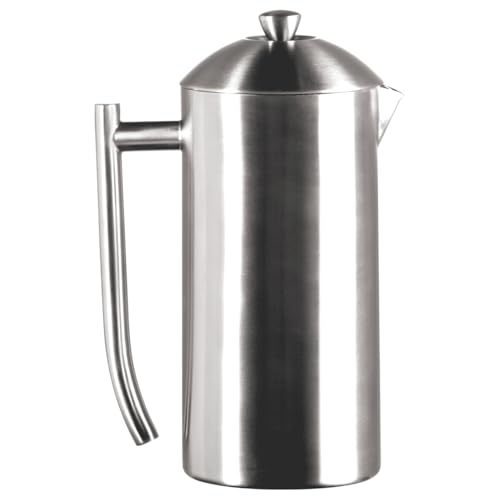
7. Frieling Stainless Steel French Press – Best Stainless Steel French Press
36-oz double-wall French press
A double-wall 18/10 stainless-steel French press with a reusable metal filter.
Brewing method: French press
Main materials: 18/10 stainless steel
Capacity: Available in multiple sizes
The Frieling French Press is a premium alternative to glass French presses. Its double-wall stainless steel construction is designed to retain heat while offering a more durable alternative to a glass brewing chamber.
French press brewing is different from drip coffee. Instead of passing water through a paper filter, you combine ground coffee and hot water in the vessel, allow them to steep, and then press the plunger to separate the grounds.
This method generally produces a fuller-bodied cup because more coffee oils and fine particles remain in the finished drink.
The stainless steel construction is particularly appealing to people who want to avoid plastic brewing chambers and fragile glass carafes.
However, check the exact model’s lid, knob, handle, and seal materials. Stainless steel construction alone does not establish that every component is plastic-free.
- Double-wall 18/10 stainless-steel body
- Insulated construction helps retain heat
- Reusable metal filter; no disposable paper filters required
- Durable alternative to a glass French press
- Premium price compared with basic French presses
- Opaque body makes it harder to see the remaining coffee
- Mesh filter needs regular cleaning; verify lid, knob and seal materials
8. Bialetti Venus – Best Stainless Steel Moka Pot
An 18/10 stainless-steel moka pot; its silicone gasket and thermoplastic handle/knob mean it is not fully plastic-free.
Brewing method: Stovetop moka pot
Main materials: 18/10 stainless steel and silicone gasket
Available sizes: Multiple capacities
The Bialetti Venus is a stainless steel moka pot designed for people who want concentrated, espresso-style coffee without purchasing an electric espresso machine.
Its construction uses stainless steel rather than the aluminum body found in many traditional moka pots. This makes it a particularly relevant option for people specifically searching for stainless steel coffee makers.
The brewing process is simple. Water is added to the lower chamber, ground coffee is placed in the filter basket, and the pot is heated on the stovetop. As pressure builds, hot water moves through the coffee grounds and collects in the upper chamber.
Because the coffee maker does not need a plastic water reservoir, electronic heating system, or plastic filter basket, its construction is relatively straightforward.
However, the gasket is an important exception. Moka pots use a sealing ring between the chambers, and the Bialetti Venus uses a gasket that should be checked for its exact material. This is not an entirely polymer-free appliance.
- 18/10 stainless-steel body
- No conventional plastic water reservoir or electrical components
- Compact stovetop design for concentrated coffee
- Suitable for people who prefer moka-pot brewing
- Silicone gasket is a polymer component and needs periodic replacement
- Thermoplastic handle and knob mean it is not entirely plastic-free
- Does not make espresso in the same way as a high-pressure espresso machine
9. Farberware Yosemite Percolator – Best Budget Stovetop Coffee Maker
An 8-cup stainless-steel percolator with a glass viewing knob and reusable basket.
Brewing method: Stovetop percolator
Main materials: Stainless steel and glass
The Farberware Yosemite Percolator is a traditional stovetop coffee maker that offers a relatively inexpensive alternative to automatic drip machines.
Its design uses a stainless steel pot with an internal percolator basket and a glass viewing knob on the lid. As water heats, it travels through the internal tube and repeatedly passes over the coffee grounds.
Unlike modern electric drip machines, this design does not require a plastic water reservoir, electronic pump, or conventional plastic brewing basket.
The percolator method produces a stronger, more traditional style of coffee. However, it can also produce bitter results if the water is allowed to circulate for too long.
The Yosemite is particularly appealing to people who want a simple coffee pot that can be used on a stovetop without relying on electricity.
- Affordable stainless-steel stovetop pot
- Glass viewing knob and reusable metal coffee basket
- No electric pump or electronic brewing components
- Makes multiple servings in one batch
- Coffee can become bitter if it percolates for too long
- No precise temperature control
- Check the exact handle and lid materials if avoiding plastic everywhere
10. Flair 49 PRO – Best Manual Espresso Maker Without an Electric Brewing System
A manual lever espresso maker with stainless-steel brewing components; check seals and accessories separately.
Brewing method: Manual lever espresso
Main materials: Stainless steel and other specialty brewing components
For people who want something more concentrated than drip coffee or French press coffee, the Flair 49 PRO offers a manual alternative to conventional electric espresso machines.
Unlike automatic espresso machines, it does not depend on an electric pump or a conventional plastic water reservoir. Instead, the user operates a manual lever to generate the pressure needed to extract espresso.
This makes it an interesting option for people who want more control over the brewing process and a machine that does not rely on the usual combination of plastic tanks, electronic pumps, and automated brewing components.
The Flair system is designed for enthusiasts who enjoy controlling their grind, coffee dose, water temperature, and extraction.
It is important to note that manual espresso machines can still use silicone seals, polymer accessories, or other components. The exact 49 PRO configuration should be checked before treating it as entirely plastic-free.
The Flair 49 PRO is worth considering if you want manual espresso-style coffee and prefer to avoid conventional electric espresso machines. It is not the simplest option for everyday convenience, but it offers a different approach to home espresso brewing.
- Manual lever operation without an electric pump
- No conventional plastic water reservoir
- Stainless-steel brewing components and hands-on extraction control
- Compact alternative to a large electric espresso machine
- Steeper learning curve than an automatic machine
- Requires a separate kettle and grinder
- Slower and more hands-on than push-button brewing
- Check seals and accessories; some configurations may include silicone or polymer parts
What to Look for in a Plastic-Free Coffee Maker
The reservoir holds water before brewing. It is separate from the carafe, so a glass serving pot does not prove that the water tank is glass.
In automatic machines, water can pass through tubing, connectors, a heating chamber and a showerhead before reaching the grounds.
The brew basket, filter holder, reusable mesh and brewing chamber can all come into contact with hot water or brewed coffee.
Some otherwise metal or glass brewers use silicone gaskets, O-rings or seals. Silicone is not the same material as conventional plastic, but it is still a polymer and matters if your standard is zero polymers.
The main brewing vessel may be glass or stainless steel while its lid, knob, handle, collar or included accessories use another material.
Terms such as BPA-free, non-toxic and PFAS-free do not automatically mean plastic-free. Also consider whether seals, filters and other wear parts can be identified and replaced, and whether the brewing method suits your routine.
Is There an Automatic Drip Coffee Maker Without Plastic Parts?
Yes. Automatic drip coffee makers with carefully designed glass and stainless steel brewing systems are now available.
The Caraway 10-Cup Coffee Maker and Simply Good Coffee THE BREWER are two particularly relevant examples.
Caraway uses a glass water reservoir, stainless steel water pathway, stainless steel showerhead, stainless steel brew basket, and glass carafe. Simply Good Coffee uses borosilicate glass, stainless steel, and medical-grade silicone in its brewing system.
These machines are different from conventional stainless steel coffee makers that still rely on plastic reservoirs or internal components.
However, there is an important distinction between having no plastic in the water and coffee path and having absolutely no plastic anywhere in the appliance. If you want the strictest possible standard, request a complete materials breakdown from the manufacturer.
Are BPA-Free Coffee Makers Actually Plastic-Free?
No. BPA-free and plastic-free are two different claims.
BPA is a chemical used in the production of certain plastics and resins. A coffee maker can use BPA-free plastic in its water reservoir, filter basket, or other components.
This means that a machine advertised as BPA-free may still expose water or coffee to plastic surfaces.
For shoppers who specifically want a coffee maker without plastic parts, the more useful information is the material of every water-contact and coffee-contact component.
A glass reservoir, stainless steel water pathway, and stainless steel filter basket provide much more meaningful information than a BPA-free label alone.
Can Hot Water Passing Through Plastic Release Microplastics?
Research has shown that certain plastic materials can release microplastic or nanoplastic particles under particular conditions, including exposure to heat, abrasion, and repeated use.
However, the amount released depends on the material, temperature, age, and other conditions. Research findings from one type of plastic container should not automatically be applied to every coffee maker.
This is one reason some consumers prefer glass, stainless steel, and ceramic brewing equipment. These materials can help reduce the amount of plastic involved in the hot-water and coffee-contact portions of the brewing process.
It is important not to interpret this preference as proof that conventional coffee makers cause a specific health problem. The long-term health implications of exposure to different types and quantities of microplastics are still being investigated.
Are There Any Completely Plastic-Free Coffee Makers?
There are manual coffee makers that can be assembled with glass, ceramic, stainless steel, and paper components, without plastic in the brewing path.
The Chemex is a particularly straightforward example because its main brewing vessel is borosilicate glass, with a wooden collar and leather tie.
The Kalita Wave stainless steel dripper and certain ceramic pour-over brewers are other options.
Some automatic machines, including Simply Good Coffee THE BREWER and Caraway’s Coffee Maker, are designed to eliminate plastic from the water and coffee path. However, they still use other materials such as silicone or may contain polymer components elsewhere.
Therefore, if you mean absolutely no plastic anywhere in the appliance, check the complete bill of materials rather than relying on the term plastic-free in marketing descriptions.
Frequently Asked Questions
What is the best plastic-free coffee maker?
For automatic brewing, Caraway is the article’s leading choice based on its glass reservoir and stainless-steel water and coffee path, but no matching Amazon listing is currently attached. Among Amazon-linked options, Simply Good Coffee THE BREWER is the strongest automatic choice. For manual brewing, the Chemex Classic is a strong all-glass option.
What is the best coffee maker without plastic touching hot water?
Simply Good Coffee THE BREWER is designed to keep plastic and aluminum out of the water and coffee path. Its system uses borosilicate glass, stainless steel and medical-grade silicone seals. Caraway is another glass-and-steel automatic option.
Are there plastic-free programmable coffee makers?
There are few automatic models with a clearly disclosed plastic-free brewing path. Caraway uses one-dial operation rather than a conventional programmable timer. Check the exact Simply Good Coffee model and current specifications if scheduling is essential.
Are Cuisinart coffee makers BPA-free?
Cuisinart’s materials vary by model. BPA-free does not mean plastic-free; check the specific reservoir, tubing, filter basket and showerhead materials rather than relying on a brand-wide claim.
What is the best all-glass coffee maker?
The Chemex Classic is a strong choice because its main brewing vessel is borosilicate glass. Pure Over is another glass-based option with an integrated reusable glass filter.
Is stainless steel better than glass for a coffee maker?
Neither is automatically better. Stainless steel is more resistant to breakage and works well for insulated brewers. Glass is nonporous, does not readily retain odors and lets you see the brew, but it can break.
Can I get a plastic-free single-cup coffee maker?
Yes. A ceramic Hario V60 is a practical single-cup option, and a smaller Chemex is another manual alternative. Pair the brewer with a glass or stainless-steel server.
What is the best non-toxic coffee maker with a grinder?
A genuinely plastic-free automatic machine with a built-in grinder is difficult to verify. Many integrated machines use plastic in reservoirs, tubing, filter baskets or coffee-contact areas. A separate grinder paired with a glass, ceramic or stainless-steel brewer gives you more material control.
Which coffee makers do not require paper filters?
French presses such as Frieling, moka pots such as Bialetti Venus and stovetop percolators such as Farberware use reusable brewing systems. Pure Over also uses an integrated glass filter.
Is a plastic-free coffee maker worth the extra money?
It depends on your priorities. Premium automatic brewers may be worth considering if you want convenience with a glass-and-steel water path, but manual options such as a ceramic dripper, Chemex, moka pot or French press can reduce plastic contact at a lower cost.
Final Verdict: Which Plastic-Free Coffee Maker Should You Buy?
The best plastic-free coffee maker depends on whether you prioritize convenience, materials, capacity, or brewing style.
For an automatic machine, the Caraway 10-Cup Coffee Maker is our leading overall recommendation because of its glass reservoir and stainless steel brewing components. Simply Good Coffee THE BREWER is another particularly strong option for people who specifically want an automatic drip machine with no plastic or aluminum in the water and coffee path.
If you prefer manual brewing, the Chemex Classic is one of the best all-glass options, while the Hario V60 Ceramic Dripper is a compact choice for making individual servings. For durability, the Frieling French Press and Bialetti Venus are worth considering.
You do not necessarily need an expensive machine to reduce plastic contact during coffee preparation. Often, a simple glass, ceramic, or stainless steel brewer is enough.
The most important thing is to look beyond the exterior and understand what materials your water and coffee actually touch.

