The Best Stainless Steel Pots for Everyday Cooking
The best stainless steel pots are built for the jobs you do repeatedly: simmering sauces, cooking grains, boiling pasta, making soup, and preparing stock. The right choice depends on the pot’s shape and construction—not simply its brand or price.
This guide focuses on individual saucepans and stockpots, not oversized cookware sets. We compare fully clad saucepans for responsive cooking with larger stockpots that may use either fully clad walls or a bonded base. Those designs are not interchangeable, and paying extra for full cladding only makes sense when the way you cook benefits from it.
Our recommendations are research-led and based on product specifications, construction, manufacturer information, and practical trade-offs. We have not physically tested these pots, so we do not present them as hands-on test winners.
- Best overall saucepan: All-Clad D3 3-Quart Saucepan
- Best value saucepan: Cuisinart MultiClad Pro 3-Quart Saucepan
- Best small saucepan: Tramontina Signature Tri-Ply Clad 2-Quart
- Best premium saucepan: Demeyere Industry 5 2-Quart
- Best stockpot value: Tramontina Signature Tri-Ply Clad 8-Quart
Which Stainless Steel Pot Should You Buy?
- For daily sauces and grains: Choose a fully clad 2- or 3-quart saucepan; the aluminum core should run up the sidewalls, not just the base.
- For pasta and soup: An 8-quart stockpot is a practical size for many households. A 6-quart pot is easier to store and lift.
- For large batches: A 10- to 12-quart stockpot makes sense for batch cooking, broth, and entertaining, but it takes up more cabinet space.
- Do not confuse construction: Fully clad means conductive layers extend up the sidewalls. A disc-bottom pot concentrates the conductive layer in its base.
- Do not buy by ply count alone: A well-designed tri-ply pot can be a better everyday choice than a heavier, more expensive five-ply model.
Best Stainless Steel Pots Reviews
1. Best Overall: All-Clad D3 Stainless 3-Quart Saucepan
 01
A versatile fully clad tri-ply 3-quart saucepan for sauces, grains, reheating, and everyday cooking.
A versatile fully clad tri-ply 3-quart saucepan for sauces, grains, reheating, and everyday cooking.
The All-Clad D3 3-quart saucepan is the strongest all-round choice for cooks who regularly make sauces, grains, oatmeal, vegetables, and smaller portions of soup. Its fully bonded tri-ply body places an aluminum core between stainless-steel layers and carries that construction up the sidewalls. That matters in a saucepan because food sits against the sides as well as the base.
D3 is responsive enough for everyday simmering and reduction work, while the stainless cooking surface is durable and does not rely on a nonstick coating. The 3-quart capacity is a useful middle ground: large enough for a family side dish or a batch of sauce, but not as awkward as a 4-quart vessel when you only need to warm leftovers.
The downside is price. All-Clad charges a premium for its bonded construction and US manufacturing, and the polished exterior shows water spots and heat tint. It is also not nonstick, so delicate foods still require temperature control and fat. If you mainly boil water, this is more saucepan than you need; if you cook sauces and grains several times a week, the design is easier to justify.
All-Clad D3 3-Quart Saucepan — Key Specifications
| Construction | Fully bonded tri-ply stainless steel with aluminum core |
| Capacity | 3 quarts |
| Cooking surface | Stainless steel |
| Cooktop compatibility | Including induction |
| Oven limit | Up to 600°F (manufacturer-stated; verify lid guidance) |
| Made in | USA with global components |
- Fully clad construction through the sidewalls
- Useful capacity for sauces, grains, soup, and reheating
- Induction compatible and responsive to burner changes
- Durable uncoated stainless cooking surface
- Costs considerably more than value-focused tri-ply options
- Polished exterior shows water spots and heat tint
- Not nonstick; delicate foods still need good technique
2. Best Value Saucepan: Cuisinart MultiClad Pro 3-Quart Saucepan
 02
A fully clad 3-quart stainless saucepan with an aluminum core through the base and sidewalls.
A fully clad 3-quart stainless saucepan with an aluminum core through the base and sidewalls.
Cuisinart MultiClad Pro is the value choice for shoppers who want a fully clad saucepan without paying All-Clad prices. Its Heat Surround construction uses a pure aluminum core between stainless-steel layers and extends through the base and sidewalls. That makes it a more versatile sauce and simmering pot than a basic stainless saucepan with only an encapsulated base.
The 3-quart size works for sauces, rice, oatmeal, vegetables, and smaller batches of soup. Cuisinart currently lists this saucepan as model MCPS193-18N. The Amazon listing attached here still displays the older MCP193-18N designation, so compare the listing photos and confirm that the 3-quart saucepan and lid are included before ordering.
The compromises are mostly refinement. The handle shape, finish, and overall feel are not as polished as more expensive cookware, and the exact MCP item number matters because MultiClad Pro includes saucepans, skillets, sauciers, and casseroles with similar names. Check that the listing is the 3-quart saucepan with cover—not the 3-quart skillet or casserole.
Cuisinart MultiClad Pro 3-Quart Saucepan — Key Specifications
| Construction | Fully clad triple-ply with aluminum core |
| Capacity | 3 quarts |
| Cooking surface | Stainless steel |
| Cooktop compatibility | All stovetops, including induction |
| Oven limit | Up to 500°F (manufacturer-stated) |
| Warranty | Limited lifetime warranty |
- Fully clad construction at a more accessible price
- Aluminum core extends through the sidewalls
- Useful 3-quart capacity and fitted cover
- Induction compatible
- Less refined fit and finish than premium lines
- Several similar-looking MCP products can cause listing confusion
- Polished stainless requires normal cleaning and care
3. Best Small Saucepan: Tramontina Signature Tri-Ply Clad 2-Quart Saucepan
 03
A compact 2-quart fully clad tri-ply saucepan with an aluminum core and induction compatibility.
A compact 2-quart fully clad tri-ply saucepan with an aluminum core and induction compatibility.
A 2-quart saucepan is one of the most useful small pots in a home kitchen. It handles a cup or two of sauce, reheating soup, cooking grains for one or two people, melting butter, and preparing small portions without leaving a large vessel half empty. Tramontina’s Signature Tri-Ply Clad version gives that practical size a fully clad body.
The aluminum core is bonded between stainless layers, and the pot is designed for induction and other common cooktops. Its 18/10 stainless cooking surface and Brazilian manufacture are part of the Signature line’s appeal. For the price, it offers a lot of the construction that makes more expensive clad saucepans versatile.
Its limitation is capacity, not the core design. Two quarts is too small for a family-sized soup or a large batch of pasta sauce. If you want one saucepan to do almost everything, choose a 3-quart model instead. If you already own a larger pot, this is a useful specialist size.
Tramontina Signature 2-Quart Saucepan — Key Specifications
| Construction | Fully clad tri-ply with aluminum core |
| Capacity | 2 quarts |
| Interior | 18/10 stainless steel (manufacturer-stated) |
| Cooktop compatibility | Including induction |
| Dishwasher safe | Yes (manufacturer-stated) |
| Made in | Brazil |
- Fully clad walls at a value-oriented price
- Ideal size for small portions, sauces, and grains
- Induction compatible
- 18/10 stainless cooking surface
- Too small to serve as the only saucepan in many kitchens
- Mirror finish can show fingerprints and water spots
- Exact bundle and model details should be checked before ordering
4. Best Premium Saucepan: Demeyere Industry 5 2-Quart Saucepan
 04
A Belgian-made five-ply saucepan with full-height cladding and a Silvinox-treated stainless surface.
A Belgian-made five-ply saucepan with full-height cladding and a Silvinox-treated stainless surface.
Demeyere Industry 5 is for cooks who want a substantial, premium saucepan and are comfortable paying for carefully engineered construction. Its five-ply body runs from base to rim, and the Belgian-made line uses a stainless cooking surface with Demeyere’s Silvinox surface treatment. Silvinox is a finishing treatment, not a nonstick coating.
The 2-quart size is especially useful for sauces, custards, reductions, and smaller batches where even heating along the walls matters. The line’s welded handles avoid the exposed interior rivets found on many saucepans, making the cooking surface easier to wipe clean. It is induction compatible and designed for use across common cooktops.
The obvious compromise is cost. A Demeyere saucepan can cost several times more than a good Tramontina or Cuisinart. It is also heavier than many basic saucepans. Buy it because you value its construction and finish—not because five layers automatically make every recipe better.
Demeyere Industry 5 2-Quart Saucepan — Key Specifications
| Construction | Fully clad five-ply from rim to rim |
| Capacity | 2 quarts |
| Interior | 18/10 stainless steel |
| Surface treatment | Silvinox finish; not a coating |
| Cooktop compatibility | Including induction |
| Made in | Belgium |
| Oven limit | Up to 500°F (manufacturer-stated) |
- Five-ply construction extends up the sidewalls
- Premium stainless finish and welded handles
- Induction compatible
- Useful for sauces and reductions where sidewall heating matters
- Very expensive for a 2-quart pot
- Heavier than basic saucepans
- The performance premium is not necessary for occasional cooking
5. Best American-Made Alternative: Heritage Steel Eater Series 2-Quart Saucepan
 05
A made-in-USA five-ply fully clad 2-quart saucepan with a stainless cooking surface and induction compatibility.
A made-in-USA five-ply fully clad 2-quart saucepan with a stainless cooking surface and induction compatibility.
The Heritage Steel Eater Series 2-quart saucepan is a strong alternative for shoppers who want fully clad stainless cookware made in the United States. Heritage Steel describes the Eater Series as five-ply cookware with a 2.3 mm cladded body. Its relatively responsive design aims to balance heat distribution with the ability to react when you adjust the burner.
The 2-quart size is useful for sauces, grains, reheating, and smaller sides. The stainless cooking surface is uncoated, and the saucepan is designed for use on induction, gas, electric, and ceramic cooktops. Heritage Steel also offers larger saucepans and saucepots in the same family, so it is possible to build a collection around the size you actually use.
The main drawback is price: it sits in the premium tier and may be harder to find through every retailer. Before buying, confirm that the listing is the Eater Series—not the Titanium Series—and check whether the lid is included. It is a credible alternative to All-Clad, but it is not automatically the better buy for every budget.
Heritage Steel Eater Series 2-Quart Saucepan — Key Specifications
| Construction | Five-ply fully clad; 2.3 mm body (manufacturer-stated) |
| Capacity | 2 quarts |
| Cooking surface | Uncoated stainless steel |
| Cooktop compatibility | Gas, electric, ceramic, induction |
| Made in | USA |
| Warranty | Lifetime warranty (manufacturer-stated) |
- Fully clad five-ply construction
- Made in the USA
- Responsive body designed for temperature control
- Uncoated stainless cooking surface
- Premium price for a small saucepan
- Retailer availability can be more limited
- Confirm Eater Series model and lid inclusion
6. Best Premium Stockpot: All-Clad D3 Stainless 8-Quart Stockpot
 06
A fully bonded tri-ply 8-quart stockpot for cooks who simmer, make stock, and prepare large batches as well as boil water.
A fully bonded tri-ply 8-quart stockpot for cooks who simmer, make stock, and prepare large batches as well as boil water.
The All-Clad D3 8-quart stockpot is the premium option for cooks who want a large pot with fully bonded tri-ply construction. Eight quarts is a versatile capacity for pasta, soup, chili, stock, and batch cooking. The D3 aluminum core is bonded through the vessel, not limited to a disc at the bottom, so the sidewalls share the same layered construction.
That extra cladding is most useful when you do more than boil water: sweating aromatics, simmering thick soups, reducing liquids, or cooking recipes where heat along the walls matters. The stockpot is induction compatible, has a stainless lid, and All-Clad lists oven and broiler use up to 600°F for D3 cookware.
The trade-off is weight and cost. A large pot becomes heavy once filled, and the D3 stockpot costs far more than a basic stockpot that can boil pasta just as effectively. If you mainly need a vessel for boiling water, save the money. If you make stock and large batches regularly, the fully clad construction is easier to justify.
All-Clad D3 8-Quart Stockpot — Key Specifications
| Construction | Fully bonded tri-ply stainless steel with aluminum core |
| Capacity | 8 quarts |
| Lid | Stainless steel |
| Cooktop compatibility | Including induction |
| Oven limit | Up to 600°F (manufacturer-stated; confirm lid guidance) |
| Made in | USA with global components |
- Fully clad construction through the sidewalls
- Versatile 8-quart capacity
- Induction compatible
- Suitable for stovetop-to-oven cooking within the stated temperature limit
- Expensive for a pot often used mainly for boiling
- Heavy when filled
- A disc-bottom stockpot is sufficient for many pasta and soup tasks
7. Best Value Stockpot: Tramontina Signature Tri-Ply Clad 8-Quart Stockpot
 07
An 8-quart fully clad tri-ply stockpot with an aluminum core and induction compatibility for pasta, soup, and batch cooking.
An 8-quart fully clad tri-ply stockpot with an aluminum core and induction compatibility for pasta, soup, and batch cooking.
For most households, the Tramontina Signature 8-quart stockpot is the more sensible stockpot purchase. It offers a useful capacity for pasta, soups, stews, chili, and family-sized batches, with tri-ply cladding that extends through the walls. That makes it more versatile for simmering and cooking thick mixtures than a basic pot with a bonded base only.
The Signature line uses an aluminum core between stainless-steel layers, an 18/10 stainless interior, and induction-compatible construction. It is made in Brazil and is generally positioned well below premium American and European stockpots. The 8-quart size is large enough for most everyday family jobs without becoming a commercial-sized vessel.
It is not a lightweight pot, especially when full, and its polished finish needs ordinary stainless-steel care. But for shoppers who want a fully clad stockpot without spending All-Clad money, this is the clearest value recommendation in the group.
Tramontina Signature 8-Quart Stockpot — Key Specifications
| Construction | Fully clad tri-ply with aluminum core |
| Capacity | 8 quarts |
| Interior | 18/10 stainless steel (manufacturer-stated) |
| Cooktop compatibility | Including induction |
| Oven limit | Up to 500°F (manufacturer-stated; verify lid limit) |
| Made in | Brazil |
- Fully clad walls at a much lower price than premium stockpots
- Practical 8-quart capacity
- Induction compatible
- Good for soups, stews, pasta, and simmering
- Heavy when filled to capacity
- Polished exterior shows water spots
- More construction than needed if you only boil pasta
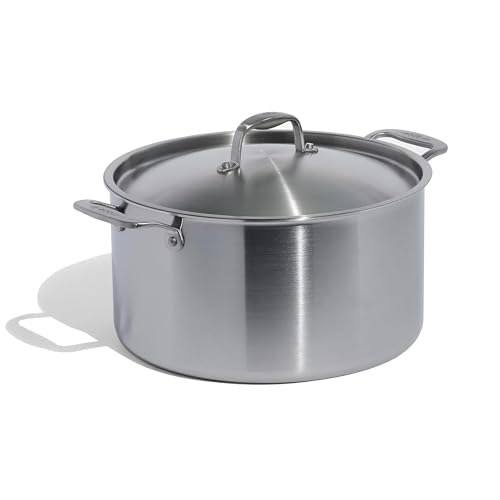
8. Best for Large Batches: Made In Stainless Clad 12-Quart Stockpot
 08
A large 12-quart five-ply stainless-clad stockpot for broth, big batches of soup, and cooking for a crowd.
A large 12-quart five-ply stainless-clad stockpot for broth, big batches of soup, and cooking for a crowd.
The Made In 12-quart Stainless Clad stockpot is aimed at serious batch cooking. Its five-ply stainless-clad construction is designed to provide heat control and responsiveness across a large vessel, while the 12-quart capacity is useful for broth, large pots of soup, seafood boils, and cooking for a crowd.
Made In lists this pot as crafted in Italy and compatible with induction. The extra capacity is the reason to choose it over an 8-quart model; the five-ply construction is a secondary consideration. If you routinely prepare large quantities, the taller, wider vessel can save you from splitting a recipe across two pots.
The obvious compromise is size. A 12-quart pot takes up more cabinet space, needs a large sink for cleaning, and can become awkward to move when full. It is also expensive. If you rarely cook for a crowd or freeze large batches, an 8-quart pot is likely the more practical purchase.
Made In 12-Quart Stainless Clad Stockpot — Key Specifications
| Construction | Five-ply stainless clad |
| Capacity | 12 quarts |
| Cooking surface | Stainless steel |
| Cooktop compatibility | Including induction |
| Made in | Italy (manufacturer-stated) |
- Large 12-quart capacity for batch cooking
- Five-ply stainless-clad construction
- Induction compatible
- Useful for stock, soup, and cooking for a crowd
- Large and cumbersome to store or wash
- Expensive compared with simpler stockpots
- Overkill for small households and occasional pasta
9. Best Budget Stockpot: Cuisinart Chef’s Classic Stainless 6-Quart Stockpot
 09
An affordable 6-quart stainless stockpot with an encapsulated aluminum base for boiling, pasta, and everyday soups.
An affordable 6-quart stainless stockpot with an encapsulated aluminum base for boiling, pasta, and everyday soups.
Cuisinart Chef’s Classic is the budget pick for people who need a straightforward stockpot for pasta, soup, vegetables, and everyday boiling. The 6-quart model uses a stainless-steel body with an encapsulated aluminum base. That base helps distribute heat across the bottom, but the pot is not fully clad up the sidewalls like the All-Clad D3 or Tramontina Signature stockpots.
For its intended jobs, that is not necessarily a problem. Water, pasta, and thin soups are heated primarily from the base, so a well-made disc-bottom pot can be perfectly practical. The 6-quart size is easier to store and handle than an oversized stockpot, and the price is usually much lower than fully clad alternatives.
Do not buy it expecting the same sidewall heating as fully clad cookware. It is a budget utility pot, not a premium sauce-reduction vessel. If you often simmer thick mixtures or cook recipes that need heat along the walls, spend more on a fully clad option.
Cuisinart Chef’s Classic 6-Quart Stockpot — Key Specifications
| Construction | Stainless steel with encapsulated aluminum base |
| Capacity | 6 quarts |
| Interior | Stainless steel |
| Cooktop compatibility | All stovetops, including induction |
| Lid | Tempered glass cover included |
| Warranty | Limited lifetime warranty |
- Affordable and practical for boiling and everyday soups
- Manageable 6-quart capacity
- Encapsulated aluminum base helps spread heat
- Induction compatible; stainless cooking surface
- Disc-bottom construction, not fully clad sidewalls
- Less suitable for thick sauces and wall-dependent simmering
- Tempered-glass lid is less heat-tolerant than an all-metal lid
10. Best Premium German Stockpot: Fissler Original-Profi Collection 6.7-Quart Stockpot
 10
A German-made 6.7-quart stainless stockpot with a CookStar base, metal lid, and interior measuring marks.
A German-made 6.7-quart stainless stockpot with a CookStar base, metal lid, and interior measuring marks.
Fissler Original-Profi is a premium European-style stockpot with a different construction philosophy from fully clad saucepans. Its CookStar base is designed to distribute heat across the bottom and support use on induction and other cooktops. The 6.7-quart pot is a useful size for soups, vegetables, pasta, and family meals, while the metal lid and interior measuring marks add practical convenience.
The line is made in Germany and uses 18/10 stainless steel. Fissler’s metal lid is designed to retain and return condensation, and the pot has a wide pouring rim. These details make it an appealing choice for cooks who value a robust, well-finished pot and prefer a metal lid over glass.
The price is the main barrier, and the CookStar base is not the same as fully clad sidewalls. For boiling and simmering in a stockpot, that distinction may not matter much. But if you want one pot for frequent reductions and wall-heated sauces, a fully clad saucepan is a better tool. Buy Fissler for its build, lid design, and German manufacture—not because it is automatically superior to every clad pot.
Fissler Original-Profi 6.7-Quart Stockpot — Key Specifications
| Construction | 18/10 stainless steel with CookStar encapsulated base |
| Capacity | 6.7 quarts |
| Lid | Condensate-Plus metal lid |
| Cooktop compatibility | Including induction |
| Oven limit | Up to 446°F (manufacturer-stated) |
| Made in | Germany |
- Premium German-made stainless steel construction
- CookStar base designed for even bottom heating
- Metal lid and wide pouring rim
- Interior measuring marks on cited models
- High price for a pot with a base-focused design
- Not fully clad up the sidewalls
- Check exact capacity and oven rating because the collection has several sizes
Stainless Steel Pots Compared: Which Construction Matters?
| Construction | Conductive layers | Best suited for | Main trade-off | ||
|---|---|---|---|---|---|

All-Clad D3 3-Qt Saucepan
Fully clad saucepan
|
Tri-ply, fully clad | Base and sidewalls | Sauces, grains, reductions | Premium price | BUY NOW |

All-Clad D3 8-Qt Stockpot
Fully clad stockpot
|
Tri-ply, fully clad | Base and sidewalls | Soup, stock, batch cooking | High cost and weight | BUY NOW |

Cuisinart 6-Qt Stockpot
Disc-bottom stockpot
|
Stainless with aluminum base | Base only | Boiling, pasta, everyday soup | Sidewalls heat less evenly | BUY NOW |
A saucepan is used for more than boiling. Milk, sauces, grains, and reductions contact the sidewalls, so fully clad construction is a meaningful advantage.
A stockpot is often used to boil water or simmer a large volume of liquid; for those jobs, a quality disc-bottom design can be entirely reasonable.
Do not pay for fully clad walls unless you will use them.
How to Choose the Best Stainless Steel Pots
Fully Clad vs. Disc-Bottom Pots
Fully clad pots bond conductive layers across the base and up the sidewalls. In tri-ply cookware, an aluminum core is typically sandwiched between stainless-steel layers.
This helps the sides heat more evenly and makes the pot more versatile for sauces, reductions, and thick mixtures.
Disc-bottom cookware concentrates the conductive material in a thick base. It can be a sensible choice for stockpots used mainly for boiling pasta, making broth, or simmering soup.
The sidewalls are usually single-layer stainless steel, so they do not heat in the same way as a fully clad vessel.
The design is not automatically inferior; it is simply better suited to different jobs.
What Size Saucepan Do You Need?
A 1- to 2-quart saucepan is useful for small portions, melting butter, heating sauces, and cooking grains for one or two people.
A 3-quart saucepan is the best all-round size for many households because it handles sauces, oatmeal, vegetables, and smaller batches of soup.
A 4-quart saucepan is useful for larger portions but can feel bulky for everyday small tasks.
What Size Stockpot Do You Need?
A 6-quart stockpot is manageable for smaller households and everyday soup. An 8-quart pot is the most versatile size for pasta, family-sized soup, chili, and stock.
A 10- to 12-quart pot is better for large batches, entertaining, and making broth in quantity. Bigger is not automatically better: a full stockpot is heavy, difficult to clean, and harder to store.
Tri-Ply vs. Five-Ply
Five-ply is not a universal upgrade. Additional layers can change stiffness, weight, and heat behavior, but layer count alone does not tell you how evenly a pot heats.
Compare the metal stack, total thickness, shape, handle design, and the way you cook. A well-designed tri-ply saucepan can be a better everyday tool than a very heavy five-ply model.
Is 18/10 Stainless Steel Better?
18/10 stainless steel contains approximately 18% chromium and 10% nickel. Chromium helps resist corrosion, while nickel improves corrosion resistance and contributes to the alloy’s nonmagnetic properties.
Many cookware makers use 18/10 for the cooking surface and a magnetic stainless exterior for induction compatibility. The grade is useful information, but it does not replace checking the pot’s construction and quality.
Is Stainless Steel Cookware Non-Toxic?
Uncoated stainless steel does not rely on a PTFE nonstick coating. It is widely used for cookware, but it is not accurate to claim that no metal can ever migrate into food.
Small amounts of nickel and chromium can migrate under certain conditions, with factors such as food acidity, cooking time, and cookware condition affecting release.
People with a known nickel sensitivity should seek appropriate professional advice about cookware materials.
What Makes a Stainless Steel Pot Induction Compatible?
The exterior base must be magnetic. Many modern stainless pots are induction compatible, but stainless steel is not automatically magnetic.
Check the exact manufacturer listing for induction compatibility. A magnet test on the base can be a quick preliminary check, but the product specification is the better confirmation.
Are Stainless Steel Pots Dishwasher Safe?
Some manufacturers label their stainless cookware dishwasher safe, but handwashing is often kinder to the finish. Detergents and mineral deposits can leave spots or dull polished surfaces.
Follow the care instructions for the exact model, avoid sudden temperature changes, and dry the pot after washing if you want to reduce water marks.
How to Prevent Food from Sticking in a Stainless Steel Pot
Stainless steel is not nonstick. Preheat the pot gradually over moderate heat, add oil or another cooking fat when appropriate, and avoid overcrowding.
For proteins, allow the surface to brown before trying to turn or move the food. For sauces and milk-based recipes, use controlled heat and stir regularly rather than relying on high burner settings.
What to Look for Before Buying a Stainless Steel Pot
-
Fully clad construction for saucepans
Choose bonded layers that extend up the sidewalls when you regularly make sauces, grains, reductions, or thick mixtures.
Look forA manufacturer description that explicitly says fully clad or bonded through the sidewalls.AvoidA listing that only says stainless steel with an aluminum or copper base if you expect fully clad walls. -
A practical capacity
Match the pot size to the amount you usually cook; oversized pots are heavy and consume storage space.
Look for2–3 qt for everyday saucepans and around 8 qt for a versatile stockpot.AvoidBuying a 12 qt stockpot for occasional small-batch cooking. -
A stable, comfortable handle
Handles should feel secure and provide enough clearance from the burner and pot body.
Look forRiveted or welded handles with a comfortable grip and solid attachment.AvoidLoose-feeling handles or designs that are awkward to lift when full. -
Induction and oven compatibility
Check the exact model and lid, not just the cookware collection name.
Look forManufacturer-confirmed induction compatibility and separate oven limits for pot and lid.AvoidAssuming every stainless pot or glass lid shares the same temperature rating. -
A useful lid and pouring rim
A well-fitting lid reduces splatter and helps retain heat; a flared rim can make pouring cleaner.
Look forA lid included in the listing and a rim designed for controlled pouring.AvoidComparing prices without checking whether the lid is included.
How We Selected These Stainless Steel Pots
This is a research-led editorial comparison, not a hands-on test. We evaluated individual pots using manufacturer specifications, construction details, product configuration, capacity, cooktop compatibility, and the trade-offs implied by each design.
-
Construction first
We distinguished fully clad sidewalls from disc-bottom designs instead of treating all stainless pots as equivalent.
-
Capacity and real use
We considered whether each size fits common home-cooking jobs, from small sauces to family-sized pasta and large-batch stock.
-
Practical compromises
We considered weight, price tier, lid design, care, and whether premium construction offers a meaningful benefit for the intended use.
-
Specification checks
We used manufacturer-published details where available and recommend checking the exact model listing because capacities and temperature limits can vary by configuration.
We have not physically tested these products. No recommendation is presented as a lab-tested or hands-on winner.
Stainless Steel Pots: Common Questions
What is the best stainless steel pot for everyday cooking?
For most everyday saucepan jobs, a fully clad 3-quart model is the most versatile size. The All-Clad D3 is the premium all-round choice, while Cuisinart MultiClad Pro offers a lower-cost fully clad alternative.
What is the best size stainless steel stockpot?
An 8-quart stockpot is a practical all-round size for many households. It handles pasta, soup, chili, and moderate batches of stock. Choose 6 quarts for smaller households or 10–12 quarts if you regularly cook large batches.
Are fully clad stainless steel pots better than disc-bottom pots?
Fully clad pots heat through the sidewalls as well as the base, which is useful for sauces and thick mixtures. Disc-bottom pots can be perfectly suitable for boiling water, pasta, and many soups. The better design depends on the job.
Is tri-ply stainless steel good enough?
Yes. A well-designed tri-ply pot is more than adequate for most home cooking. Thickness, alloy selection, bonding, shape, and handle design matter at least as much as the layer count.
Is five-ply stainless steel worth the extra money?
Sometimes, but not automatically. Five-ply may offer a different feel, weight, and heat response. It is worth paying for only when the exact pot’s construction and handling suit the way you cook.
Do stainless steel pots work on induction?
Many do, but not all. Check the exact model’s induction compatibility or test the base with a magnet as a preliminary check.
Can stainless steel pots go in the oven?
Many stainless pots can, but the maximum temperature may differ for the pot, lid, and handle. Follow the manufacturer’s instructions for the exact model.
Are stainless steel pots safe for acidic foods?
Quality stainless steel is commonly used for acidic foods, but it is not perfectly inert. Avoid storing very acidic foods in cookware for extended periods, and follow the manufacturer’s care guidance. Anyone with a known nickel sensitivity should seek individualized advice.
How do you clean stainless steel pots?
Wash with warm water and dish soap, use a nonabrasive sponge for routine cleaning, and dry after rinsing to reduce water spots. For stuck-on food, soak the pot and use a stainless-safe cleaner rather than scraping aggressively.
Should I buy a stainless steel pot set or individual pots?
If you need only one saucepan and one stockpot, buying individual pieces usually avoids paying for pans you will not use. A set makes sense when you need most of its included sizes and the construction is consistent across the pieces.
Which Stainless Steel Pot Is Worth Buying?
- Choose a fully clad 3-quart saucepan for the most versatile everyday use.
- Choose Tramontina Signature if you want fully clad construction at a value-focused price.
- Choose an 8-quart stockpot for most family cooking; go larger only if you regularly make big batches.
- A disc-bottom stockpot can be a smart budget choice for boiling and soup.
- Do not pay extra for five-ply or a premium brand unless you will benefit from the construction.
For most kitchens, the All-Clad D3 3-quart saucepan is the strongest all-round individual pot, while the Cuisinart MultiClad Pro is the value alternative. For a small saucepan, Tramontina Signature is hard to ignore. For stockpots, Tramontina’s 8-quart fully clad model offers the best balance of capacity and price; the All-Clad D3 is the premium option, and Cuisinart Chef’s Classic is the sensible budget choice if you mainly boil or simmer.
The best stainless steel pots are not necessarily the most expensive ones. Match the construction to the cooking job, choose a capacity you will actually use, and verify the exact model before ordering.