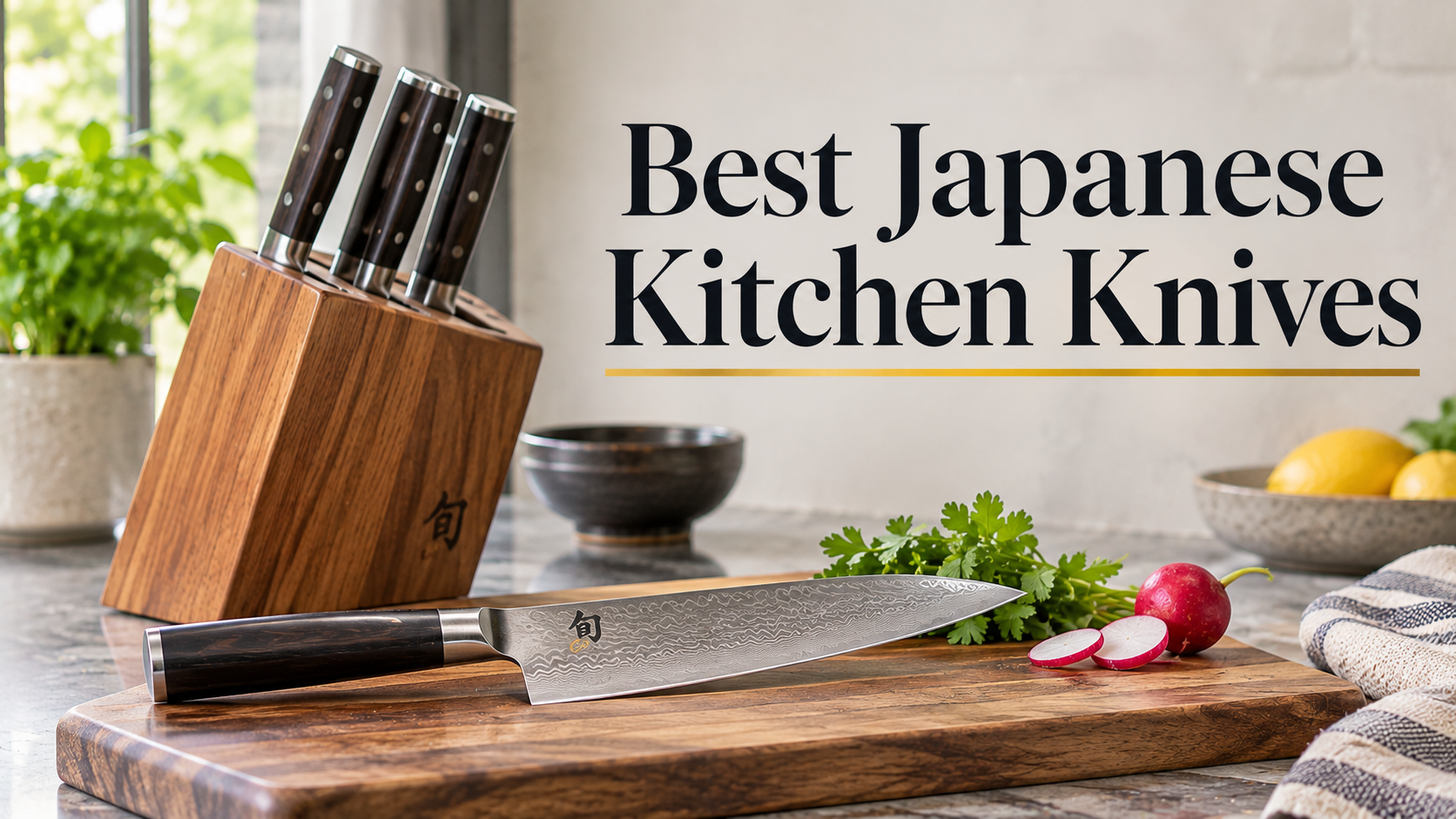
The Best Japanese Kitchen Knives for Home Cooks
The best Japanese kitchen knives combine a keen edge, thoughtful blade geometry, and steel suited to the way you cook. Our top recommendation is the MAC MTH-80 for its practical all-round design, while Tojiro, Shun, MIYABI, Global, Yaxell, and Yoshihiro offer strong alternatives for different budgets and cutting styles.
This guide compares Japanese-made knives available to US shoppers, including gyuto, santoku, and nakiri styles. We focus on identifiable models, published specifications, construction, intended use, care requirements, and value—not unsupported claims of hands-on testing.
- 10 Japanese kitchen knives compared
- Top Japanese knife brands and artisan makers
- Gyuto vs. santoku vs. nakiri explained
- Steel, sharpening, and care advice
Which Japanese Kitchen Knife Should You Buy?
- Best overall: MAC MTH-80 Professional for an everyday workhorse with a familiar handle and versatile 200 mm blade.
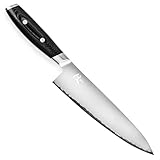
- Best no-frills VG10: Yaxell Mon for a straightforward three-layer VG10-core gyuto with a durable micarta handle.
- Best premium: Shun Classic or MIYABI Koh if you want a refined finish and a keen, hard blade.
- Best for vegetables: Yoshihiro VG10 Nakiri for straight, controlled vegetable prep.
- Best shorter all-rounder: Tojiro Classic Santoku 170 mm for smaller boards and everyday home cooking.
A good Japanese knife is not automatically the best choice for every cook. Blade length, handle comfort, edge geometry, and willingness to maintain it matter more than country of origin alone.
The 10 Best Japanese Knives by Use





Individual Reviews: The 10 Best Japanese Kitchen Knives
The shortlist above gives you the fastest route to a recommendation. The reviews below explain what each knife is best at, where it makes compromises, and which type of cook is most likely to appreciate it. You can then use the comparison and buying guide to narrow the choice by blade length, steel, shape, and maintenance.
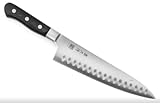
01. Best Overall: MAC MTH-80 Professional Chef’s Knife
01
A versatile 200 mm Japanese-made chef’s knife with a familiar Western-style handle, stainless construction, and shallow food-release dimples.
The MAC MTH-80 is the most balanced choice here for a home cook who wants one Japanese-made knife for regular, varied kitchen work. Its 200 mm blade is long enough for most vegetables, herbs, and boneless proteins, but remains easier to manage than the 240 mm Tojiro if your cutting board or counter space is limited.
Its molybdenum-vanadium stainless steel, relatively thin profile, and shallow food-release dimples make it a practical, performance-first design. The familiar Western-style handle is an advantage for cooks moving from a conventional chef’s knife: there is no need to adjust to an octagonal wa handle or a radically different grip.
The dimples may reduce contact with some foods, but they do not make the blade nonstick.
The main reason to choose the MTH-80 is its combination of control, versatility, and comparatively straightforward stainless-steel care—not an elaborate finish or a long list of premium materials. It is still a meaningful investment, and its plain appearance may disappoint buyers who want a decorative Damascus blade.
It is also not a cleaver: avoid bones, frozen food, prying, and forceful twisting, and use a suitable cutting board.
Choose it if you want a dependable everyday chef’s knife that feels familiar and controlled. If you specifically want a longer cutting edge for large ingredients and long slicing strokes, the Tojiro DP 240 mm is the more logical alternative.
Manufacturer details: MAC’s official MTH-80 specifications.
- Practical 200 mm blade and familiar handle
- Hollow-edge dimples help reduce food drag
- Japanese-made stainless construction
- Costs more than entry-level options
- Less decorative than Damascus competitors
02. Best Long-Blade Gyuto: Tojiro DP Gyutou 240mm
02
A 240 mm VG10-core gyuto for cooks who want extra reach for large ingredients and long slicing strokes.
The Tojiro DP Gyutou is the long-blade choice in this roundup. At 240 mm, it gives experienced cooks extra reach for large vegetables, wide cuts of meat, and long slicing strokes. That length can be genuinely useful, but it is not automatically an upgrade over a standard 200–210 mm chef’s knife.
The DP construction pairs a VG10 stainless cutting core with stainless cladding, giving the knife a hard, corrosion-resistant edge without the daily care demands of a reactive carbon-steel blade.
Its double-bevel profile makes it suitable for general-purpose use, while the reinforced laminated handle and full-tang construction provide a familiar, durable format. The appeal is functional rather than ornamental: this is a straightforward working gyuto, not a knife bought primarily for a decorative finish.
The compromise is handling. A 240 mm blade needs a longer board and more clearance, and it can feel cumbersome when trimming small ingredients or working in a compact kitchen.
The harder edge also deserves controlled technique; do not twist it through dense food or use it on bones or frozen ingredients. If you are new to Japanese knives, consider whether you actually need this much blade before choosing it.
Choose the Tojiro when you already know you prefer a long gyuto and want a practical VG10 option. For a more maneuverable everyday knife, the MAC MTH-80 or a 210 mm gyuto is likely to be easier to live with.
Manufacturer details: Tojiro’s official F-809 specifications.
- Stain-resistant steel and double-bevel edge
- Long blade suits larger ingredients and slicing
- Useful value from an established Japanese maker
- 240 mm length may overwhelm smaller boards
- Less convenient for compact prep spaces
03. Best Premium Everyday Knife: Shun Classic 8-Inch Chef’s Knife
03
A premium 8-inch chef’s knife combining a VG-MAX cutting core, stainless Damascus cladding, and a pakkawood handle.
The Shun Classic is the premium, presentation-conscious option for cooks who want a recognizable Japanese knife with a refined finish. Its VG-MAX cutting core is surrounded by stainless Damascus cladding, and the pakkawood handle gives it a polished look while being more practical in a kitchen than untreated wood.
The familiar 8-inch chef’s-knife format is versatile for everyday slicing, chopping, and mincing. Shun’s established range and sharpening support may also appeal to buyers who prefer a major brand with a clear product family rather than choosing from numerous small workshop models.
The layered pattern is attractive, but it is the blade geometry, heat treatment, and edge condition—not the pattern itself—that determine cutting performance.
This is a relatively hard, fine-edged knife, so it rewards controlled cutting rather than rough treatment. Do not use it to split bones, cut frozen food, pry, or scrape forcefully across a board with the edge.
It also costs more than simpler workhorse options, and a buyer focused only on performance per dollar may get better value from MAC or Tojiro.
Choose the Classic if you value its finish, brand support, and premium feel as much as its cutting ability. If you want a Shun at a more accessible price and are comfortable with a simpler handle and blade construction, compare it with the Sora.
Manufacturer details: Shun’s official Classic 8-inch specifications.
- VG-MAX core with stainless Damascus cladding
- Comfortable pakkawood handle
- Established brand and service ecosystem
- Premium price for a daily chef’s knife
- Hard edge needs careful handling
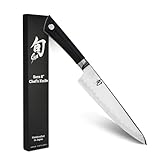
04. Best Budget Shun: Shun Sora 8-Inch Chef’s Knife
04
An accessible Shun option with a VG10 cutting edge, 420J stainless upper, and practical textured polymer handle.
The Shun Sora is the more accessible route into Shun’s Japanese-made range, but it should be judged as its own model rather than as a Classic with a few cosmetic details removed. Its composite blade combines a VG10 cutting edge with a 420J stainless upper section, while the textured polymer handle prioritizes practicality over the warmer look of pakkawood.
For everyday home cooking, the 8-inch format is familiar and versatile. The stainless construction is relatively easy to maintain, and the handle is a sensible choice for buyers who care more about grip and simple upkeep than traditional materials.
Its simpler finish also means you are paying less for decorative presentation than with some premium Damascus models.
The trade-off is refinement. Buyers who want a more substantial premium feel, a wood-style handle, or the Classic’s VG-MAX and Damascus construction should not assume the Sora delivers the same experience. As with any fine-edged Japanese-style knife, it should be kept away from bones, frozen food, and twisting cuts.
Choose the Sora if you want a practical Shun chef’s knife and prefer to keep the price below the brand’s more decorative lines. If you are paying extra mainly for materials and finish, the Classic is the more appropriate comparison.
Manufacturer details: Shun’s Sora product specifications.
- Lower entry price than Shun Classic
- VG10 cutting edge
- Familiar 8-inch chef-knife format
- Simpler construction and finish
- Not the same build as Shun Classic
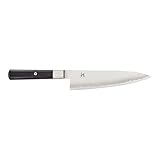
05. Best Fine-Edge Premium Pick: MIYABI Koh 8-Inch Chef’s Knife
05
A slim 8-inch FC61 stainless blade, hand-honed edge, and octagonal pakkawood handle for precise everyday cutting.
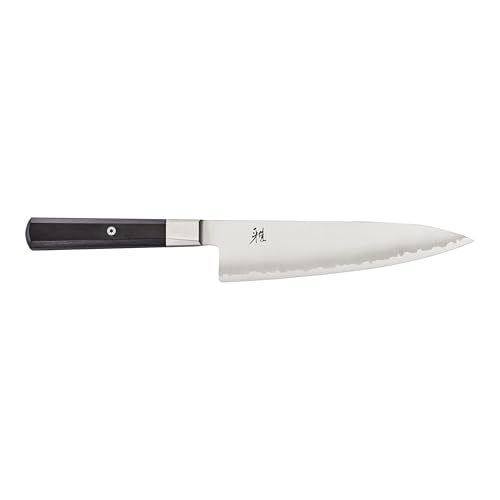
The MIYABI Koh is aimed at cooks who prefer a slim blade, a fine edge, and a traditional-looking octagonal handle. Its FC61 stainless steel is listed at approximately 61 HRC, and Zwilling describes the blade as ice-hardened and hand-honed.
Those details make it a more precision-oriented option than a thick, forgiving Western chef’s knife.
The 8-inch profile is versatile enough for routine slicing, chopping, and detail work, while the octagonal pakkawood handle gives the knife a distinctive Japanese-style feel. Its restrained appearance will appeal to buyers who want refined materials without a prominent Damascus pattern.
The Koh’s strongest selling point is the combination of a fine cutting feel and considered handle design, not simply the steel name.
A hard, thin edge needs sensible technique. Use a controlled push cut or gentle rocking motion, avoid lateral twisting, and do not force the blade through bones, frozen food, or very hard materials.
The knife also costs more than entry-level stainless options, so its price is easier to justify if you notice and appreciate the difference in blade profile and handling.
Choose the Koh if you want a precise-feeling premium knife and are prepared to care for its edge. If you prefer a tougher, less precious everyday tool, the MAC MTH-80 may be the more forgiving purchase.
Manufacturer details: Zwilling’s official MIYABI Koh specifications.
- FC61 steel listed at 61 HRC
- Thin Japanese profile and hand-honed edge
- Octagonal pakkawood handle
- Hard, fine edge needs careful technique
- Higher price than basic stainless knives
06. Best Lightweight Design: Global G-2 8-Inch Chef’s Knife
06
A lightweight 20 cm all-stainless chef’s knife with Global’s distinctive dimpled handle and CROMOVA 18 steel.
The Global G-2 is the most distinctive handle design in this group. Its one-piece stainless-steel construction and dimpled metal grip create a light, streamlined knife that feels quite different from a conventional Western chef’s knife with a separate handle.
The 20 cm blade is a useful all-purpose size for vegetables, herbs, and boneless proteins, while Global’s CROMOVA 18 stainless steel is intended to balance edge performance with corrosion resistance. The seamless construction is easy to wipe clean, and the low weight may suit cooks who dislike a heavy knife or prefer a nimble feel during repetitive prep.
The handle is also the main reason not to buy it sight unseen. Its metal surface and dimpled texture feel excellent to some users but too hard, narrow, or unfamiliar to others; comfort depends on hand size, grip, and whether your hands are wet or oily during prep.
The lightweight balance will not satisfy everyone either, especially cooks who prefer a blade with more forward weight. A secure, comfortable grip matters more than the all-metal appearance.
Choose the G-2 if low weight, stainless construction, and Global’s distinctive design appeal to you. If possible, handle one before buying. If you prefer a familiar grip and a more conventional balance, the MAC or Tojiro is a safer starting point.
- Very light, distinctive all-steel construction
- CROMOVA 18 stainless blade
- Easy-to-clean handle design
- Metal handle feel is not for everyone
- Different balance and profile from traditional gyuto
07. Best Damascus Value: Yaxell Ran Plus 8-Inch Chef’s Knife
07
A VG10-core knife with 69-layer Damascus cladding and a durable black canvas micarta handle.
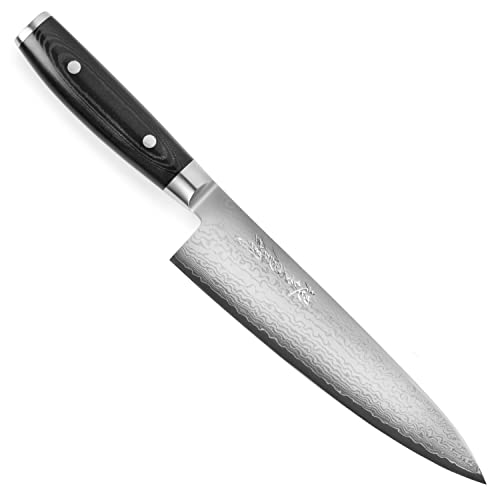
The Yaxell Ran Plus is for buyers who want a Japanese VG10-core knife with a pronounced Damascus appearance and a durable composite handle. Its construction is listed as a VG10 core with 69 layers of stainless cladding, while the black canvas micarta handle gives it a more understated, work-ready look than the patterned blade.
The VG10 core is the functional heart of the knife; the layered cladding contributes to the blade’s appearance and construction but does not, by itself, make the knife sharper or guarantee better cutting. The stated hardness is around 61 HRC, which supports a keen edge but calls for a controlled approach.
Micarta is a practical handle material for regular kitchen use because it is stable and does not need the same treatment as untreated wood.
The Ran Plus makes most sense when you genuinely value the combination of VG10, the layered finish, and the handle. If you only want a capable stainless chef’s knife, a simpler Tojiro or MAC may deliver better value. As with other hard Japanese blades, avoid bones, frozen food, prying, and forceful twisting, and use a suitable board.
Choose the Ran Plus if the Damascus finish is part of what you want and the price is competitive. If you would rather pay for practical cutting performance than decorative cladding, compare it with the Yaxell Mon before deciding.
Manufacturer details: Yaxell’s official Ran series specifications.
- VG10 core and 69-layer stainless cladding
- Micarta handle is practical
- Decorative finish at a competitive price
- Damascus pattern does not guarantee better cutting
- Hard blade is not for bones or frozen food
08. Best Santoku: Tojiro Classic Santoku 170mm
08
A compact 170 mm santoku with a VG10 core, stainless cladding, and reinforced laminated handle for everyday prep.
The Tojiro Classic Santoku is the compact all-rounder in this selection. Its 170 mm blade is shorter and generally flatter than a gyuto, which can make it easier to control on a smaller cutting board and convenient for the everyday chopping and slicing that dominate many home kitchens.
The F-503 specification lists a VG10 stainless core with 13-chrome stainless cladding, a double-bevel edge, and a reinforced laminated handle over a full tang. Tojiro lists the knife at about 190 g, so it is not an ultra-light santoku; the appeal is a sturdy, familiar construction in a shorter format.
Stainless cladding makes routine care more straightforward than with a fully reactive carbon-steel blade, although the exposed edge still needs normal washing and drying.
The flatter profile suits up-and-down chopping and push cuts better than a pronounced rocking motion. Its shorter edge also gives you less reach for large ingredients and long slicing strokes, and the 190 g weight may feel substantial to someone expecting a very light Japanese knife.
It is intended for normal kitchen ingredients, not bones or frozen food.
Choose this santoku if you want one compact knife for vegetables, fish, and boneless proteins, particularly if your board is small. If you often slice large roasts or prefer a curved edge for rocking cuts, a gyuto will be more versatile.
Manufacturer details: Tojiro’s official F-503 specifications.
- 170 mm blade is easy to control
- Double edge suits left- and right-handed cooks
- Good all-round santoku shape
- Shorter blade is less suited to large roasts
- Flatter profile is not ideal for every rocking technique
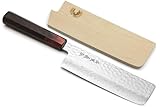
09. Best Vegetable Knife: Yoshihiro VG10 Damascus Nakiri 165mm
09
A 165 mm VG10 nakiri with hammered Damascus cladding and a rosewood octagonal handle, designed for vegetable preparation.
The Yoshihiro VG10 nakiri is the specialist choice for cooks whose prep work involves a large amount of vegetables. Its 165 mm rectangular blade has a nearly straight edge, so more of the cutting edge can meet the board at once than on a strongly curved chef’s knife.
That makes it useful for clean, repeatable cuts through carrots, cabbage, onions, and leafy greens.
This model is described with a VG10 stainless core, 46-layer hammered Damascus cladding, a double-bevel edge, and a rosewood octagonal handle. The hammered finish is visually distinctive and may help reduce some food contact, but it does not prevent ingredients from sticking.
The VG10 core and stated hardness around 60 HRC support a keen edge; the handle gives it a more traditional feel than the Western-style handles on several other picks.
The nakiri’s shape is also its limitation. Its squared-off tip and flatter edge are excellent for vegetable work but less convenient for trimming around joints, delicate tip work, or long slicing cuts.
It is not a cleaver and should not be used on bones or frozen food. The rosewood handle also deserves sensible care: do not leave the knife soaking or put it in a dishwasher.
Choose the Yoshihiro if you already own an all-purpose knife and want a dedicated vegetable tool. If this will be your only kitchen knife, a gyuto or santoku is the more flexible first purchase.
Manufacturer details: Yoshihiro’s VG10 46-layer nakiri specifications.
- 165 mm nakiri shape excels at vegetable prep
- VG10 stainless core
- Double-edged blade
- Specialist shape is less versatile than a gyuto
- Not intended for bones or heavy chopping
10. Best No-Frills VG10 Knife: Yaxell Mon 8-Inch Chef’s Knife
10
A straightforward three-layer VG10-core gyuto with stainless outer layers and a practical micarta handle.
The Yaxell Mon is the restrained alternative to the Ran Plus for buyers who want a VG10-core Japanese chef’s knife without paying specifically for a multi-layer Damascus presentation. Its three-layer construction places a VG10 cutting core between stainless outer layers, and the listed micarta handle is a practical composite option for regular kitchen use.
That simpler construction is not inherently a disadvantage. The cutting core and the way the blade is ground and sharpened matter more to everyday cutting than whether the sides display an elaborate pattern.
For a buyer who values a straightforward stainless knife and a low-maintenance handle, the Mon’s understated design may be exactly the point. Its listed hardness is around 61 HRC, so it should still be treated as a fine-edged knife rather than a heavy-duty chopper.
The main question is value relative to the Ran Plus and other VG10 options. If the Mon is only slightly cheaper, the more decorative Ran Plus may be more appealing; if the price difference is meaningful, the Mon can be the more rational buy for someone who does not care about Damascus cladding.
It is not a bargain automatically just because its finish is simpler. Check the exact model, blade length, and current seller listing before ordering, since the Mon family includes different knife shapes and sizes.
Choose the Mon when you want the VG10-core format and micarta handle but prefer a plain, functional finish. Compare its current price with the Tojiro DP and Yaxell Ran Plus before deciding which offers the better value for your needs.
- VG10 core with stainless cladding
- 61 HRC specification
- Micarta handle is low maintenance
- Less decorative than the Ran Plus
- Still needs careful handling and hand washing
Japanese Kitchen Knives Compared
The knives below cover different jobs rather than pretending that one blade shape or price range suits everyone. A gyuto is the closest Japanese counterpart to a Western chef’s knife; a santoku is shorter and flatter; a nakiri is purpose-built for vegetables.
Product prices and availability change, so use the live retailer listings for current details.
Compare Our Top Japanese Knife Picks
| Blade length | Steel | Handle style | Best for | ||
|---|---|---|---|---|---|
MAC MTH-80
Best overall
|
200 mm | Molybdenum-vanadium | Western-style | Everyday prep | BUY NOW |

Tojiro DP Gyutou
Long blade
|
240 mm | VG10 core / 13-chrome cladding | Reinforced laminated handle | Long slicing cuts | BUY NOW |

Shun Classic
Premium
|
8 in | VG-MAX core | Pakkawood | Premium all-round use | BUY NOW |
Shun Sora
Accessible Shun
|
8 in | VG10 edge / 420J body | Textured polymer | Accessible Shun option | BUY NOW |
MIYABI Koh
Fine edge
|
8 in | FC61 stainless | Octagonal pakkawood | Precise cutting | BUY NOW |

Global G-2
Lightweight
|
20 cm | CROMOVA 18 | Stainless steel | Lightweight handling | BUY NOW |

Yaxell Ran Plus
Damascus finish
|
8 in | VG10 core | Black canvas micarta | Damascus styling | BUY NOW |

Tojiro Classic Santoku
Shorter all-rounder
|
170 mm | VG10 core / 13-chrome cladding | Reinforced laminated handle | Compact everyday prep | BUY NOW |
Yoshihiro Nakiri
Vegetable prep
|
165 mm | VG10 core | Octagonal rosewood | Vegetable-focused prep | BUY NOW |
Yaxell Mon
No-frills VG10
|
8 in | VG10 core | Black canvas micarta | Lower-cost VG10 option | BUY NOW |
MAC MTH-80 vs. Tojiro DP: Which Should You Choose?
These two knives serve different priorities.
The MAC MTH-80 is the more approachable everyday choice for cooks who want a versatile 200 mm blade, a familiar Western-style handle, and a profile that transitions easily from a conventional chef’s knife.
The Tojiro DP in this roundup is a 240 mm gyuto: its longer edge gives you more reach for large ingredients and long slicing strokes, but it takes more room on the board and can feel unwieldy if you are used to an 8-inch knife.
Choose the MAC if you want one Japanese-made knife for routine home prep and prefer control over extra length.
Choose the Tojiro if you specifically want a long gyuto and have the board space and technique to use it comfortably.
This is not a simple quality ranking: the better choice depends on whether you value everyday maneuverability or a longer cutting edge.
MAC MTH-80 vs. Tojiro DP
|
Everyday versatility
MAC MTH-80
|
VS |
Long-blade reach
Tojiro DP Gyutou 240mm
|
|---|---|---|
|
200 mm
|
Blade length |
240 mm
|
|
Molybdenum-vanadium stainless
|
Steel construction |
VG10 core / 13-chrome cladding
|
|
Western-style
|
Handle |
Reinforced laminated full tang
|
|
Everyday control and general prep
|
Best suited to |
Large ingredients and long slicing cuts
|
|
Premium price; plain finish
|
Main compromise |
Longer blade needs more board space
|
| BUY NOW | BUY NOW |
How to Choose a Japanese Kitchen Knife
A good Japanese knife should match your cutting habits, not just its steel name or country of origin. Before choosing, consider these five factors.
The comparison below summarizes how the three blade shapes differ in everyday use, typical length, and versatility.
1. Choose the right blade length
A 180 mm knife is easier to control on a small board, while 210 mm is a versatile standard for many home cooks. A 240 mm gyuto offers more cutting length for large ingredients and long slicing strokes, but it needs more board space.
If you are unsure, an 8-inch chef’s knife or a 180–210 mm gyuto is usually the least surprising transition from a Western knife.
2. Understand stainless vs. carbon steel
Stainless steel is more forgiving for everyday home use because it resists corrosion. It still needs washing and drying, but it is less likely to develop rust spots when you forget to wipe it immediately.
Carbon steel can take an excellent edge and is often easier to sharpen, but it reacts more readily with moisture and acidic foods. Some knives combine a hard carbon-steel core with softer stainless cladding; the exposed cutting edge still needs carbon-steel care.
3. Do not buy by steel name alone
VG10, VG-MAX, FC61, and CROMOVA 18 are different stainless-steel formulations. A steel label does not tell the whole story.
Heat treatment, blade thickness, grind, edge geometry, and sharpening quality all affect how a knife cuts and how easy it is to maintain. A well-made, moderately priced knife can outperform a more expensive model with a less suitable grind for your technique.
4. Consider hardness and edge geometry
Many Japanese knives use harder steel and thinner edges than typical Western chef’s knives. That can support precise slicing and longer edge retention, but it also makes the blade less tolerant of twisting, prying, bones, frozen food, and hard cutting surfaces.
If you often cut through poultry joints or squash, keep a tougher beater knife for those jobs rather than forcing a thin gyuto to do everything.
5. Pick a handle that feels secure
Western-style handles are familiar and often easier for cooks transitioning from German knives. Traditional wa handles are lighter and may be octagonal, oval, or D-shaped.
Pakkawood and micarta are practical composite materials; untreated wood needs more care. If possible, hold the knife before buying, because handle comfort is highly personal.
What to Look for in a Japanese Kitchen Knife
-
Blade length
Choose a size that fits your board and hand; 180–210 mm is versatile for many homes.
Look forA 180–210 mm gyuto or 165–180 mm santoku for everyday use.AvoidA 240 mm blade if your board or prep area is cramped. -
Steel and corrosion resistance
Stainless steel is easier to live with; carbon steel needs prompt drying and more attention.
Look forA clearly identified steel and maker-published care guidance.AvoidVague listings that use 'Japanese steel' without naming the material or manufacturer. -
Blade geometry
A thin grind can slice cleanly, but a delicate edge is less tolerant of lateral force.
Look forA profile that matches your preferred push-cutting, chopping, or rocking technique.AvoidUsing a thin knife for bones, frozen foods, or prying. -
Handle comfort
Handle shape, balance, and grip affect control during longer prep sessions.
Look forA secure grip and a handle shape that feels natural in your hand.AvoidChoosing only by appearance or handle material. -
Authentic origin and seller
Brand, model, manufacturing location, and warranty should be traceable.
Look forAn official product page and a reputable seller with clear returns.AvoidUnverifiable 'hand-forged Japanese' claims from anonymous marketplace brands.
Should You Buy a Japanese Kitchen Knife Set?
Most home cooks are better off starting with one good gyuto or santoku rather than buying a large Japanese kitchen knife set. Sets can be convenient, but they may include shapes you rarely use, and a high piece count does not guarantee consistent steel or workmanship.
If you want a set, look for a practical combination such as a chef’s knife or gyuto, a paring knife, and a utility or santoku knife. Check the exact model names, steel details, country of origin, warranty, and storage included.
A Japanese knife set on Amazon can make sense as a gift, but compare the individual knives—not just the Damascus pattern or number of pieces—before buying.
What Do Japanese Knife Enthusiasts Recommend on Reddit?
Discussions in r/chefknives and r/TrueChefKnives frequently bring up Tojiro DP and the MAC MTH-80 as sensible first Japanese knives. The recommendations are not unanimous: some owners prefer Tojiro’s harder VG10 edge for precise cutting, while others favor the MAC as a more forgiving everyday workhorse.
Several discussions also emphasize handling a knife before buying because grip and balance are personal. Treat Reddit threads as owner anecdotes and recurring community preferences—not controlled tests—and verify the exact model and specifications before ordering.
Searches for “best Japanese kitchen knives Reddit” or “best Japanese knives Reddit” can be useful for finding owner experiences, but forum recommendations reflect individual preferences and maintenance habits. Use them to identify models worth researching, then confirm the exact knife’s specifications and seller details before buying.
See this Tojiro DP vs. MAC MTH-80 discussion and this beginner Japanese knife recommendation thread.
Japanese Knife Types: Gyuto vs. Santoku vs. Nakiri
Japanese kitchen knives are not all shaped for the same job.
The gyuto is the most versatile option for general cooking, the santoku is a shorter all-rounder, and the nakiri is designed specifically for vegetable preparation.
Their blade profiles affect how they move through food and how they feel on the cutting board.
Gyuto: The Most Versatile Japanese Chef’s Knife
A gyuto is the Japanese-style chef’s knife for cooks who want one blade to handle most everyday kitchen tasks. Its gently curved edge supports a rocking motion as well as push-cutting, while the pointed tip helps with precise work such as trimming, scoring, and separating smaller ingredients.
Common gyuto lengths run from about 180 to 240 mm, so choose a shorter blade if you have limited board space or prefer a more compact knife.
Santoku: A Compact Everyday All-Rounder
A santoku is a compact all-purpose Japanese knife, commonly around 165 to 180 mm long. Its taller blade and comparatively flat edge suit the up-and-down chopping and push-cutting motions used for vegetables, boneless meat, and fish.
The rounded or less pointed tip gives it a different feel from a gyuto, and its shorter length can be easier to control on a small cutting board. It is a strong everyday option, although it offers less reach for long slicing cuts.
Nakiri: A Specialist Knife for Vegetables
A nakiri is a Japanese vegetable knife with a rectangular blade and a very straight cutting edge. Because much of the edge can meet the board at once, it works especially well for chopping, slicing, and dicing vegetables in a repeated up-and-down motion.
Most nakiri blades are about 165 to 180 mm long. The squared-off shape is specialized, however: it is less convenient for tasks that need a pointed tip or a curved edge, so it is usually best as a second knife rather than the only knife in a kitchen.
Gyuto vs. Santoku vs. Nakiri
|
Gyuto
Tojiro DP Gyutou
|
Santoku
Tojiro Classic Santoku
|
Nakiri
Yoshihiro VG10 Nakiri
|
|
|---|---|---|---|
|
|
|
|
|
| Typical blade length | 180–240 mm | 165–180 mm | 165–180 mm |
| Blade profile | Curved edge; pointed tip | Flatter edge; rounded tip | Straight edge; rectangular blade |
| Best for | All-purpose prep and slicing | Everyday chopping and dicing | Vegetable slicing and chopping |
| Main advantage | Most versatile shape | Compact and easy to control | Full edge contact on the board |
| Main limitation | Longer models need board space | Less reach for long slicing | Less versatile beyond vegetables |
| BUY NOW | BUY NOW | BUY NOW |
Which Japanese Knife Should You Choose?
Choose a gyuto if you want the most versatile single knife and regularly make longer slicing cuts. Choose a santoku if you prefer a shorter, easier-to-control blade for everyday chopping. Choose a nakiri when vegetable preparation is your main priority and you already have an all-purpose knife for other tasks.
For most first-time buyers, a gyuto or santoku is the more practical choice. A nakiri is worth adding when vegetable preparation is a major part of your routine, but it is a specialist blade rather than a replacement for an all-purpose knife.
Notable handmade Japanese knife makers
Japan has both large knife manufacturers and independent artisans. Established companies such as Tojiro, Kai (Shun), Global, MIYABI, and Yaxell offer named product lines with more standardized specifications and broad retail availability.
Independent makers often work through specialist shops and may produce smaller batches, distinctive grinds, or hand-finished details.\n\nNames often encountered in the handmade-knife market include Yu Kurosaki, Takeshi Saji, Yoshimi Kato, and Yoshikazu Tanaka.
Their work is not interchangeable: compare the exact model, steel, heat treatment, grind, handle, and seller rather than assuming that a handmade knife is automatically sharper or better.
Where are Japanese kitchen knives made?
Japanese knife production is spread across several regions, and the place of manufacture can help explain a knife’s tradition—but it does not guarantee quality by itself. Sakai (Osaka) is especially associated with traditional Japanese-style blades and specialist single-bevel knives.
Seki (Gifu) is a major cutlery center known for a broad range of modern kitchen knives.
Tsubame-Sanjo (Niigata) has a strong metalworking and stainless-cutlery tradition, while
Echizen (Fukui) and Tosa (Kochi) are also important knife-making areas.\n\nFor a useful overview, see the Japan National Tourism Organization’s guide to Tsubame-Sanjo and Sakai Ichimonji’s explanation of Japan’s knife-making regions.
Check the exact model’s country-of-origin statement: a Japanese brand name does not, on its own, prove that a particular knife was made in Japan.
How to Care for Japanese Kitchen Knives
Japanese knives last longer when you protect the edge from impact and moisture. Even stainless models should be hand-washed and dried promptly unless the manufacturer explicitly says otherwise.
- Wash by hand: Use mild soap and a soft sponge. Do not leave the knife soaking in a sink.
- Dry immediately: Wipe the blade completely before storage, especially after cutting acidic or salty foods.
- Use a suitable board: Wood or a knife-friendly synthetic/rubber board is preferable to glass, stone, ceramic, or metal. Hard surfaces can dull or chip a thin edge.
- Avoid twisting and prying: Use a cleaver or tougher knife for bones, frozen food, and hard materials.
- Store safely: Use a saya, blade guard, knife block, or magnetic rack that protects the edge. Do not leave the knife loose in a drawer.
- Sharpen appropriately: A whetstone is a reliable choice for many Japanese knives. Follow the maker’s recommended angle and method; some asymmetric or single-bevel blades require specialist technique.
- Treat carbon steel differently: Wipe it during prep when needed, wash and dry it promptly, and apply a light coat of food-safe oil for longer storage if the maker recommends it.
There is no fixed sharpening calendar that suits every knife. Sharpen when the edge no longer performs well with normal honing or maintenance, and use a method appropriate to its bevel and steel.
If you are new to whetstones—or own an expensive, asymmetric, or single-bevel knife—learning from the maker or a qualified sharpener is safer than guessing at an angle.
Storage and Sharpening
The best way to store Japanese kitchen knives is to keep the edge from rubbing against other utensils. Use a knife block with correctly sized slots, a wall-mounted magnetic strip, or individual blade guards in a drawer.
Do not leave a Japanese knife loose in a cutlery drawer, and avoid storing it while wet. A wooden or quality composite cutting board is also kinder to a fine edge than glass, stone, or ceramic.
For sharpening, a whetstone is usually the most versatile option for a double-bevel gyuto or santoku when used correctly.
The best knife sharpener for Japanese kitchen knives depends on the blade: a simple guided system may help some home cooks, while single-bevel knives and expensive thin-grind blades are better handled by someone who understands their geometry.
Avoid aggressive pull-through sharpeners that remove too much steel. The best way to sharpen Japanese kitchen knives is to maintain the existing bevel carefully, use light pressure, and follow the maker’s guidance.
Are Japanese Knives Worth It?
A well-made Japanese kitchen knife can be worth the price if you value a thin, precise edge and are willing to care for it properly.
The benefits are not automatic: a harder, thinner blade may chip if twisted, used on bones, or paired with a hard glass cutting board, and some carbon-steel models need more attention to prevent rust.
For most home cooks, one dependable gyuto or santoku is a better first purchase than an expensive set. Choose a model that fits your hand, cutting style, board size, and maintenance habits.
If you prefer rougher handling or rarely sharpen your knives, a tougher Western-style knife may be the more practical everyday tool.
If you are also choosing the rest of your kitchen setup, see our guide to the best cookware sets for a comparison of stainless steel, ceramic, and nonstick options. For pan-specific advice, read our guide to the best non-toxic pans. If you are leaning toward stainless steel, our All-Clad D3 vs. D5 comparison explains the differences between the two constructions.
How We Selected These Japanese Kitchen Knives
This is a research-based buying guide, not a hands-on test. We compared identifiable models using manufacturer specifications, product construction, stated country of origin, blade shape, steel type, intended use, and availability through US-facing retail listings. We prioritized established makers and models with traceable specifications, and assigned each pick a specific use case so readers can choose by needs rather than by an arbitrary universal ranking.
-
Model and maker verification
We favored products with a traceable manufacturer, model name, and published construction details.
-
Blade and steel suitability
We considered blade length, edge style, steel type, and how those characteristics fit common home-cooking tasks.
-
Practical ownership
We considered care requirements, handle materials, sharpening needs, and how demanding the blade may be for a first-time owner.
-
US availability
We checked US-facing Amazon listings for the products attached to this draft; prices, stock, and seller details can change.
No knife was physically tested for this article. Product descriptions are editorial assessments based on published specifications and research, not claims of personal use.
Frequently Asked Questions About Japanese Kitchen Knives
What are the best Japanese kitchen knives for most home cooks?
The MAC MTH-80 is a strong all-round choice for cooks who prefer a familiar Western-style handle. Tojiro offers good value, while Shun Classic and MIYABI Koh suit buyers who want a more premium finish and a fine edge. The best option depends on blade length, handle comfort, and how carefully you maintain it.
What are the best Japanese knife brands?
Shun, Tojiro, MAC, MIYABI, Global, Yaxell, Sakai Takayuki, Misono, Masamoto, and Takamura are established names worth comparing. For handmade knives, look at individual makers such as Yu Kurosaki, Takeshi Saji, Yoshimi Kato, and Yoshikazu Tanaka.
Are Japanese kitchen knives better than German knives?
Neither is universally better. Japanese knives often have thinner blades, harder steel, and sharper edge geometry for precise slicing. German knives are often thicker and more forgiving for heavy chopping and rougher use. Choose based on your cutting technique and maintenance habits.
Is Shun a good Japanese knife brand?
Shun is a well-known Japanese knife brand from Kai, with widely available lines such as Classic and Sora. It is a good choice for buyers who value a refined finish, established support, and a sharp edge. Its thinner, harder blades still need careful handling.
What is the best budget Japanese kitchen knife?
In this roundup, the Yaxell Mon is the lower-cost VG10-core option. Tojiro is another value-focused Japanese maker, although the 240 mm DP model featured here is a long-blade choice rather than the most compact budget pick. Compare the exact model, blade length, seller, and return policy rather than buying a generic knife solely because its listing says Japanese steel.
What is the difference between a gyuto and a santoku?
A gyuto is a longer, pointed Japanese chef’s knife with a more curved edge. A santoku is usually shorter and taller, with a flatter profile that many cooks find comfortable for vegetables and everyday prep. A gyuto is more versatile for long slicing cuts; a santoku is compact and easy to control.
Are Damascus Japanese knives sharper?
Not automatically. Damascus describes layered cladding or a visible pattern, not a guarantee of cutting performance. Steel quality, heat treatment, grind, blade thickness, and sharpening determine how a knife cuts. A plain-finish knife can outperform a decorative Damascus model.
Can Japanese kitchen knives go in the dishwasher?
Most should be hand-washed and dried immediately. Dishwasher heat, detergent, and movement can damage handles and chip or dull the edge. Follow the care instructions for the exact model.
What is the best way to sharpen Japanese kitchen knives?
A whetstone is a common choice, but the correct angle and technique depend on the knife. Double-bevel gyuto and santoku knives are different from single-bevel yanagiba or deba knives. Avoid aggressive pull-through sharpeners and consult the maker or a qualified sharpener if unsure.
Are Japanese knives made in Japan on Amazon?
Some are, but marketplace listings vary. Check the exact model, manufacturer, country-of-origin statement, seller identity, and official product page. A Japanese-sounding brand name or a Damascus pattern is not proof that a knife was made in Japan.
Which Japanese Kitchen Knife Should You Buy?
- Choose one good gyuto or santoku before buying a large set.
- Do not pay extra for Damascus unless you also like the knife’s geometry and handle.
- Buy from a reputable seller and verify the exact model and country of origin.
- Hand-wash, dry, and store the blade safely.
For a versatile Japanese-made knife that suits everyday home cooking, start with the MAC MTH-80. Choose Tojiro if value matters most, Shun Classic or MIYABI Koh if you want a more premium finish and fine edge, Global if you prefer a lightweight all-stainless design, and a santoku or nakiri if your prep style favors those blade shapes. The right knife is the one that fits your hand, board, cutting technique, and willingness to care for it.