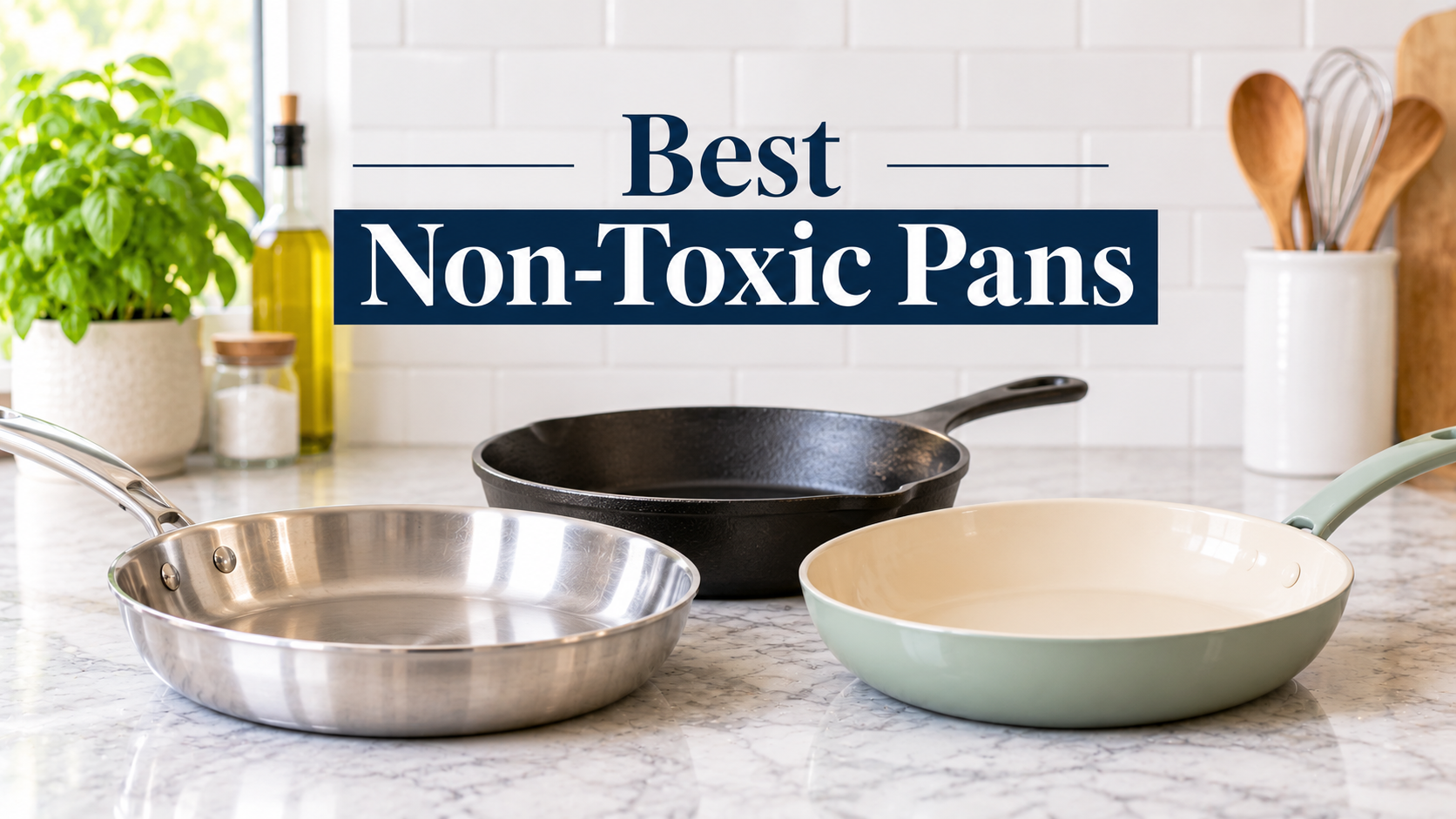
Best Non-Toxic Pans in 2026
Choosing the best non-toxic pans is not as simple as buying anything labeled “PFOA-free,” “granite,” or “natural.” Those phrases can hide important differences in the cooking surface. A pan may be made from stainless steel, cast iron, carbon steel, or aluminum with a ceramic coating—and each material behaves differently.
For most kitchens, the most sensible approach is to build around an uncoated pan that can last for years, then add one PFAS-free ceramic pan if you want easy-release eggs and delicate foods. Uncoated stainless steel, cast iron, and carbon steel avoid the need for a synthetic nonstick coating. Ceramic-coated pans can offer convenient food release, but their coating is not permanent.
This guide compares eight options available through Amazon US, explains what their cooking surfaces are made of, and shows where each one makes sense. We do not describe a pan as “toxin-free” simply because its marketing says so, and we do not claim to have physically tested products we have not tested.
Key Takeaways
- Best long-term all-rounder Uncoated stainless steel is versatile and durable if you are comfortable learning how to cook on it.
- Best for eggs PFAS-free ceramic-coated cookware is convenient, but its easy-release performance declines over time.
- Best uncoated high-heat options Bare cast iron and carbon steel avoid applied nonstick coatings and can last for years with proper care.
- Best cast-iron alternative without seasoning Enameled cast iron offers cast-iron heat retention with a glass-based cooking surface, but it is heavy and can chip.
- Read beyond the label “PFOA-free,” “granite,” and “stone” do not by themselves establish that a pan is PFAS-free.
Best Non-Toxic Pans at a Glance




Important: Product prices, stock, and model specifications change. Check the exact size and current manufacturer description before buying. “Best” here means best fit for a particular use—not a claim that every pan has been independently lab-tested by The Everyday Kitchen.
How We Chose These Non-Toxic Pans
We prioritized the material that touches food, the presence or absence of a nonstick coating, construction, practical cooking use, stove compatibility, maintenance, and whether the manufacturer makes specific material claims. We also favored recognizable cookware makers and product lines with clearly described construction over vague “healthy granite” marketing.
-
Material and food-contact surface
We prioritized the material that touches food and whether the pan uses an applied nonstick coating.
-
Construction and practical use
We considered construction, heat behavior, stove compatibility, maintenance, and intended cooking tasks.
-
Evidence and transparency
Manufacturer material statements are identified as such, not presented as independent chemical testing.
This is a research-based buying guide, not a hands-on laboratory test. We have not independently tested these eight pans for chemical migration, coating wear, heat distribution, or long-term durability. Where a safety-related feature is based on a manufacturer statement, we identify it as such rather than presenting it as an independent test result.
Best Non-Toxic Pans for Cooking Reviews
1. Best Ceramic Nonstick Pan – GreenPan Valencia Pro 10-Inch Frying Pan
Best for eggs and delicate foods
A PFAS-free ceramic-coated option with an induction-compatible hard-anodized body. Its easy-release surface is convenient, but ceramic coatings gradually lose performance and should be treated as a replaceable cooking surface.
The GreenPan Valencia Pro is the strongest fit for cooks who want a conventional nonstick experience while avoiding intentionally added PFAS in the cooking coating. Its Thermolon ceramic nonstick surface is marketed by GreenPan as free of PFAS, PFOA, lead, and cadmium. The pan has a hard-anodized aluminum body and a magnetic base designed to work on induction cooktops.
Its main advantage is convenience. Ceramic nonstick is particularly useful for eggs, omelets, pancakes, and other foods that are frustrating in stainless steel. The 10-inch size is practical for one or two portions, while the Valencia Pro line is offered in other sizes if you cook for a family.
The trade-off is the coating. Ceramic nonstick does not last indefinitely, and its easy-release performance can decline with repeated use. Treat it as a replaceable convenience pan, not a lifetime skillet. Use low-to-medium heat, avoid thermal shock, and follow the care instructions even if the listing says the pan is dishwasher-safe.
Best for: Eggs, omelets, pancakes, and cooks who want PFAS-free ceramic nonstick with induction compatibility.
Not ideal for: Very high-heat searing, metal-utensil habits, or anyone expecting a ceramic coating to last as long as bare stainless steel.
- PFAS-free ceramic coating stated by the manufacturer
- Easy food release for eggs and pancakes
- Induction-compatible magnetic base
- Ceramic coating wears with use
- Not the best choice for prolonged high-heat searing
- Requires gentle care to preserve food release
2. Best Affordable Stainless Steel Pan – Tramontina Signature Tri-Ply Clad 10-Inch Frying Pan
Best for everyday uncoated cooking
An uncoated stainless-steel cooking surface over an aluminum core. It is a versatile, durable choice for browning, sautéing, and pan sauces, although delicate foods require proper preheating and cooking fat.
If you want a pan without a nonstick coating, the Tramontina Signature Tri-Ply Clad is one of the more sensible places to start. Its cooking surface is stainless steel, with an aluminum core sandwiched between stainless layers to improve heat distribution. There is no ceramic or PTFE nonstick layer to wear away.
Stainless steel is a practical everyday material because it handles browning, sautéing, pan sauces, and acidic ingredients better than bare cast iron or carbon steel. It is also compatible with induction when the specific model has a magnetic exterior, as this line does.
The learning curve is real: eggs and other delicate foods can stick if the pan is not preheated correctly or if you use too little fat. That is a cooking-technique issue, not evidence that the pan is unsafe. Preheat gradually, add oil or butter, and let food release naturally before turning it.
Best for: Everyday cooking, searing, vegetables, sauces, and buyers who want an uncoated pan at a reasonable price.
Not ideal for: Anyone who expects food to slide around like it does on a fresh nonstick coating.
- Uncoated stainless-steel food-contact surface
- Tri-ply construction with aluminum core
- Induction-ready and versatile
- Food can stick without good heat control
- Less forgiving for eggs than nonstick
- Requires more technique than ceramic
3. Best Budget Cast Iron Pan – Lodge Chef Collection 10-Inch Skillet
Best for searing and heat retention
A pre-seasoned cast-iron skillet with no synthetic nonstick coating. It retains heat well and can last for decades, but it is heavier than most alternatives and needs to be dried and maintained.
Cast iron is one of the simplest choices if your priority is avoiding synthetic nonstick coatings. The Lodge Chef Collection skillet is made from cast iron and comes pre-seasoned with an oil-based layer that helps protect the surface and improve food release. Seasoning is not a synthetic nonstick coating; it is a thin layer of polymerized cooking oil bonded to the iron.
Cast iron excels at retaining heat. It is a strong choice for searing meat, frying potatoes, baking cornbread, and cooking dishes that benefit from steady heat. It works on gas, electric, and induction cooktops, and it can move from stovetop to oven when used within the manufacturer’s temperature guidance.
The downsides are weight and upkeep. Cast iron heats more slowly than thin aluminum, can be awkward to lift when full, and needs to be dried thoroughly after washing. Acidic foods such as tomato sauce can interact with a new or poorly seasoned surface, especially during long cooking times. It is also not the best choice if you want a lightweight pan for quick weekday cooking.
Best for: Searing, frying, oven cooking, induction, and long-term value.
Not ideal for: Cooks who dislike heavy cookware or do not want to maintain seasoning.
- No synthetic nonstick coating
- Excellent heat retention
- Durable and relatively affordable
- Heavy compared with stainless or carbon steel
- Needs seasoning care and thorough drying
- Long acidic cooking can affect seasoning
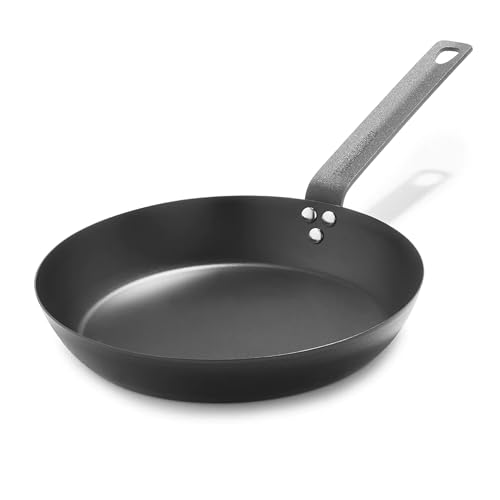
4. Best Budget Carbon Steel Pan – Merten & Storck 10-Inch Pre-Seasoned Carbon Steel Pan
Best for high-heat cooking
A pre-seasoned carbon-steel pan that is lighter and more responsive than cast iron. Its cooking surface is uncoated; food release improves with seasoning and proper heat control.
Carbon steel is a useful middle ground between stainless steel and cast iron. It is generally lighter than cast iron, responds more quickly to temperature changes, and can develop a naturally slick seasoned surface with repeated cooking. The Merten & Storck 10-inch pan arrives pre-seasoned, so it is a more approachable starting point than an untreated carbon steel skillet.
There is no applied PTFE or ceramic nonstick layer on the cooking surface. Instead, food release improves as you build and maintain seasoning. This makes carbon steel attractive to cooks who want a durable pan for eggs, vegetables, stir-frying, and searing without relying on a disposable nonstick coating.
Carbon steel does require attention. Dry it promptly, apply a very thin layer of oil when needed, and avoid leaving acidic foods such as tomato or vinegar-based sauces in the pan for extended periods. The seasoning can be damaged by aggressive cleaning or prolonged acidic cooking, but it can be rebuilt.
Best for: High-heat cooking, stir-frying, searing, and cooks willing to maintain seasoning.
Not ideal for: Low-maintenance cooking or frequent long-simmered tomato sauces.
- Uncoated carbon-steel cooking surface
- Lighter and more responsive than cast iron
- Suitable for induction and high-heat cooking
- Seasoning needs maintenance
- Acidic foods can strip seasoning
- Not as low-maintenance as stainless steel
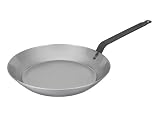
5. Best Premium Carbon Steel Pan – Matfer Bourgeat Black Carbon Steel Frying Pan
Best for experienced home cooks
A professional-style, uncoated carbon-steel pan built for searing and temperature control. It rewards proper seasoning and care, but is less convenient for cooks who want a maintenance-free skillet.
Matfer Bourgeat is a professional-oriented carbon steel option for cooks who want an uncoated pan with a long service life. Its black carbon steel surface has no synthetic nonstick coating. Once properly seasoned, it can develop good food release while remaining capable of high-heat searing and fast temperature response.
The larger 12 5/8-inch version offers room for multiple portions, making it useful for searing meat, browning vegetables, and cooking larger meals. It is also a more serious piece of cookware than a lightweight ceramic pan, so expect a different cooking experience and more hands-on maintenance.
Its main weakness is that carbon steel is not carefree. The pan needs seasoning, thorough drying, and sensible storage. Acidic ingredients can strip seasoning or react with exposed iron. It is also not the best pan for a beginner who wants to cook eggs immediately without learning heat control.
Best for: Experienced home cooks, high-heat searing, and a durable uncoated cooking surface.
Not ideal for: Beginners seeking effortless nonstick performance or people who cook acidic sauces in the same pan every day.
- Uncoated carbon-steel surface
- Strong searing performance and temperature response
- Can provide long service with proper care
- Requires seasoning and careful drying
- Not suited to long acidic cooking
- Higher price than entry-level carbon steel
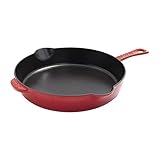
6. Best Enameled Cast Iron Pan – Staub 11-Inch Enameled Cast Iron Skillet
Best for cast-iron heat without seasoning
Cast iron with a black matte vitreous-enamel cooking surface. It avoids seasoning and handles acidic ingredients, but it is heavy, costly, and the enamel can be damaged by impact or thermal shock.
The Staub 11-Inch Cast Iron Skillet gives this roundup a different option from bare cast iron. It has a cast-iron body with a black matte vitreous-enamel interior. Staub describes that interior as glass-based enamel bonded to the iron, not exposed cast iron and not a conventional synthetic nonstick coating. It is designed for browning and searing without the seasoning routine required by bare cast iron.
The main advantage is convenience: the enamel surface does not need seasoning and can be used with acidic ingredients such as tomato-based sauces. Staub says its cookware is regularly tested by third-party laboratories and that its enamel is designed to meet applicable food-contact requirements. Those are manufacturer statements, not independent tests conducted by The Everyday Kitchen. Read Staub’s safety and materials information.
The compromises are substantial. This is a heavy, premium-priced skillet, and its enamel is not indestructible: hard impacts, sudden temperature changes, or misuse can damage it. It also does not behave like a slick ceramic or PTFE nonstick pan. Use moderate heat, avoid thermal shock, and follow Staub’s care guidance.
Best for: Cooks who want cast-iron heat retention and an enamel cooking surface that does not require seasoning.
Not ideal for: Budget buyers, anyone who wants lightweight cookware, or people expecting effortless nonstick release.
- Vitreous-enamel food-contact surface; no seasoning required
- Cast-iron body retains heat well
- Enamel surface is suitable for acidic ingredients when used as directed
- Manufacturer publishes material and safety information
- Heavy and more expensive than bare cast iron
- Enamel can be damaged by impact or thermal shock
- Not a true nonstick pan
7. Best Classic Stainless Steel Skillet – Cuisinart Chef’s Classic 12-Inch Skillet
Best for larger everyday meals
An uncoated stainless-steel skillet with an encapsulated aluminum base. It offers a practical stainless option, though its disc-bottom construction differs from fully clad cookware.
The Cuisinart Chef’s Classic 12-inch skillet is a straightforward option for cooks who want a stainless-steel food-contact surface without paying premium-clad cookware prices. Its construction uses stainless steel with an encapsulated aluminum base, which helps spread heat across the bottom of the pan.
Unlike a fully clad pan, a disc-bottom design concentrates its added conductive layer in the base rather than extending it up the sides. That is not automatically a problem, but it can produce a different heating pattern when cooking across the entire surface. For ordinary sautéing, shallow frying, and one-pan meals, it can be a practical value choice.
The stainless cooking surface is uncoated and durable. As with other stainless pans, delicate foods require the right preheating and enough cooking fat. Check the exact model’s compatibility and oven limits before use, because specifications can differ across Cuisinart product lines.
Best for: Buyers who want an uncoated stainless skillet at an accessible price.
Not ideal for: Cooks who specifically want fully clad construction from base to rim.
- Uncoated stainless-steel cooking surface
- Encapsulated aluminum base
- Induction-compatible model listing
- Disc-bottom construction rather than fully clad sides
- Food release depends on technique
- Large 12-inch size may not suit small burners
8. Best Lower-Cost Ceramic Alternative – SENSARTE 12.5-Inch Ceramic Frying Pan
Best for a larger nonstick cooking area
A budget-oriented ceramic-coated pan marketed as PFAS-, PTFE-, and PFOA-free. It offers convenient food release and a generous cooking area, but its coating will not last as long as uncoated stainless steel or iron.
The SENSARTE 12.5-inch ceramic frying pan is a budget-oriented choice for people who want a broad nonstick surface for eggs, pancakes, and quick meals. The manufacturer describes its coating as free of intentionally added PFAS, PTFE, and PFOA, and the listing identifies it as induction-compatible.
That makes it worth considering if you want a ceramic-coated pan without spending as much as you might on a premium cookware line. However, a manufacturer’s material statement is not the same as independent testing of every batch or proof that a pan is harmless under every possible use condition. Check the current product listing and any available test documentation before buying.
As with other sol-gel ceramic coatings, expect food release to decline over time. Avoid overheating an empty pan, use gentle utensils, and hand-wash if you want to extend the coating’s useful life. The large size is convenient for family cooking but may be too wide for a small burner.
Best for: Budget-conscious buyers who want a large ceramic-coated nonstick pan for everyday low-to-medium-heat cooking.
Not ideal for: High-heat searing, long-term durability, or buyers who want an uncoated pan.
- Manufacturer states PFAS/PTFE/PFOA-free coating
- Large cooking surface
- Induction-compatible according to the listing
- Ceramic coating can lose nonstick performance
- Manufacturer claims are not independent testing
- Large diameter may heat unevenly on a small burner
Which Pan Material Is Actually the Best for Health-Conscious Cooking?
The best non-stick pan material depends on what you mean by “best.” If you want to avoid applied nonstick coatings altogether, choose uncoated stainless steel, cast iron, or carbon steel. If you want easier food release and are specifically avoiding PFAS, a ceramic-coated pan can be a practical compromise—but it is still a coating that wears with use.
Stainless Steel: Best All-Around Uncoated Choice
Stainless steel is durable, non-reactive for most normal cooking, and suitable for acidic ingredients. It does not provide built-in nonstick release, so technique matters. People with a known nickel sensitivity may prefer to discuss cookware choices with a qualified clinician; stainless steel grades differ in composition, and “stainless” does not mean every alloy is identical.
Cast Iron: Best for Heat Retention and Long-Term Use
Cast iron has no synthetic nonstick coating. Its seasoned surface is formed from cooking oil, and the pan can last for decades with basic care. It is heavy, slower to heat, and can transfer small amounts of iron to food. That is not automatically harmful, but people who have been told to limit iron intake should seek individualized medical advice.
Enameled Cast Iron: Cast-Iron Heat Without Seasoning
Enameled cast iron has a cast-iron body covered by a fired, glass-based enamel surface. Unlike bare cast iron, it does not need a seasoning layer and is generally easier to use with acidic ingredients. The trade-off is that enamel can chip or crack if the pan is dropped, struck, or exposed to sudden temperature changes. It is also not a synthetic nonstick coating and should not be expected to release food like a fresh ceramic or PTFE pan. Check the manufacturer’s care instructions and stop using cookware if the food-contact enamel becomes damaged.
Carbon Steel: Best for High Heat Without a Synthetic Coating
Carbon steel offers a similar seasoned cooking surface to cast iron but is usually lighter and more responsive. It is excellent for searing and stir-frying. It needs seasoning and is less suitable for long acidic cooking, so it is not the easiest single pan for every household.
Ceramic-Coated Nonstick: Best for Convenient Food Release
Ceramic-coated pans typically use a silica-based sol-gel coating over a metal body. Many brands market these coatings as PFAS-free. They can be useful for eggs and delicate foods, but their nonstick performance tends to decline faster than an uncoated pan’s service life. “Ceramic” in this context usually means a coating, not a solid ceramic pan.
PTFE Nonstick: Not the Choice If Your Goal Is Avoiding PFAS
PTFE is a fluoropolymer used in many conventional nonstick coatings. PFOA is a different chemical that was historically used in the manufacture of some nonstick products, so a PFOA-free label alone does not establish that a pan is PTFE-free or free of every PFAS. Health Canada advises consumers not to preheat empty nonstick cookware and to avoid high-heat use above 260°C (500°F). If your goal is to avoid PTFE or PFAS-based coatings altogether, check the exact product’s material disclosure rather than relying on a PFOA-free claim. Health Canada’s cookware safety guidance.
Compare the Best Non-Toxic Pans
| Food-contact surface | Applied nonstick coating | Best use | Maintenance | Main compromise | ||
|---|---|---|---|---|---|---|

GreenPan Valencia Pro
Ceramic nonstick
|
Ceramic coating | Yes, ceramic | Eggs and delicate foods | Gentle care; coating wears | Finite coating life | BUY NOW |

Tramontina 10-Inch
Stainless steel
|
Stainless steel | No | Everyday browning | Preheat and use fat | Food can stick | BUY NOW |

Lodge Chef Collection
Bare cast iron
|
Seasoned iron | No | Searing and heat retention | Seasoning; dry promptly | Weight and upkeep | BUY NOW |

Merten & Storck
Carbon steel
|
Seasoned steel | No | High heat and stir-fry | Seasoning; dry promptly | Seasoning upkeep | BUY NOW |
Matfer Bourgeat
Premium carbon steel
|
Seasoned steel | No | Searing and large portions | Seasoning; dry promptly | Price and upkeep | BUY NOW |
Staub 11-Inch
Enameled cast iron
|
Vitreous enamel | No, enamel | Searing and acidic foods | Avoid chips and thermal shock | Weight and price | BUY NOW |

Cuisinart 12-Inch
Stainless steel
|
Stainless steel | No | Everyday meals | Preheat and use fat | Disc-bottom heating | BUY NOW |

SENSARTE 12.5-Inch
Ceramic nonstick
|
Ceramic coating | Yes, ceramic | Eggs and larger portions | Gentle care; coating wears | Finite coating life | BUY NOW |
What to Look for When Buying Non-Toxic Pans
-
Clear coating disclosure
Identify the exact food-contact coating rather than relying on broad marketing language.
Look forA clear statement about PTFE, PFAS, and the specific coating used.AvoidAssuming PFOA-free means PFAS-free, or that “granite” and “stone” identify a material. -
The actual food-contact surface
The outside material does not necessarily tell you what touches food.
Look forSpecific construction details for the cooking surface and any coating.AvoidAssuming a stainless exterior means an uncoated stainless interior. -
Credible documentation
Safety claims should be supported by meaningful documentation.
Look forTesting details that identify what was tested, by whom, and against which standard.AvoidVague “non-toxic” claims without supporting information. -
Cooktop and size compatibility
A good material choice still needs to work with your kitchen.
Look forConfirmed induction compatibility and a base sized for your burner.AvoidAssuming every stainless or ceramic pan works on induction. -
Realistic service life
Choose a pan whose maintenance and expected lifespan fit your habits.
Look forUncoated stainless, cast iron, or carbon steel for longevity; ceramic for convenience.AvoidExpecting ceramic nonstick to last indefinitely.
Common Non-Toxic Cookware Myths: Fact vs. Fiction
PFOA is only one member of the broader PFAS family; the label alone does not establish that a product is PFAS-free.
Check the manufacturer’s explicit statement about the coating and PFAS.
Ceramic sol-gel coatings gradually lose their easy-release performance.
Treat ceramic nonstick as a convenience surface with a finite service life.
Risk depends on the material, condition, and how the pan is used; avoid overheating and follow the manufacturer’s instructions.
Avoid sweeping claims and distinguish coating types.
Are Ceramic Non-Toxic Pans Really Safe?
Ceramic-coated pans are popular because many use a PFAS-free sol-gel coating rather than PTFE. That can make them a reasonable option for shoppers who want to avoid fluoropolymer nonstick surfaces. However, “ceramic” is not a regulated guarantee that a pan contains no substances of concern, and it does not tell you how the coating performs after years of wear.
Look for a clear statement about PFAS and PTFE, ask whether lead and cadmium are tested for where relevant, and favor brands that make product-specific documentation available. Do not assume a ceramic coating is indestructible or that a pan can safely be overheated because a product page uses the phrase “non-toxic.”
Are Stainless Steel Pans Safer Than Nonstick Pans?
Uncoated stainless steel avoids the need for a synthetic nonstick layer, which is why it is a strong option for people who want to reduce exposure to PFAS-based coatings. It is also durable and versatile. That does not mean every stainless steel pan is identical: alloy grade, construction, and the condition of the cooking surface still matter.
Stainless steel can release small amounts of nickel and chromium into food, particularly during long cooking with acidic ingredients and when cookware is new. A study of 18/10 stainless steel pots found that release varied with acidity, cooking time, and prior use; under the study’s tested conditions, the measured amounts were below known allergy-triggering thresholds for most people, although highly sensitive individuals may still need to take care. This is a more accurate way to frame the issue than saying stainless steel is either completely inert or broadly unsafe. See the 2017 study published in Contact Dermatitis.
Best Non-Toxic Pans for Eggs
If eggs are your main reason for buying a non-toxic frying pan, a PFAS-free ceramic-coated pan is the easiest option among the materials in this guide. GreenPan Valencia Pro is the more established premium pick; SENSARTE is a lower-cost alternative. Both still rely on a coating, so use moderate heat and gentle utensils.
Seasoned cast iron and carbon steel can also cook eggs well once the surface is properly seasoned and the temperature is controlled. Stainless steel can cook eggs too, but it takes more practice. Preheat gradually, add enough butter or oil, and avoid trying to move the eggs before they have set.
Best Non-Toxic Pans for Induction Cooktops
For induction, check the manufacturer’s compatibility statement for the exact pan and size. Cast iron and carbon steel are generally magnetic and work well on induction, although they can heat quickly and may scratch glass cooktops if dragged. Tri-ply stainless steel pans such as the Tramontina Signature line are designed for induction. GreenPan Valencia Pro ceramic pans use a magnetic base, but other ceramic pans may not.
Do not assume that every stainless steel or ceramic pan works on induction. If the manufacturer does not clearly confirm compatibility, check the base with a magnet before buying.
Are Expensive Non-Toxic Pans Worth It?
Not always. A well-made uncoated stainless steel or cast iron pan can offer excellent long-term value without costing as much as premium designer cookware. Higher prices may buy better construction, more even heating, more comfortable handles, a thicker body, or a longer warranty—but the price alone does not prove a pan is safer.
For ceramic nonstick, paying more may get you better construction or a more convenient design, but it does not turn a coated pan into a lifetime purchase. If durability is your top priority, put most of your budget toward uncoated cookware and buy ceramic only for the tasks where nonstick convenience genuinely helps.
What About Non-Toxic Pots and Pans Sets?
If you are replacing an entire cookware collection, do not buy a large set simply because the box says “non-toxic.” First check the interior cooking surface of every pot and pan. Some sets mix stainless steel pieces with coated fry pans, while others use ceramic coatings throughout. The number of pieces can also be misleading: lids, utensils, and small accessories may inflate the count without adding useful cooking capacity.
For a durable starter collection, consider an uncoated stainless steel saucepan and stockpot, a stainless steel skillet, and one ceramic-coated skillet for eggs. Add cast iron or carbon steel if you regularly sear meat or cook at high heat. This combination is usually more practical than buying a large set of coated pans that will all need replacing as their nonstick performance fades.
Common Mistakes to Avoid When Buying Non-Toxic Pans
Do not treat “PFOA-free,” “granite,” “stone,” and “titanium” as precise descriptions of a pan’s cooking surface. These terms can describe marketing categories or finishes rather than the material that actually touches food. Check whether the interior is uncoated stainless steel, seasoned iron or steel, vitreous enamel, PTFE, or a ceramic coating, and look for product-specific documentation when a safety claim matters.
Do not assume that every nonstick pan is automatically dangerous during normal use, or that every product marketed as non-toxic has been independently tested. Consider the coating type, condition, heat limits, and care instructions. Customer reviews can help reveal practical problems such as warping or handle comfort, but anecdotes cannot establish chemical safety or replace material disclosures and testing.
Frequently Asked Questions
What are the best non-toxic pans to cook with?
For long-term use without an applied nonstick coating, choose uncoated stainless steel, cast iron, or carbon steel. If you want easy food release for eggs, consider a PFAS-free ceramic-coated pan and treat it as a shorter-life item.
What is the best non-stick pan material?
For people avoiding PFAS, ceramic-coated nonstick is the most common easy-release alternative. Its coating can wear over time. Seasoned cast iron and carbon steel can also become naturally slick, but they need maintenance and heat control.
Are non-toxic pans completely toxin-free?
No cookware should be described as completely toxin-free without defining what was tested and under which conditions. “Non-toxic” is a broad marketing phrase, not a precise material specification. Focus on the actual cooking surface, clear PFAS/PTFE disclosures, and product-specific testing.
Are PFOA-free pans the same as PFAS-free pans?
No. PFOA is one chemical within the broader PFAS family. A PFOA-free claim does not automatically mean a pan is free of PTFE or all PFAS-related substances. If that is your goal, look for explicit PFAS-free and PTFE-free statements.
Are ceramic pans better than Teflon pans?
Ceramic-coated pans are often marketed as PFAS-free alternatives to PTFE nonstick. They can be a good fit for shoppers who want to avoid fluoropolymer coatings, but their nonstick performance often declines with use. The best choice depends on your priorities and the exact product’s material disclosures.
Can I use non-toxic pans on an induction cooktop?
Yes, provided the pan has a magnetic base. Cast iron and carbon steel are generally induction-compatible, and many stainless steel and ceramic-coated pans are designed for induction. Always check the exact model.
What are the best affordable non-toxic cookware options?
A basic cast iron skillet or an entry-level uncoated stainless steel pan is often the best value over time. If you need easy nonstick release, a budget ceramic pan can work, but factor in the possibility of replacing it when the coating wears.
Which non-toxic pan is best for eggs?
A ceramic-coated PFAS-free pan is the easiest option for most people. Properly seasoned carbon steel or cast iron can also work well, while stainless steel requires more careful temperature control and cooking fat.
Are these recommendations suitable for the UK and Australia?
The material guidance applies broadly, but the exact models, sizes, product names, and warranties available in the UK and Australia can differ from Amazon US listings. Buy from a local retailer or the brand’s regional store, and verify the specifications for the exact regional model.
Our Final Recommendation
- Choose uncoated stainless steel for the most versatile long-term option.
- Choose cast iron or carbon steel for high-heat cooking and long service life.
- Keep ceramic nonstick for eggs and delicate foods, understanding that the coating will wear.
There is no single best non-toxic pan for every kitchen. If you want one durable pan that avoids a synthetic nonstick coating, start with the Tramontina Signature Tri-Ply Clad stainless steel skillet. If you want a low-cost pan that can take serious heat, choose Lodge cast iron. If you want a lighter pan for high-heat cooking, carbon steel is worth learning.
For eggs and delicate foods, keep one ceramic-coated pan such as the GreenPan Valencia Pro—but understand that its coating is a consumable surface, not a lifetime material. A small combination of uncoated stainless steel plus one ceramic pan is a more honest and practical solution than buying an entire “non-toxic” set based on a marketing label.