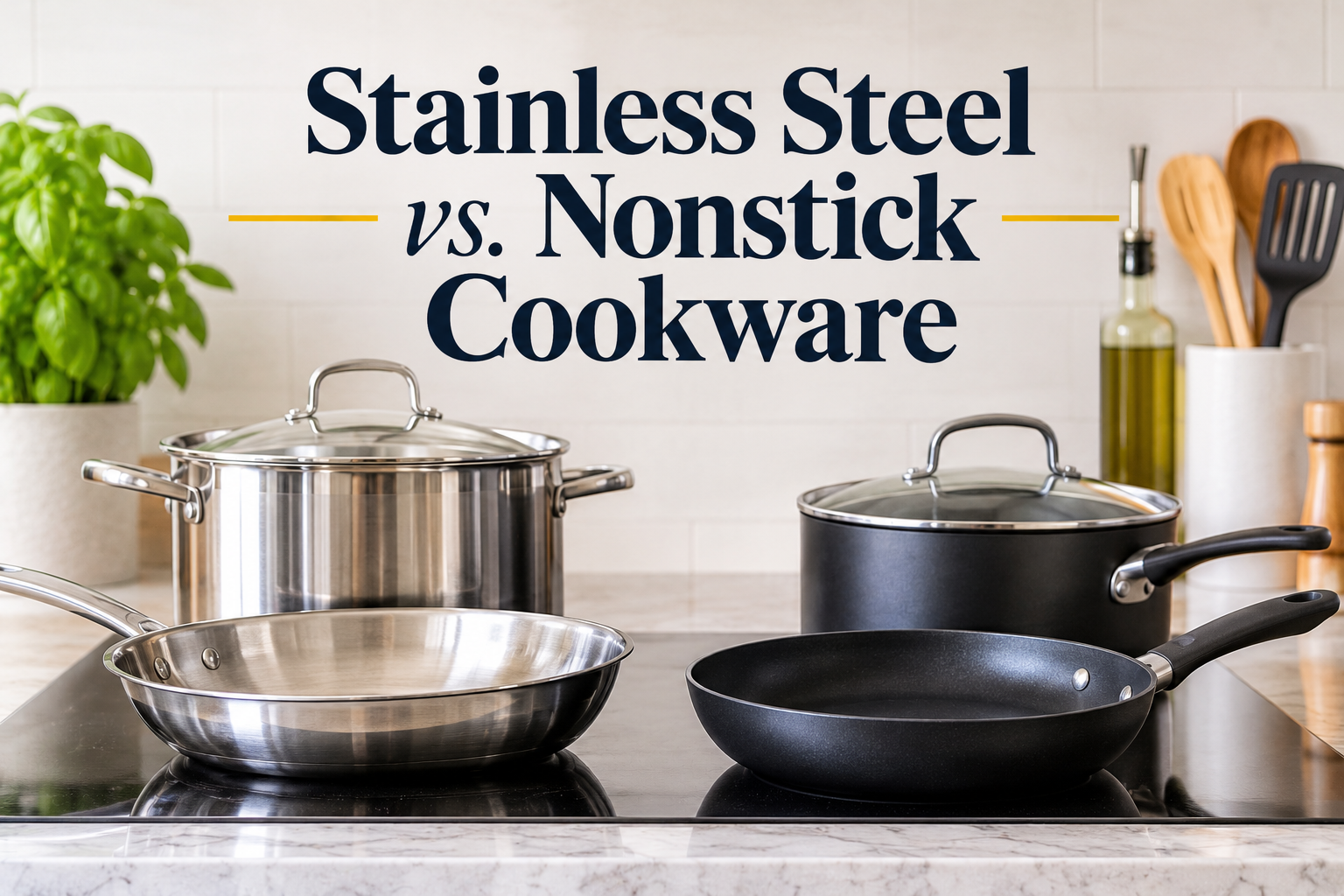
Choosing between stainless steel and nonstick cookware is not just a question of which pan is easier to use. The surface affects how food browns, how much attention cooking requires, how long the pan lasts and what you need to know about food-contact materials. The honest answer is that neither material wins every job. Stainless steel is the better long-term workhorse for browning, searing and everyday cooking at higher heat. Nonstick is more convenient for eggs, delicate fish and low-fat cooking, but its coating needs more careful handling and eventually wears out.
This guide compares stainless steel vs nonstick cookware in practical terms, explains what the health evidence actually says, and adds ceramic-coated pans and cast iron to the comparison. It does not treat every nonstick coating as identical or label any cookware material “toxic” without context.
The Short Answer
- Best all-around choice Stainless steel is the stronger long-term workhorse for browning, searing, pan sauces and higher-heat cooking.
- Best for easy food release Nonstick is more forgiving for eggs, pancakes and delicate fish, but its coating wears and needs careful heat management.
- Health and safety Food-grade stainless steel is suitable for most people, though nickel sensitivity matters. PTFE cookware can be used as directed, but should never be overheated empty.
- Best setup for most kitchens Use stainless steel for most cooking and keep one dedicated nonstick skillet for foods that tend to stick.
There is no universal winner: cooking habits, pan construction and care matter.
Quick Verdict: Stainless Steel vs. Nonstick Cookware
Choose stainless steel if you want durable cookware for searing, browning, pan sauces, sautéing and frequent high-heat cooking. A quality clad stainless steel pan can last for many years, does not rely on a fragile nonstick coating and is versatile across a wide range of recipes.
Choose nonstick if easy food release matters more than maximum durability. It is especially useful for eggs, omelets, pancakes and delicate foods that can tear or stick.
Use it at low to medium heat, avoid empty preheating, follow the maker’s utensil guidance and replace it when the cooking surface is badly damaged.
For most kitchens, the best setup is a stainless steel cookware base plus one dedicated nonstick skillet.
You get the durability and browning ability of stainless steel without giving up the convenience of a coated pan for sticky foods. If you are choosing a complete set, see our best cookware sets guide for options across stainless steel, ceramic and nonstick.
Stainless Steel vs. Nonstick: Side-by-Side Comparison
| Factor | Stainless Steel | Nonstick |
|---|---|---|
| Food release | Requires proper preheating, fat and technique | Excellent when the coating is in good condition |
| Browning and searing | Excellent; fond helps build pan sauces | Limited; not designed for aggressive high-heat searing |
| Eggs and delicate foods | Possible, but technique-sensitive | Usually easier and more forgiving |
| Heat tolerance | Generally high; check handles and manufacturer limits | Keep to low or medium heat and follow the stated limit |
| Durability | Usually excellent; no coating to wear away | Finite; coating performance declines with use |
| Cleaning | Can need soaking or scrubbing for stuck-on food | Usually quick to wipe clean |
| Utensils | Metal utensils are generally suitable | Use utensils approved by the manufacturer; avoid scratching |
| Dishwasher | Often allowed, but handwashing helps preserve finish | Handwashing is usually the safer choice for coating life |
| Oven use | Often oven-safe, depending on handles and construction | Limited by coating and handle temperature ratings |
| Long-term value | Higher upfront cost can be offset by long service life | Lower initial cost, but periodic replacement is expected |
| Best role | Main everyday cookware | Specialist pan for sticky or delicate foods |
Which Is Better for Everyday Cooking?
For everyday cooking, stainless steel is the better main cookware because it handles browning, sauces and a wider range of temperatures without a coating that wears out.
Nonstick is more convenient for quick breakfasts and delicate foods. Beginners who value easy release may find nonstick less frustrating at first, while cooks willing to learn heat control will get more long-term versatility from stainless steel.
For most households, the practical answer is to use stainless steel for most meals and keep one nonstick skillet for eggs and other sticky foods.
Cooking Performance: Which Pan Cooks Better?
Stainless Steel Is Better for Browning and Searing
A stainless steel pan is the stronger choice when you want a deep golden crust on chicken, steak, mushrooms or vegetables. Food can initially stick to the metal, but that is not automatically a flaw.
As the surface browns and the food releases, the browned bits left behind—known as fond—can be loosened with stock, wine or water to make a flavorful pan sauce.
Stainless steel is also more comfortable with the higher temperatures used for searing and reducing sauces. The important detail is construction: stainless steel itself is not an especially efficient heat conductor.
Better pans use an aluminum or copper core, often in a fully clad or impact-bonded design, to spread heat more evenly. A thin, inexpensive stainless pan can still develop hot spots.

Clad stainless steel with an aluminum core
A good-value tri-ply stainless set with an aluminum core for more even heating. It includes fry pans, saucepans, a braiser and a sauce pot, but still requires heat control to limit sticking.

Fully bonded tri-ply construction
A premium fully bonded tri-ply set for frequent searing, browning and pan sauces. Its aluminum core runs through the cookware, but the stainless surface still needs technique and the price is high.
Nonstick Is Better for Eggs and Delicate Foods
Nonstick cookware has a clear advantage when food release is the priority. Eggs, crepes, pancakes, flaky fish and cheese-heavy dishes are easier to turn or remove from a sound nonstick surface.
It can also reduce the amount of butter or oil needed to prevent sticking, although a little fat can still improve flavor and browning.
The trade-off is heat. Nonstick pans are not the right tool for prolonged high-heat searing, broiling or cooking directly over an open flame.
The coating and the pan’s base material have temperature limits, so the manufacturer’s instructions matter. If you routinely cook over high heat, stainless steel is the more forgiving choice.

Traditional coated nonstick for easy food release
An affordable coated set for eggs, pancakes and quick cleanup. Keep heat moderate, avoid empty preheating and protect the coating. It is not compatible with induction cooktops.

Hard-anodized aluminum with a PTFE coating
A premium hard-anodized aluminum set with a PTFE coating and induction-compatible base. It offers easy food release, but the coating is not permanent and is not suited to high-heat searing.
Does Stainless Steel Heat More Evenly?
Not automatically. The phrase “stainless steel cookware” describes the food-contact surface, not the entire construction.
A fully clad pan with an aluminum or copper core can distribute heat well; a thin single-layer pan may not. For a closer look at premium stainless cookware, compare All-Clad vs. Heritage Steel.
Many nonstick pans use an aluminum body, which heats quickly but can vary in thickness and quality. Compare the pan’s construction, base thickness and responsiveness—not just the coating name.
Stainless Steel vs. Nonstick Cookware Health: What Is Actually Safer?
Health claims about cookware are often exaggerated in both directions. “Stainless steel is completely non-toxic” is too absolute, and “every nonstick pan is dangerous” is also misleading.
The more useful questions are what the cooking surface is made from, whether it is damaged or overheated, what food is being cooked and whether the pan is used as directed.
Three Claims That Need Context
PTFE-coated cookware is not expected to cause adverse health effects when used as directed.
The key practical risk described by regulators is overheating, especially heating an empty pan.
Nickel and chromium can migrate from stainless steel under some cooking conditions.
The amount varies with alloy, food acidity, cooking duration and pan age; nickel sensitivity deserves particular attention.
PTFE is itself a fluoropolymer in the broader PFAS family, and PFOA is a different substance.
Check the exact coating and material disclosure rather than relying on one marketing phrase.
Is Stainless Steel Cookware Non-Toxic?
For most people, food-grade stainless steel from a reputable manufacturer is a practical, durable cooking surface. It is corrosion-resistant because chromium in the alloy helps form a thin protective layer.
Common cookware grades also contain nickel, which is relevant for people with a known nickel allergy or sensitivity. Stainless steel is therefore not literally an inert material under every condition.
Research has found that nickel and chromium can migrate from stainless steel into acidic foods such as tomato sauce. The amount depends on factors including the steel grade, whether the pan is new, cooking time and food chemistry.
A study published in the Journal of Agricultural and Food Chemistry reported higher release from new cookware and during longer cooking, with release generally declining over repeated use.
Another study of 18/10 stainless pots found measured amounts below known allergy-triggering thresholds in the conditions tested.
These findings do not mean ordinary stainless steel cooking is unsafe for everyone; they do mean people with nickel sensitivity should discuss cookware choices with a qualified clinician and consider lower-nickel alternatives.
Health Canada also advises people with nickel allergies not to use cookware containing nickel and recommends following the manufacturer’s instructions.
Its overview of the safe use of cookware and bakeware explains the composition and practical precautions for stainless steel, cast iron and nonstick surfaces.
Is PTFE Nonstick Cookware Safe?
Many traditional nonstick pans use polytetrafluoroethylene (PTFE), a fluoropolymer often associated with the Teflon brand. PTFE is part of the broader PFAS family, but that fact alone does not tell you the risk from using a finished pan.
The German Federal Institute for Risk Assessment (BfR) states that adverse health effects are not expected when PTFE-coated cookware is used as intended.
Its key warning is overheating an empty pan: at around 360°C (680°F), the coating can decompose and release gases that are hazardous to health.
Health Canada takes a similarly practical approach: do not preheat nonstick cookware empty, avoid high heat above 260°C (500°F), and ventilate the kitchen. A pan left empty over a powerful burner can heat rapidly, especially on induction or gas.
Keep the burner moderate, add food or cooking fat before heating, and never use a nonstick pan as a broiler or grill pan unless the manufacturer explicitly permits it.
It is also important to separate PFOA from PTFE. PFOA was historically used in the manufacture of some fluoropolymer products and has been phased out of many markets; it is not the same substance as the PTFE coating on a finished pan.
A “PFOA-free” label does not necessarily mean “PFAS-free,” because PTFE itself is a fluoropolymer within the PFAS group. Read the exact material claim rather than relying on a broad marketing phrase.
For the current evidence and safety guidance, see the BfR’s 2025 assessment of PTFE-coated cookware and Health Canada’s nonstick cookware precautions.
What If the Nonstick Coating Is Scratched or Peeling?
A scratch does not automatically mean that a pan has caused acute harm, but a visibly deteriorating coating is a good reason to stop using it.
Deep scratches, peeling, blistering or a rough, patchy surface indicate that the cookware has reached the end of its useful life. Replacing a worn pan is sensible maintenance, not a reason to panic.
Do not use metal utensils, abrasive pads or harsh cleaners on a coated surface unless the manufacturer specifically allows them.
Never heat a nonstick pan empty to “burn off” residue. If a pan has overheated and produced fumes, turn off the heat, move people and pets away from the area, and ventilate the room.
Nonstick vs. Stainless Steel vs. Ceramic Cookware
“Ceramic cookware” can mean two very different things. Traditional ceramic or glazed pottery is a ceramic vessel.
Most modern ceramic nonstick frying pans, however, are metal pans—often aluminum—with a silica-based sol-gel coating marketed as ceramic. That coating is still a surface layer and can lose its easy-release performance over time. It is not the same as a solid ceramic pot.
Key Materials and Terms Explained
- PTFE
Polytetrafluoroethylene, a fluoropolymer commonly used as the food-release coating on traditional nonstick pans.
- PFAS
A broad family of per- and polyfluoroalkyl substances. PTFE is a fluoropolymer within this wider group; the term does not make every PFAS material identical.
- PFOA
A processing chemical historically used in the manufacture of some fluoropolymer products. It is not the same substance as the PTFE coating on a finished pan.
- Sol-gel ceramic coating
A silica-based coating used on many metal pans marketed as ceramic nonstick. It is a surface coating, not a solid ceramic cooking vessel.
- Fond
The browned bits left on a pan after searing or sautéing, which can be deglazed to build a pan sauce.
| Type | Main advantage | Main compromise | Best use |
|---|---|---|---|
| Stainless steel | Durability and browning | Food can stick without technique | Everyday cooking, searing, sauces |
| PTFE nonstick | Very easy food release | Must avoid overheating; coating wears | Eggs, pancakes, delicate fish |
| Ceramic-coated nonstick | Easy release when new; often sold as PFAS-free | Release performance can decline; claims vary by product | Low-to-medium-heat everyday tasks |
| Cast iron | Heat retention and high-heat cooking | Heavy; needs seasoning and drying care | Searing, baking, shallow frying |
Ceramic-coated pans are often marketed as a chemical-free alternative, but “ceramic” does not mean the pan has no coating or that it will stay nonstick indefinitely. Ask whether the product is explicitly free of PTFE and other PFAS if that is your priority.
Check the manufacturer’s material disclosure and assess durability: many ceramic-coated pans lose their slick release sooner than a good stainless steel pan lasts.
For a deeper material comparison, read our guide to ceramic vs. stainless steel cookware. If you are comparing other cookware materials, our titanium vs. stainless steel cookware guide explains where titanium fits—and where marketing claims need closer scrutiny.
Stainless Steel Pan vs. Cast Iron: Which Should You Choose?
Cast iron is a useful third option, but it solves a different problem. It holds heat exceptionally well, making it excellent for a hard sear, cornbread, oven baking and foods that benefit from a stable hot surface.
It is heavier than most stainless pans, heats more slowly and needs basic seasoning and drying care to limit rust.
Stainless steel is generally easier to maintain, lighter in many designs and better suited to acidic pan sauces or tomato-based cooking than bare cast iron. Cast iron can react with acidic foods, particularly during long cooking or storage.
A well-made stainless pan is the more versatile everyday option; cast iron is worth owning if you enjoy its heat retention and do not mind the weight.
Nonstick is different from both. It is not a substitute for cast iron or stainless steel when the goal is high-heat browning. Think of the three as tools for different jobs rather than competitors where one must replace the others.
How to Stop Food From Sticking to a Stainless Steel Pan
People often conclude that stainless steel is bad cookware after one attempt at frying eggs or searing fish. In reality, the pan usually needs a little more technique than a coated skillet.
These steps help reduce sticking without pretending stainless steel will behave exactly like nonstick. The right tools also help: see our guide to the best cooking utensils for stainless steel cookware.
The Six Steps That Reduce Sticking
-
Preheat gradually.
Warm the pan over medium or medium-low heat rather than blasting it on high.
-
Add oil after the pan is warm.
Swirl a thin, even layer across the cooking surface.
-
Let the food release.
Meat and fish often cling at first; once a crust forms, they may release more easily. Do not force them up too soon.
-
Dry ingredients well.
Surface moisture can interfere with browning and encourage steaming.
-
Avoid overcrowding.
Too much food drops the pan temperature and releases moisture.
-
Use the right heat.
Medium heat is enough for many everyday tasks; high heat is not a universal shortcut.
These steps reduce sticking but do not make stainless steel behave exactly like a coated pan.
Stainless steel is not magically nonstick when heated correctly. Eggs and other delicate foods can still be challenging, especially for beginners.
If you cook eggs every morning and do not want to manage temperature and timing, keeping one nonstick skillet is a perfectly reasonable choice.
What to Look for When Buying Stainless Steel or Nonstick Cookware
How to Choose the Right Pan
-
Look for multi-ply construction.
Fully clad stainless steel with an aluminum or copper core generally offers better heat distribution than a thin single-layer body.
Look forFully clad stainless steel with an aluminum or copper core generally offers better heat distribution than a thin single-layer body. -
Check the cooking surface and grade.
Reputable makers should identify the stainless steel used. If you have a nickel allergy, do not assume standard 18/10 cookware is suitable; check the alloy and discuss options with your clinician.
Look forReputable makers should identify the stainless steel used. If you have a nickel allergy, do not assume standard 18/10 cookware is suitable; check the alloy and discuss options with your clinician. -
Check induction compatibility.
The exterior base must be magnetic for induction. A stainless cooking surface alone does not guarantee compatibility.
Look forThe exterior base must be magnetic for induction. A stainless cooking surface alone does not guarantee compatibility. -
Inspect handles and lids.
Riveted handles, comfortable grips and oven-safe ratings matter in everyday use.
Look forRiveted handles, comfortable grips and oven-safe ratings matter in everyday use. -
Choose useful sizes.
A 10- or 12-inch skillet is more useful to many households than a large set full of rarely used pieces.
Look forA 10- or 12-inch skillet is more useful to many households than a large set full of rarely used pieces. -
Identify the coating.
Find out whether it is PTFE-based, ceramic-coated or another system. “Granite,” “stone” and “titanium-reinforced” are not precise descriptions of the food-contact chemistry.
Look forFind out whether it is PTFE-based, ceramic-coated or another system. “Granite,” “stone” and “titanium-reinforced” are not precise descriptions of the food-contact chemistry. -
Read the temperature limit.
Check both stovetop and oven ratings, and do not assume a metal handle makes the coating safe at any oven temperature.
Look forCheck both stovetop and oven ratings, and do not assume a metal handle makes the coating safe at any oven temperature. -
Check the care instructions.
Confirm which utensils, cleaning methods and dishwasher settings are allowed.
Look forConfirm which utensils, cleaning methods and dishwasher settings are allowed. -
Do not overpay for vague claims.
A premium price does not guarantee a longer-lasting coating. Clear material disclosures and a meaningful warranty are more useful.
Look forA premium price does not guarantee a longer-lasting coating. Clear material disclosures and a meaningful warranty are more useful. -
Buy the pan for a specific job.
A single 10-inch or 12-inch skillet is often enough; there is little reason to buy a full nonstick set if stainless steel is your main cookware.
Look forA single 10-inch or 12-inch skillet is often enough; there is little reason to buy a full nonstick set if stainless steel is your main cookware.
Stainless Steel vs. Nonstick Cookware: What People Often Debate on Reddit
When home cooks compare stainless steel vs nonstick cookware on Reddit, the practical debate usually comes down to convenience versus longevity. In one recent discussion about frying eggs on stainless steel, cooks described how difficult it can be to get consistent release.
Another discussion about whether nonstick is still necessary showed why some people keep one coated pan for eggs even after moving most cooking to stainless steel. These are individual experiences, not controlled tests, but they illustrate the real trade-off.
Neither experience proves that one material is universally better. The result depends on cooking habits, pan construction, heat control and how much maintenance a person is willing to do.
A useful way to interpret forum advice is to look for the cooking task behind the recommendation: someone who mostly fries eggs has different priorities from someone who sears meat and makes pan sauces.
Which Is Better: Stainless Steel or Nonstick?
The Best Choice for Your Kitchen
- Stainless steel is the better all-around investment for most cooks who want one dependable pan. It handles browning, sautéing, acidic sauces and higher-heat cooking, and a well-constructed pan can remain useful for decades. Its weakness is food release: it rewards technique and can be frustrating for delicate foods.
- Nonstick is better when convenience is the priority. It makes eggs, pancakes and fragile foods easier to cook and clean up, but it is a consumable item rather than a lifetime pan. Treat it gently, keep the heat moderate and replace it when the coating is visibly deteriorating.
If you are looking for the best cookware stainless steel vs nonstick options, start with a quality stainless steel skillet or saucepan and add one nonstick skillet for the jobs stainless steel makes unnecessarily difficult. That combination is more practical—and usually better value—than buying an entire set in either material.
Frequently Asked Questions
Stainless Steel vs. Nonstick: Common Questions
Are stainless steel pans better than nonstick?
Stainless steel pans are better for searing, browning, pan sauces, higher-heat cooking and long-term durability. Nonstick pans are better for eggs, pancakes, delicate fish and easy cleanup. For most kitchens, owning both is more useful than expecting one to do every job.
Which is healthier, stainless steel or nonstick?
Neither material can be declared universally healthier without considering the exact product and how it is used. Food-grade stainless steel is a durable option, although small amounts of nickel and chromium can migrate into food under certain conditions. PTFE nonstick cookware is not expected to cause adverse health effects when used as directed, but it should never be overheated empty.
Is stainless steel cookware non-toxic?
Food-grade stainless steel is widely used for cooking and is suitable for most people. However, it can release small amounts of nickel and chromium, particularly when new or used for prolonged cooking of acidic foods. People with nickel allergies should check the alloy and seek individualized advice.
Is nonstick cookware toxic when scratched?
A scratch does not automatically mean a pan has poisoned food. However, deep scratches, peeling, blistering or a deteriorating surface are reasons to retire the pan. Follow the manufacturer’s care instructions and do not continue using cookware with a badly damaged coating.
Can you use metal utensils on stainless steel and nonstick pans?
Metal utensils are generally fine with uncoated stainless steel. For nonstick cookware, use wood, silicone or other utensils approved by the manufacturer; metal tools can scratch or shorten the life of the coating.
Is ceramic nonstick safer than traditional nonstick?
Ceramic-coated cookware is often made without PTFE, but the label alone does not establish every aspect of product safety or durability. Check the manufacturer’s exact PFAS and coating disclosures. Ceramic coatings can also lose their nonstick performance with use, so they are not automatically a longer-lasting choice.
Can stainless steel replace nonstick cookware?
It can replace nonstick for most cooking tasks if you are comfortable managing heat, oil and timing. It is not equally convenient for every egg, pancake or delicate fish recipe. Keeping one small nonstick pan is a sensible compromise.
Which lasts longer, stainless steel or nonstick?
Stainless steel usually lasts much longer because it has no nonstick coating to wear away. A quality stainless pan can serve for many years or decades with normal care. Nonstick performance gradually declines, and the pan eventually needs replacement.
Is stainless steel better than cast iron?
Stainless steel is generally easier to maintain and more versatile for acidic sauces. Cast iron retains heat exceptionally well and is excellent for searing and baking, but it is heavier and needs seasoning care. The better choice depends on the cooking task.
Which is better for everyday cooking?
Stainless steel is the better main cookware for most everyday cooking because it handles browning, sauces and a wider range of temperatures without a coating that wears out. A nonstick skillet is still useful for eggs, pancakes and other delicate foods.
Which cookware is better for beginners?
Nonstick is usually easier for beginners because food releases with less technique and cleanup is simple. Stainless steel has a learning curve, but it offers greater versatility and longer service life once you learn to control heat and timing.
Which pan is best for cooking eggs?
A sound nonstick pan is generally the easiest choice for fried eggs and omelets. Stainless steel can cook eggs successfully, but it requires careful preheating, temperature control and enough cooking fat; it is not equally forgiving.
Can you sear steak in a nonstick pan?
A nonstick pan is not the best tool for a hard steak sear. High heat can exceed the coating’s recommended use conditions, and the surface does not develop fond in the same way as stainless steel. Use stainless steel or cast iron for high-heat searing.
Is stainless steel worth the extra cost?
It can be, particularly if you cook often and want cookware that can last for many years. A quality clad stainless pan costs more upfront but does not need replacing because a coating wears away. You do not need an expensive full set: one good skillet or saucepan may be enough to start.
Sources and Further Reading
- German Federal Institute for Risk Assessment (BfR): PTFE nonstick cookware safety, updated 2025.
- Health Canada: The safe use of cookware and bakeware.
- Stainless steel leaches nickel and chromium into foods during cooking, peer-reviewed research.
- Release of nickel and chromium in common foods during cooking in 18/10 stainless steel pots, peer-reviewed research.