Zojirushi vs Cuckoo: Which Rice Cooker Is Better?
Zojirushi and Cuckoo both make excellent rice cookers, but they are not interchangeable. Zojirushi is strongest in non-pressure Micom and Neuro Fuzzy models with precise everyday-rice settings; Cuckoo stands out for pressure cooking, Korean-style rice and twin-pressure flexibility.
The honest answer depends on the exact models and the rice you cook. A 5.5-cup Zojirushi Neuro Fuzzy cooker is not a like-for-like rival to a 10-cup Cuckoo twin-pressure machine. This comparison separates pressure from non-pressure models, looks closely at compact 3-cup options and explains when paying for extra technology is actually worthwhile.
- Micom and Neuro Fuzzy versus Cuckoo pressure and twin-pressure cooking
- Rice texture, cooking speed and the programs that matter
- Compact 3-cup Zojirushi and Cuckoo models
- Specific models, capacity, voltage and ownership trade-offs
The Short Answer
- Choose Zojirushi If you mainly cook white, sushi or everyday rice and want a predictable, straightforward cooker with fuzzy-logic control.
- Choose Cuckoo If you want pressure cooking, chewier rice, more mixed-grain and GABA options, or a model with both pressure and non-pressure modes.
- Choose Tiger If you want a simpler Micom cooker and value the Tacook tray for steaming a second component while rice cooks.
- Compare capacity carefully Rice cooker capacity is normally stated as uncooked rice and uses a supplied cup measure, commonly 180 ml—not a standard US measuring cup.
Zojirushi vs Cuckoo: The Main Difference
The biggest difference is not that one brand is automatically better. It is that their product ranges put different emphasis on cooking technology. Zojirushi is well known for Micom and fuzzy-logic cookers that adjust cooking time and temperature. Its Neuro Fuzzy models add more nuanced control over the cooking cycle and texture settings. Cuckoo sells basic Micom models too, but its range is particularly notable for high-pressure, induction-heating and twin-pressure cookers.
That distinction changes the buying decision. A non-pressure Zojirushi and a high-pressure Cuckoo do not cook rice in the same way. Pressure can produce a denser, stickier result and can be useful for brown or mixed grains. A conventional Micom cooker generally gives you a simpler cooking process and may suit people who mostly prepare white rice.
Our overall verdict: Zojirushi is the safer starting point for people who primarily want everyday white or sushi rice without pressure-cooker complexity. Cuckoo is the more versatile choice if you specifically want pressure cooking and a wider range of Korean-style rice programs. Neither brand wins every category.
Zojirushi vs Cuckoo: Micom, Fuzzy Logic and Pressure Cooking
What Zojirushi’s Micom and Neuro Fuzzy systems do
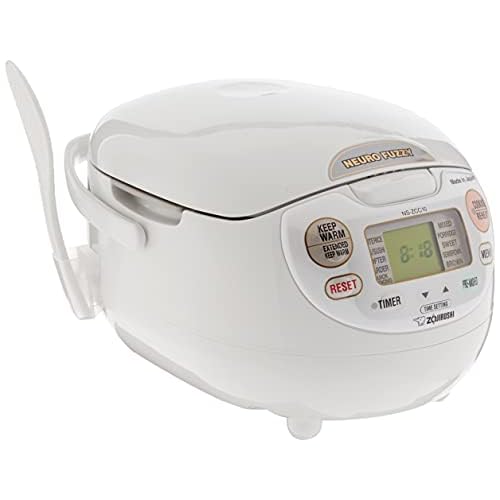
Micom means microcomputer-controlled cooking. Rather than simply heating until the water is absorbed, the cooker follows a programmed cycle and adjusts temperature and timing. Zojirushi’s Neuro Fuzzy models use fuzzy-logic control to make finer adjustments during cooking. On the NS-ZCC10, the menu includes regular white, sushi, softer and harder white-rice settings, mixed rice, porridge, sweet rice, semi-brown, brown, rinse-free and quick cooking.
This is useful when you cook different types of rice and want to adjust the result without switching to a pressure cooker. The trade-off is time: a full fuzzy-logic cycle can take longer than a basic one-touch cooker or a turbo pressure cycle. That is not necessarily a flaw—the cooker is following a more involved program.
What Cuckoo pressure cooking changes
Cuckoo’s pressure models seal the cooking chamber and cook under pressure. That can shorten some cooking programs and produce a stickier, chewier texture that many people prefer for Korean-style white rice. Cuckoo also offers models with both high-pressure and non-pressure modes, which are more flexible than a pressure-only cooker.
Pressure is not an automatic upgrade for every household. If your priority is separate, fluffy grains of long-grain rice, a pressure model may not be the texture you want. The sealed lid, steam release, gasket and pressure components also add parts to clean and maintain. If you mostly cook plain white rice and do not need the extra modes, a conventional Micom model may be the more sensible purchase.
Is Cuckoo faster than Zojirushi?
Some Cuckoo pressure models advertise turbo white-rice cycles in roughly 18–24 minutes, while Zojirushi’s Neuro Fuzzy models use longer programmed cycles for many rice settings. These are not directly comparable timings: the chosen menu, batch size, rice type and whether the time includes pressure build-up or resting all matter. Do not assume every Cuckoo is faster than every Zojirushi. Compare the exact programs on the models you are considering.
Zojirushi vs Cuckoo vs Tiger: Which Brand Has the Edge?
Tiger belongs in this comparison because it offers a middle ground: dependable Micom cooking without making pressure the central feature. The JBV-A10U adds a Tacook tray that uses steam to cook a separate food while the rice cooks below. That is a practical extra, but its feature set is simpler than the premium Zojirushi and Cuckoo models.
For everyday white rice, all three brands have models worth considering. The more useful question is whether you need Neuro Fuzzy texture adjustments, Cuckoo pressure modes or Tiger’s synchronized steaming tray. If you are already comparing Tiger and Zojirushi, see our Tiger vs Zojirushi rice cooker comparison.


|
Zojirushi
Zojirushi NS-ZCC10
|
VS |
 Cuckoo
 CRP-ST1009FG
|
|---|---|---|
|
Neuro Fuzzy Micom
|
Cooking system |
Twin pressure
|
|
5.5 cups
|
Uncooked capacity |
10 cups
|
|
No
|
Pressure cooking |
Yes / no-pressure
|
|
Texture settings
|
Standout feature |
Two pressure modes
|
|
White and sushi rice
|
Best fit |
Mixed grains and sticky rice
|
| BUY NOW | BUY NOW |
Best Zojirushi and Cuckoo Models Compared
The following models illustrate the real differences better than comparing brand slogans. Model names matter: a Zojirushi Neuro Fuzzy cooker is not the same product as a basic Zojirushi one-touch cooker, and a Cuckoo Micom model is not the same as a Cuckoo pressure model.
Zojirushi NS-ZCC10: Best for Everyday White Rice
A 5.5-cup (uncooked) Neuro Fuzzy Micom rice cooker with dedicated white- and sushi-rice settings, adjustable texture options, and automatic plus extended keep-warm. A strong fit for households that want consistent everyday rice without pressure cooking.
The NS-ZCC10 is a strong choice for households that cook rice often and value control over the final texture. Its menu includes regular and sushi white rice, softer and harder settings, mixed rice, porridge, sweet rice, semi-brown, brown, rinse-free and quick cooking. Automatic, extended keep-warm and reheating functions make it convenient for meals that are not served immediately.
The spherical inner pan and programmed cooking cycle are the main reasons to choose it over a basic one-switch cooker. Its limitations are equally clear: it is not a pressure cooker, full cycles can take time, and its nonstick inner pan needs sensible care. It is also a relatively large countertop appliance for a 5.5-cup model. See Zojirushi’s official NS-ZCC10 specifications before buying.
Zojirushi NS-ZCC10 Specs
| Model | NS-ZCC10 |
| Capacity | 5.5 cups uncooked / 1.0 L |
| Technology | Neuro Fuzzy Micom |
| Power | 680 W, 120 V |
| Rice programs | White, sushi, mixed, porridge, brown and more |
| Keep warm | Automatic and extended |
- Neuro Fuzzy control with softer and harder texture options
- Useful menu range for white, sushi rice and porridge
- Automatic and extended keep-warm functions
- Official product listing identifies it as made in Japan
- Not a pressure cooker
- Longer programmed cycles than basic or turbo models
- Nonstick inner pan requires careful handling
- 5.5-cup capacity may be more than a small household needs
Cuckoo CRP-P0609S: Best High-Pressure Rice Cooker
A 6-cup (uncooked) high-pressure rice cooker with white, brown, mixed-rice and porridge programs. Its 11.4 PSI pressure system is designed for a softer, stickier result, with a detachable inner lid and automatic steam release.
The CRP-P0609S is built for shoppers who want pressure-cooked rice rather than simply a computerized cooker. It offers dedicated white, brown and mixed-rice programs, plus porridge, scorched rice, multi-cook and auto-clean functions. Cuckoo lists 11.4 PSI and a 6-cup uncooked capacity on its official CRP-P0609S product page.
Expect a different texture from a conventional Zojirushi Micom: pressure cooking tends to make rice stickier and chewier. That is a benefit for some rice styles and a drawback for people who prefer distinct, fluffy grains. Consider the extra cleaning and the larger footprint before choosing it.
Cuckoo CRP-P0609S Specs
| Model | CRP-P0609S |
| Capacity | 6 cups uncooked / 12 cups cooked |
| Technology | High-pressure heating |
| Pressure | 11.4 PSI / 78.4 kPa (official specification) |
| Power | 890 W, 120 V |
| Features | Voice guide, auto-clean, preset timer |
- Pressure cooking for a stickier rice texture
- Dedicated brown, mixed and glutinous rice programs
- Auto-clean and voice guidance
- Detachable inner lid and automatic steam release
- Larger and more complex than a basic Micom cooker
- Pressure texture is not ideal for every rice preference
- More lid, gasket and steam components to maintain
- 6-cup uncooked capacity may be excessive for one or two people
Cuckoo CRP-ST1009FG: Best for Large Households
A 10-cup (uncooked) twin-pressure rice cooker that switches between high-pressure and non-pressure cooking. Its 16 menu options and 20-cup cooked capacity suit larger households that want flexibility across different rice textures.
The CRP-ST1009FG is the Cuckoo option to consider when you want both pressure and non-pressure cooking in one large-capacity machine. Its 10-cup uncooked capacity and twin-pressure system offer flexibility for different rice textures, while the voice guide and automatic steam release make operation more guided.
Its size is the main compromise: a 10-cup cooker is a lot of machine for a small household. It is also more expensive and mechanically involved than a standard Micom model. Buy it because you will use the capacity and two cooking modes, not because the specification list is longer. Check the manufacturer’s CRP-ST1009FG listing for the exact regional specifications.
Cuckoo CRP-ST1009FG Specs
| Model | CRP-ST1009FG |
| Capacity | 10 cups uncooked / 20 cups cooked |
| Technology | Twin pressure: high-pressure and non-pressure |
| Menus | 16 cooking modes |
| Special features | Voice guide, open cooking mode, automatic steam release |
| Origin | Made in Korea (manufacturer listing) |
- Switch between high-pressure and non-pressure cooking
- Large capacity for families and batch cooking
- Broad menu including GABA and vegetable rice
- Voice guide and automatic steam release
- Too large for many singles and couples
- Higher cost than basic Micom cookers
- More parts and settings to clean and manage
- Overkill if you only cook small portions of white rice
Zojirushi vs Cuckoo 3-Cup Rice Cookers: Which Is Better?
For a small household, the 3-cup comparison is more useful than comparing two large flagship machines. The Zojirushi NS-LHC05 is a documented non-pressure Micom cooker. The Cuckoo CR-0375FW is harder to classify: Cuckoo’s US store describes it as electric pressure in its product copy, but lists its type as electric heating; Cuckoo America’s current CR-0375F page describes the related model as Micom and non-pressure. Treat this as a model-listing discrepancy, not a settled pressure-versus-non-pressure comparison.
The NS-LHC05 has published programs for white and mixed rice, sushi rice, brown rice, GABA brown rice, Jasmine rice, porridge and quick cooking. It also has triple heating, automatic keep-warm and reheating. Cuckoo’s CR-0375F family offers fuzzy-logic cooking and a 3-cup uncooked capacity, but the exact CR-0375FW listing and regional version need checking before you rely on its cooking-system label. Do not infer pressure performance from the TPC safety wording alone.
If you want a clearly documented compact non-pressure cooker, the Zojirushi NS-LHC05 is the safer recommendation. The Cuckoo is a possible compact alternative, but I would not buy it specifically for pressure cooking until Cuckoo confirms the exact CR-0375FW version in writing. Compare the manual, voltage, menu and warranty for the precise model number on the listing.
Be precise about the model numbers. Zojirushi has several similar 3-cup machines, including NS-LGC05 and NS-LHC05, with slightly different menu sets. Confirm the exact model, voltage and included functions on the listing rather than assuming all 3-cup Zojirushi cookers are identical.
Zojirushi NS-LHC05: Best Compact Micom Cooker

A compact 3-cup (uncooked) Micom rice cooker with triple heating and programs for white, sushi, brown, GABA brown and Jasmine rice. A practical choice for singles or couples who want more control than a basic one-touch cooker.
The NS-LHC05 suits singles, couples and small kitchens that want a computerized cooker rather than a basic one-switch model. Its menu includes white/mixed rice, sushi rice, brown rice, GABA brown rice, Jasmine white rice, porridge and quick cooking. The triple heater warms from the bottom, sides and lid, and the inner lid is detachable for cleaning.
It is not a pressure cooker, and its small capacity is a limitation if you often cook for guests or batch-prep rice. Check the exact NS-LHC05 listing because Zojirushi’s other 3-cup models do not all share the same menu; its official manual lists the model’s programs and electrical rating.
Zojirushi NS-LHC05 Specs
| Model | NS-LHC05 |
| Capacity | 3 cups uncooked |
| Technology | Micom fuzzy logic |
| Heating | Triple heater: bottom, side and lid |
| Power | 450 W, 120 V |
| Programs | White/mixed, sushi, brown, GABA brown, Jasmine, porridge, quick |
- Compact 3-cup uncooked capacity
- Triple heating system
- Detachable washable inner lid
- Dedicated sushi, mixed, brown rice and porridge menus
- Not suitable for large family batches
- No pressure cooking
- Premium pricing for a small-capacity cooker
- Model-specific menu differences can confuse comparisons
Cuckoo CR-0375FW: Compact Fuzzy-Logic Cooker (Verify the Version)
A compact 3-cup fuzzy-logic cooker. Cuckoo listings conflict on whether the CR-0375FW is pressure-based, so confirm the exact model suffix and manual before buying.
The CR-0375FW is a cautionary example of why exact model numbers matter. Cuckoo’s US store page calls it an electric-pressure rice cooker in the description, but the same page lists its type as electric heating. Cuckoo America’s current CR-0375F page describes the related 3-cup model as Micom and explicitly lists non-pressure operation.
The pages may refer to different revisions or regional versions; the available manufacturer information does not justify treating every CR-0375FW listing as a confirmed pressure cooker. Its fuzzy-logic control and compact capacity are useful on paper, but verify the precise model, manual, voltage and cooking system with the seller before ordering.
Cuckoo CR-0375FW Specs — Verify Exact Version
| Model | CR-0375FW (check suffix) |
| Capacity | 3 cups uncooked |
| Technology | Fuzzy-logic control listed |
| Cooking system | Conflicting official listings: electric pressure vs Micom/non-pressure |
| Safety | TPC system; 12 safety features on US store listing |
| Before buying | Confirm exact model, manual, voltage and pressure type |
- Compact 3-cup uncooked capacity
- Fuzzy-logic cooking control is listed
- TPC safety features appear on the US store listing
- Could suit buyers seeking a small Cuckoo cooker once the exact version is confirmed
- Official Cuckoo listings conflict on pressure classification
- Do not buy specifically for pressure cooking without written confirmation
- Regional voltage and model details need checking
- Small capacity limits batch cooking
Tiger JBV-A10U: Best for Rice and Steaming
A 5.5-cup (uncooked) Micom rice cooker with Tiger’s Tacook tray for steaming a second food while rice cooks. It is a simpler non-pressure option for households that value convenient one-pot meal preparation.
The JBV-A10U is a useful middle-ground choice for households that want a straightforward computerized rice cooker and the option to steam a second food at the same time. Its Tacook tray sits above the rice and uses steam for vegetables or protein.
The cooker has plain rice, brown rice, slow-cook and steam settings, with automatic keep-warm. It does not pressure-cook rice and has fewer specialized menus than the premium Zojirushi and Cuckoo models. Choose it for the Tacook convenience and simpler operation, not because it matches the feature set of a high-end pressure cooker.
Tiger JBV-A10U Specs
| Model | JBV-A10U |
| Capacity | 5.5 cups uncooked / about 11 cups cooked |
| Technology | Micom |
| Programs | Plain rice, brown rice, slow cook, steam |
| Special feature | Tacook synchronized cooking tray |
| Voltage | 120 V |
- Tacook tray steams another food while rice cooks
- 5.5-cup uncooked capacity suits many families
- Straightforward Micom operation
- Can handle steaming and slow cooking
- No pressure cooking
- Fewer rice programs than premium models
- Nonstick inner pot needs careful care
- Keep-warm duration is model-specific; follow the manual
Which Rice Cooker Is Better for Different Types of Rice?
White rice and sushi rice
For mostly white or sushi rice, start with a Zojirushi Micom or Neuro Fuzzy model. Its dedicated white and sushi settings, plus softer and harder texture options on the NS-ZCC10, make it a strong everyday choice. A non-pressure Cuckoo Micom can also do the job, especially if you want a shorter quick-cook option. Pressure is not a requirement for good white rice.
Brown rice, GABA rice and mixed grains
Cuckoo’s pressure range is more compelling if brown rice, GABA rice, beans and mixed grains are regular parts of your meals. Pressure can help soften tougher grains and create a chewier result. Zojirushi also offers brown-rice and GABA options on selected Micom models, so check the specific program list before deciding. The brand name alone does not tell you which grain programs a cooker supports.
Jasmine and long-grain rice
If you prefer fluffy, separate grains, look closely at the non-pressure options and the exact long-grain menu. Zojirushi’s NS-LGC05 includes a long-grain white-rice setting; the NS-ZCC10 includes texture choices for white rice. Cuckoo’s pressure models can cook long-grain rice, but pressure-cooked texture may be softer or stickier than what you want. Follow the water lines and the manual for the rice variety you use.
Porridge, oatmeal and extra functions
Both brands offer more than plain rice. Zojirushi models include porridge programs, and selected compact units add steel-cut oatmeal. Cuckoo pressure models add multi-cook, auto-clean, steaming and scorched-rice options depending on the model. Tiger’s Tacook tray is more about cooking a second food while the rice cooks. Choose the extra functions you will actually use; a long menu is not valuable if most of it stays untouched.
What Rice Cooker Owners Say About Zojirushi and Cuckoo
Reddit discussions are mixed rather than a clean brand vote. In a pressure-versus-non-pressure discussion, one commenter described owning several Zojirushi models and said the pressure version produced softer rice, while another participant emphasized that the difference depends on the rice and the cook’s preference. In a separate Cuckoo pressure-cooker thread, owners discussed whether pressure makes short-grain rice pleasantly chewy or too soft; the replies did not establish one universally preferred result. These are individual experiences, not controlled comparisons.
A third Cuckoo owner discussion gives a useful practical example: one owner said they used the non-pressure mode for long-grain rice such as basmati and pressure mode for sticky short-grain rice. That is one household’s preference, not a universal rule, but it illustrates why twin-pressure models appeal to people who cook different rice styles. Reddit threads comparing brands rarely provide matched models, identical rice, or controlled cooking conditions, so use them to understand preferences—not to rank brands scientifically.
What to Check Before Buying
- Voltage and plug: Many North American models are rated for 120 V / 60 Hz. If you are buying outside North America, confirm the exact voltage and plug compatibility before ordering. A voltage mismatch is not a minor detail.
- Capacity: Rice-cooker cup measures are commonly 180 ml, not a standard US measuring cup. Capacity refers to uncooked rice unless the listing clearly says cooked.
- Inner pot: Most models discussed here use a coated nonstick inner pot. Use the supplied rice paddle, avoid metal utensils and do not scrub the coating aggressively.
- Cleaning: Pressure models have more parts around the lid and steam path. Check whether the inner lid and steam cap are removable.
- Warranty and service: Confirm local warranty coverage and replacement-part availability, especially if importing a model.
- Menu language: Cuckoo voice guides and control panels vary by model and market. Confirm that the specific version supports a language you can use.
- Model suffixes: A final letter can indicate color or regional version. Check the exact model code rather than relying on a similar product photo.
For more options across both brands, see our guides to the best Zojirushi rice cookers, best Cuckoo rice cookers and best rice cookers overall. If avoiding conventional nonstick coatings is a priority, our non-toxic rice cooker guide explains why the inner pot material needs to be checked separately from the brand name.
Frequently Asked Questions
Zojirushi vs Cuckoo: FAQs
Is Zojirushi better than Cuckoo?
Zojirushi is usually the better starting point for people who mainly cook white or sushi rice and want a non-pressure Micom cooker. Cuckoo is often the better fit if you want pressure cooking, sticky rice texture, GABA programs or twin-pressure flexibility. The exact model matters more than the brand name.
Is Cuckoo or Zojirushi better for Korean rice?
Cuckoo’s dedicated pressure models are especially suited to people who prefer the sticky, chewy texture associated with Korean-style rice. A non-pressure Micom model can still cook good rice, but it produces a different texture.
Is Zojirushi Neuro Fuzzy a pressure rice cooker?
No. The NS-ZCC10 Neuro Fuzzy is a non-pressure Micom rice cooker. It uses computerized fuzzy-logic control to adjust cooking time and temperature, but it does not pressure-cook rice.
Is Cuckoo faster than Zojirushi?
Some Cuckoo pressure models offer turbo white-rice cycles that are shorter than many Zojirushi Neuro Fuzzy programs. Cooking time varies by model, menu, batch size and rice type, so compare the exact program rather than assuming every Cuckoo is faster.
Which is better for brown rice, Zojirushi or Cuckoo?
Both brands have brown-rice programs. Cuckoo pressure models are worth considering if you want pressure-softened brown or mixed grains. Zojirushi is a good option if you prefer a non-pressure cooking cycle. Check the exact model’s menu.
What is the difference between Cuckoo pressure and twin pressure?
A conventional Cuckoo pressure model cooks under pressure. A twin-pressure model lets you choose between high-pressure and non-pressure cooking, giving you more control over whether the rice is stickier or less sticky.
Is the Zojirushi NS-ZCC10 worth it?
It can be worth the premium if you cook rice often and value its Neuro Fuzzy control, texture settings, multiple grain programs and extended keep-warm. It is less compelling if you only need basic rice cooking or specifically want pressure cooking.
Is Cuckoo CR-0375FW a pressure cooker?
Cuckoo’s US store page describes the CR-0375FW as an electric-pressure cooker in its product copy, but its technical type field says electric heating. Cuckoo America’s current CR-0375F page identifies the related model as Micom and non-pressure. Because the listings conflict, do not rely on the pressure claim: confirm the exact model suffix, rating plate and manual with Cuckoo or the seller before buying.
Which 3-cup rice cooker is better, Cuckoo or Zojirushi?
The Zojirushi NS-LHC05 is the clearer choice if you want a documented non-pressure Micom cooker with triple heating and dedicated rice menus. The Cuckoo CR-0375FW may be worth considering for its compact fuzzy-logic features, but its pressure classification is inconsistent across official listings. Verify the exact version before treating it as a pressure or non-pressure alternative.
Is Tiger better than Zojirushi or Cuckoo?
Tiger is a credible alternative, not a universal winner. The JBV-A10U is a simpler Micom cooker with a Tacook steaming tray. Zojirushi offers advanced non-pressure rice programs in models such as the NS-ZCC10, while Cuckoo offers dedicated pressure and twin-pressure options.
Do Zojirushi and Cuckoo rice cookers use the same cup size?
Many rice cookers from both brands use a supplied rice cup of about 180 ml. Use the cup included with your exact model and follow its inner-pot water markings rather than substituting a standard US measuring cup.
Can I buy a 120V Zojirushi or Cuckoo rice cooker in Europe or Morocco?
Do not assume a North American 120 V model will work safely on a 220–240 V supply. Check the rating plate and manufacturer documentation for the exact model. A plug adapter does not convert voltage; choose a locally compatible model or seek qualified electrical advice.
So, Which One Should You Buy?
- Best for white rice: Zojirushi NS-ZCC10
- Best for pressure cooking: Cuckoo CRP-P0609S
- Best for large households: Cuckoo CRP-ST1009FG
- Best compact documented Micom: Zojirushi NS-LHC05
- Cuckoo CR-0375FW: verify pressure classification before buying
- Best third option: Tiger JBV-A10U
For most people who mainly cook white rice, sushi rice or everyday meals, Zojirushi is the easier recommendation—especially a Micom or Neuro Fuzzy model such as the NS-ZCC10. If you specifically want pressure cooking and a stickier texture, Cuckoo is the stronger choice; the CRP-P0609S is a clear high-pressure option, while the CRP-ST1009FG adds twin-pressure flexibility for larger households. For a compact kitchen, the Zojirushi NS-LHC05 is the clearer documented non-pressure choice. Treat the Cuckoo CR-0375FW cautiously until its exact pressure classification is confirmed by the manufacturer. Tiger remains a practical third option if the Tacook tray appeals to you.