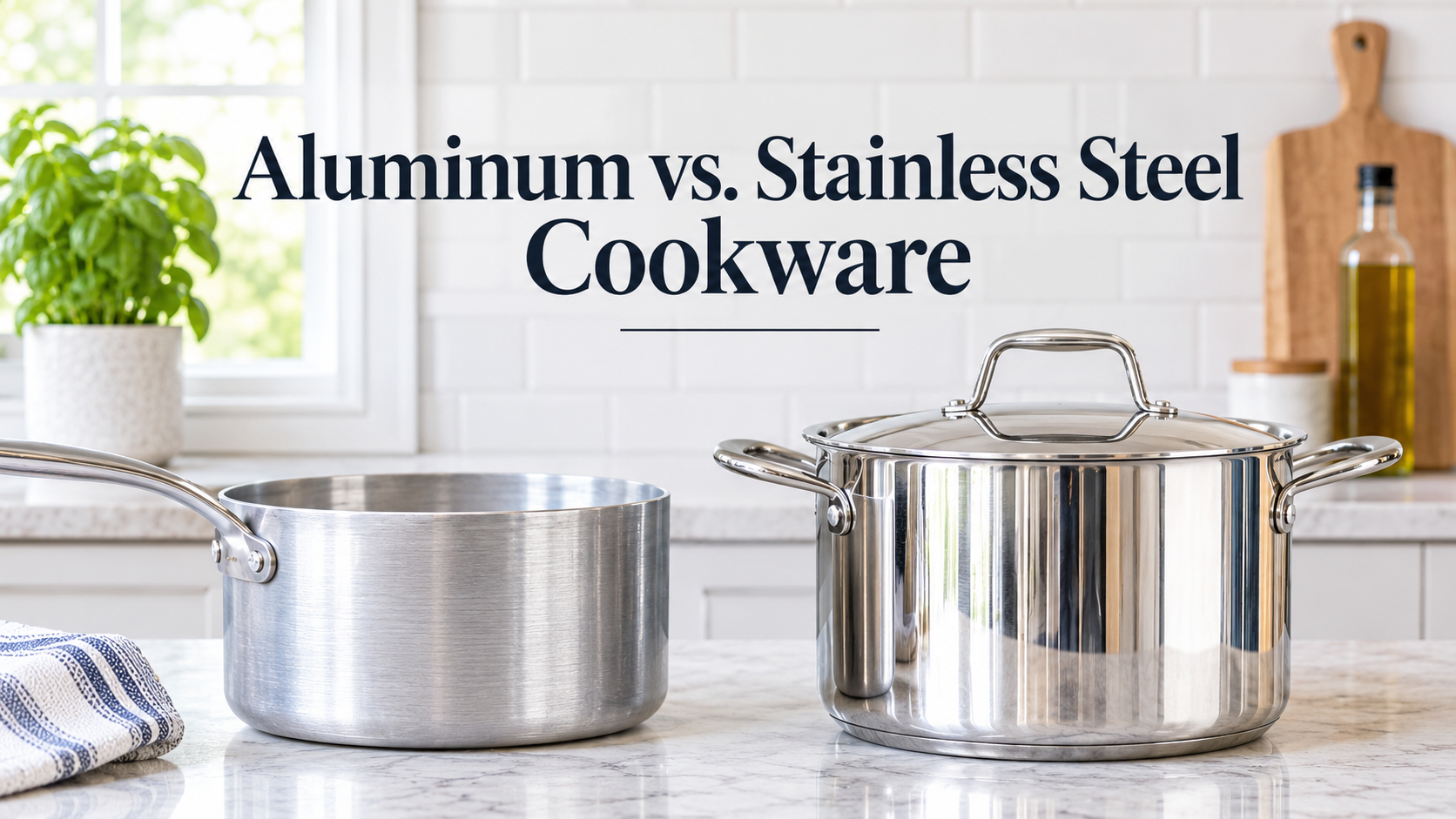
Aluminum vs. Stainless Steel Cookware
The better choice depends on the pan's construction and what you cook. Stainless steel is usually the stronger long-term option for versatile, uncoated stovetop cookware; aluminum is lighter, conducts heat faster, and is often better for sheet pans and responsive everyday frying.
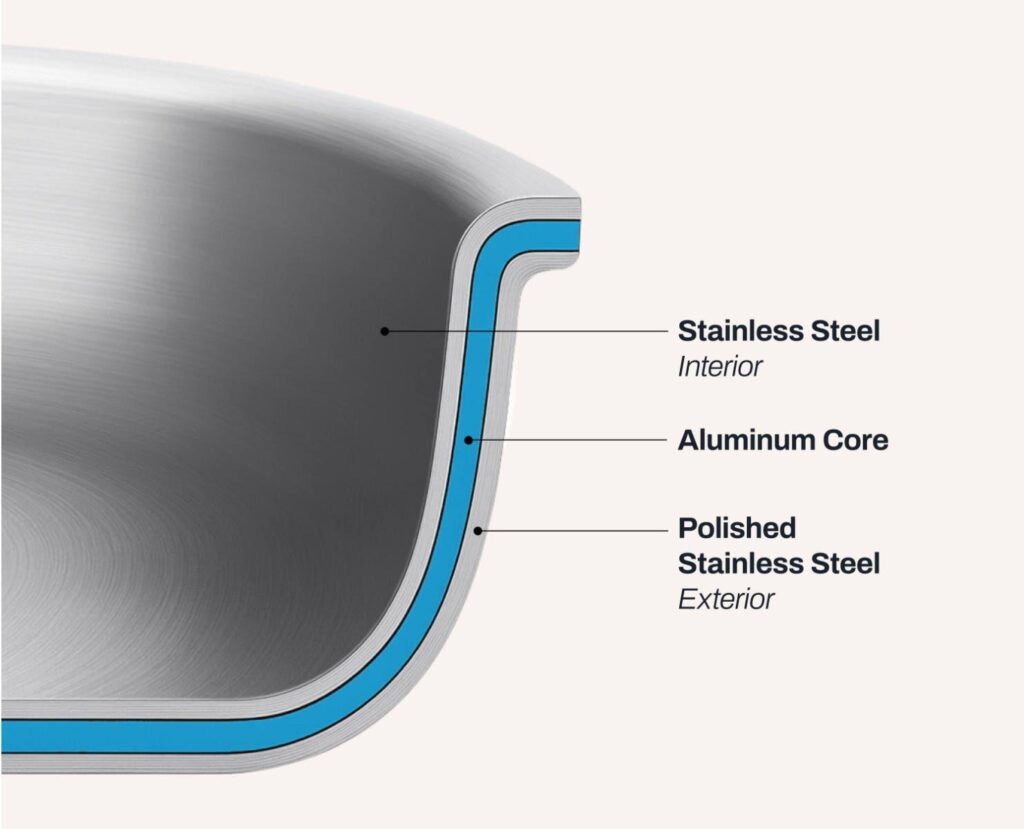
For most home kitchens, fully clad stainless steel with an enclosed aluminum core is the most versatile choice for searing, sautéing, sauces, and acidic recipes. The stainless-steel cooking surface resists corrosion, while the aluminum core helps distribute heat.
Aluminum still has clear advantages. It is lightweight, heats quickly, and performs especially well in heavy-gauge bakeware. Hard-anodized aluminum also has a more durable, less reactive surface than ordinary bare aluminum, although some pans have an additional nonstick coating that needs different care.
Neither material is automatically toxic or universally safer. Food-contact surfaces, product quality, surface condition, cooking time, food acidity, and individual nickel sensitivity all matter. This guide compares those differences and explains which material makes sense for each job.
Quick Material Verdict
- Best all-around cookware Quality multi-ply stainless steel with an aluminum core.
- Best lightweight option Thick-gauge or hard-anodized aluminum.
- Best for sheet pans Uncoated, heavy-gauge aluminum.
- Best for acidic recipes Stainless steel or intact, properly made hard-anodized aluminum.
- Best for induction Magnetic stainless steel or aluminum cookware with a bonded induction-compatible base.
Choose stainless steel if you want durable, versatile cookware for everyday stovetop cooking, especially acidic foods, searing, and sauces. Choose aluminum when fast, even heating, lighter weight, or baking performance matters more. A well-made pan can outperform a poorly made pan regardless of material, so thickness and construction matter. There is no universal winner for health: intact anodized aluminum and good-quality stainless steel are both reasonable choices for most people when used as directed.
Aluminum vs. Stainless Steel Cookware: Quick Comparison
| Factor | Aluminum cookware | Stainless steel cookware |
|---|---|---|
| Heat conductivity | Excellent; heats quickly and spreads heat well when thick enough | Relatively poor on its own; quality cookware often uses an aluminum or copper core |
| Temperature response | Heats and cools quickly | Usually slower to respond, especially in thick, fully clad construction |
| Weight | Usually lighter | Usually heavier, depending on construction |
| Reactivity | Uncoated aluminum can react with acidic or salty foods | Generally nonreactive in normal cooking, though small amounts of nickel and chromium can migrate under some conditions |
| Durability | Depends heavily on gauge and surface; can dent, pit, or scratch | Usually highly durable and corrosion-resistant |
| Maintenance | Uncoated aluminum may discolor or pit; anodized and coated surfaces need appropriate care | Can show sticking, discoloration, and heat tint, but is generally easy to maintain |
| Best cookware uses | Frying pans, griddles, stockpots, and lightweight cookware | Saucepans, skillets, stockpots, sauté pans, and acidic sauces |
| Best bakeware uses | Sheet pans, cake pans, and many baking trays | Durable trays and specialty bakeware where corrosion resistance matters more than fast heat transfer |
| Induction | Does not work by itself unless it has a magnetic stainless-steel base | Works when the base is magnetic; not every stainless grade is induction-compatible |
| Typical cost | Often less expensive, although premium anodized pieces can cost more | Ranges from budget single-ply to expensive multi-ply cookware |
| Oven and broiler use | Depends on the coating, handles, lid, and stated oven limit; many nonstick aluminum pans have lower limits | Often suitable for higher oven heat, but handles, lids, and manufacturer ratings still set the limit |
| High-heat searing | Bare, heavy-gauge aluminum can handle stovetop heat, but coated versions have lower limits and are not ideal for hard searing | Generally better for high-heat searing and fond when the pan is properly preheated |
| Long-term lifespan | Body may last, but a nonstick coating can wear and eventually require replacement | Uncoated, well-made stainless can remain serviceable for many years; construction and care matter |
| Cleaning | Coated and anodized surfaces often need gentler utensils and cleaners | Can need more scrubbing for stuck-on food or heat tint, but has no nonstick layer to wear away |
Which Material Should You Choose for Each Job?
The better material depends on the job. Use this as a practical shortcut rather than treating either metal as the winner in every category.
| Kitchen task | Better starting point | Why |
|---|---|---|
| One versatile everyday skillet | Fully clad stainless steel | Durable uncoated surface for browning, pan sauces, and a wide range of foods. |
| Eggs and delicate foods | Aluminum-bodied nonstick | Lightweight construction and easy release; the coating, not the aluminum body, determines care and lifespan. |
| Cookies and sheet-pan baking | Heavy-gauge aluminum | Fast, even heat transfer supports consistent browning. |
| Tomato sauces and acidic recipes | Stainless steel | Its food-contact surface is generally less reactive than bare aluminum. |
| Lightweight everyday cookware | Hard-anodized aluminum | Usually lighter than comparable stainless cookware and responsive to temperature changes. |
| Long-term uncoated cookware | Quality stainless steel | No nonstick layer to wear out; a well-made pan can remain useful for many years. |
A Stainless-Steel Saucepan for Sauces and Simmering
Best Stainless-Saucepan Example

A useful example of stainless steel’s versatility for simmering, acidic ingredients, and everyday sauce work.
The stainless-steel interior gives you an uncoated surface for tomato-based sauces, reductions, and simmering, while the enclosed aluminum core helps spread heat beyond what a thin single-layer stainless pan can manage. It is heavier than basic aluminum and still needs sensible heat control, but it demonstrates why clad stainless steel is such a practical all-round construction.
Heat Performance: Aluminum Conducts Heat Better
Aluminum is a much better heat conductor than stainless steel. It spreads heat across the cooking surface quickly and responds rapidly when you turn the burner up or down. This is why aluminum is widely used in cookware cores, commercial bakeware, and sheet pans.
Stainless steel is comparatively inefficient at conducting heat. A thin, single-layer stainless pan can develop hot spots and may heat unevenly. Manufacturers address this by bonding stainless steel to a thick aluminum or copper layer.
In fully clad cookware, the conductive core often extends up the sides; in disc-bottom cookware, the conductive layer is concentrated in the base.
This distinction matters when comparing an aluminum pan with a stainless steel pan. A fully clad stainless-steel pan with a thick aluminum core may heat more evenly than a very thin aluminum pan.
For a closer look at how the number of layers changes stainless-steel cookware construction, see our 3-ply vs. 5-ply stainless steel cookware comparison.
Do not assume every stainless pan is slow or every aluminum pan is excellent: gauge, core thickness, burner size, and pan design determine real-world performance.
Stainless Steel vs. Aluminum Cookware Health and Safety
Neither material should be described as automatically toxic. The more useful question is what can migrate from the cooking surface into food, under which conditions, and in what amount.
Is aluminum cookware safe?
People are exposed to small amounts of aluminum through food, water, and the environment. Health Canada’s cookware guidance notes that worn or pitted aluminum can transfer more aluminum or lead to food, and that acidic or salty foods—including tomatoes, citrus, and sauerkraut—can increase transfer.
It advises avoiding long cooking or storage of acidic and salty foods in aluminum cookware and using low-to-medium heat with appropriate care.
The U.S. Agency for Toxic Substances and Disease Registry says typical levels of aluminum from pots and pans are not generally considered harmful, although frequent cooking of acidic foods in aluminum can increase exposure.
One separate issue is lead contamination in some poorly controlled products. Health Canada reports that some aluminum cookware manufactured outside North America has been found to transfer lead into food. A 2025 study also identified lead in some tested aluminum cookware and found that certain products released lead under simulated cooking or storage conditions.
This is not evidence that all aluminum cookware contains lead; it is a reason to buy from a traceable manufacturer, avoid unverified or poorly labeled imports, and be especially cautious with cookware of unknown origin. Read the cookware lead-contamination study.
Claims that ordinary aluminum cookware causes Alzheimer’s disease are not supported as a reason to panic or discard every aluminum pan. The evidence does not establish normal cookware use as a cause of Alzheimer’s.
The sensible precautions are practical: avoid badly pitted or damaged uncoated aluminum, do not simmer acidic food in it for hours, and do not store leftovers in it.
Is stainless steel cookware safer?
Stainless steel is corrosion-resistant and generally less reactive with food than bare aluminum. However, it is not chemically inert under every condition. Research has found that nickel and chromium can migrate from stainless steel into acidic foods, with migration affected by the steel grade, cooking duration, whether the pan is new, and repeated use.
One study using tomato sauce found the greatest release from new cookware and lower release after repeated cooking cycles, although some migration remained. See the studies on nickel and chromium release during cooking and metal release from stainless-steel pots.
For most people, normal use of good-quality stainless steel cookware is considered safe. The exception worth taking seriously is a person who is highly sensitive to dietary nickel.
If that applies to you, ask your healthcare professional about cookware choices rather than assuming every stainless-steel grade behaves identically. Stainless steel grades vary, and “18/10” or “18/8” describes composition, not a guarantee of zero metal migration.
Which is better for health?
For the general population, both can be used safely when the cookware is well made, in good condition, and used according to its instructions. Stainless steel has an advantage for acidic and salty foods because it is less reactive than bare aluminum.
Intact hard-anodized aluminum also reduces transfer compared with ordinary uncoated aluminum. Stainless steel is not automatically the healthier choice for someone with nickel sensitivity.
Do not confuse the metal body with a nonstick coating. An aluminum nonstick frying pan has an aluminum body and a separate cooking surface. Its use and replacement decisions depend on the coating type and condition, not just the aluminum underneath.
Aluminum vs. Stainless Steel: How to Tell the Difference
You can often identify cookware by combining several clues, but appearance alone is not definitive. Some stainless steel is brushed or polished; aluminum can be polished, darkened, anodized, or covered with a nonstick coating.
- Magnet test: a magnet usually does not stick to aluminum. It may stick to magnetic stainless steel, especially many 400-series grades. Many common 300-series stainless steels are nonmagnetic or only weakly magnetic, so a magnet test cannot prove that a pan is aluminum.
- Weight: aluminum is generally lighter than stainless steel of similar size and thickness. A thick aluminum pan can still feel substantial, and a thin stainless pan can feel light.
- Color and finish: bare aluminum often has a softer, duller silver-gray appearance. Stainless steel often looks brighter or more reflective, but finishes overlap.
- Corrosion and discoloration: aluminum can develop gray oxidation, dark marks, or pitting. Stainless steel is more resistant to rust and corrosion, but it can stain, pit under harsh conditions, or show heat tint.
- Markings: check the base, packaging, manufacturer page, or model number. “Aluminum,” “hard-anodized aluminum,” “stainless steel,” “18/10,” “18/8,” and “tri-ply” are more useful clues than appearance.
Important: a stainless-steel pan may have an aluminum core or disc base. That does not make its cooking surface aluminum. In a clad pan, the food-contact surface is usually stainless steel while aluminum is enclosed inside the construction to improve heat distribution.
Types of Aluminum Cookware: Anodized, Cast, and Forged
Hard-Anodized Aluminum vs. Stainless Steel
Hard-anodized aluminum is aluminum that has undergone an electrochemical process that creates a harder, more durable oxide surface. It is not the same as ordinary bare aluminum, and it is not automatically the same as a nonstick-coated pan. Some hard-anodized cookware has an additional nonstick coating; some does not.
Compared with bare aluminum, an intact anodized surface is more resistant to scratching and corrosion and reduces the transfer of aluminum into food. It retains aluminum’s strong heat conduction and relatively light weight.
Stainless steel is generally more tolerant of abrasive cleaning and high-heat searing, and it is often easier to keep for decades, but it may be heavier and more expensive.
Choose hard-anodized aluminum if you want responsive heating and a lighter pan. Choose stainless steel if you want a long-lasting, uncoated cooking surface and frequently prepare acidic foods. Follow the manufacturer’s instructions: deep gouges, peeling nonstick layers, or damaged surfaces are reasons to stop using a pan, regardless of its base metal.
Cast Aluminum Cookware
Cast aluminum cookware is made by pouring molten aluminum into a mold. It can be thicker and more rigid than inexpensive stamped aluminum, and its shape can help distribute heat.
It is often used for Dutch-oven-style pots, roasters, and heavier frying pans. Its actual performance depends on wall thickness, base design, and whether the interior is bare, anodized, enamel-coated, or nonstick.
Stainless steel is generally more resistant to corrosion and surface damage. Cast aluminum is usually lighter and transfers heat more efficiently. For acidic dishes, check the interior finish rather than assuming every cast-aluminum pot is suitable. An intact enamel or appropriate coating changes the food-contact surface; bare aluminum remains more reactive.
Forged Aluminum Cookware
Forged aluminum is shaped under pressure, often producing a pan that is stronger and more substantial than a thin stamped-aluminum pan without the weight of cast iron. Forging describes the manufacturing method, not a special health or nonstick property.
A forged aluminum pan may still have a nonstick coating, an anodized surface, or an uncoated interior.
Stainless steel is the stronger choice for an uncoated, highly durable cooking surface. Forged aluminum is attractive when low weight and quick heat response are priorities. Compare the cooking surface, thickness, base stability, handle attachment, and care instructions—not the word “forged” alone.
Aluminum Alloys: What Buyers Should Know
Most cookware described as aluminum is an alloy rather than chemically pure aluminum. Manufacturers add other elements to improve strength, hardness, or manufacturing performance. Stainless steel is also an alloy, primarily iron with chromium and sometimes nickel and other elements. The term “stainless” refers to corrosion resistance, not an absence of metal components.
For consumers, the exact alloy designation is less useful than the pan’s construction and food-contact surface. Look for clear manufacturer specifications, a stable flat base, adequate thickness, and a surface designed for cooking.
Be skeptical of vague claims such as “aircraft-grade aluminum” or “medical-grade stainless” when the seller does not identify the actual material or provide meaningful specifications.
Aluminum vs. Stainless Steel Frying Pans
For a frying pan, aluminum’s fast heat response is useful for eggs, pancakes, delicate fish, and quick sautéing—especially when the pan has a suitable nonstick or anodized surface. It is also lighter to lift and toss.
The trade-off is that bare aluminum needs more care around acidic ingredients, and coated versions require you to protect the cooking surface.
Stainless steel is better for browning, fond development, pan sauces, and high-heat searing when used correctly. Food can stick if the pan is not preheated appropriately or if the cooking fat and temperature are poorly managed.
A multi-ply stainless pan with an aluminum core offers a useful compromise: stainless steel where food touches, aluminum for heat distribution. If you are comparing stainless options for a broader kitchen setup, see our guide to the best cookware sets.
If you want one pan for most tasks, choose a quality tri-ply or five-ply stainless-steel skillet. If you want an easy-release pan for eggs, a separate aluminum-bodied nonstick or hard-anodized pan can be a practical companion. No single pan has to do every job.
Best Value Stainless Option

A lower-cost fully clad skillet for browning, searing, and pan sauces.
This pan illustrates the main advantage of clad stainless steel: the food-contact surface is stainless steel, while an enclosed aluminum layer improves heat distribution. It is a sensible value-oriented option for browning and pan sauces, but it is not nonstick; preheating and cooking technique matter, and its weight may feel substantial compared with aluminum.
Best Premium Stainless Option

A premium fully clad stainless skillet for cooks who value durable construction and searing performance.
The D3’s bonded tri-ply construction carries its aluminum core through the pan rather than limiting the conductive layer to a base disc. That makes it a strong example of premium clad stainless cookware for searing, browning, and pan sauces. The trade-offs are its higher price, substantial weight, and the learning curve of cooking on an uncoated stainless surface.
Aluminum vs. Stainless Steel Nonstick Pans
Most conventional nonstick frying pans use an aluminum body because aluminum is light and conducts heat well. The nonstick performance comes from the coating, not from aluminum itself. A stainless-steel-bodied nonstick pan may also have a bonded aluminum core and a coated cooking surface.
If you are weighing aluminum against another coated cooking surface, our aluminum vs. ceramic cookware comparison covers coating types, safety and durability. For a broader look at coated versus uncoated cooking surfaces, see our stainless steel vs. nonstick cookware comparison.
When comparing nonstick pans, identify the coating first. PTFE-based nonstick and ceramic-coated nonstick are different technologies with different performance and care characteristics. Do not assume a pan is PFAS-free just because it is marketed as aluminum, stainless steel, granite, stone, or “healthy.”
If you are comparing coated and uncoated options before buying, our best non-toxic pans guide compares ceramic-coated, stainless steel, cast iron, and carbon steel pans, including their practical trade-offs.
Check the manufacturer’s explicit coating disclosure. Avoid overheating empty nonstick pans, use the utensils recommended by the manufacturer, and replace cookware when the coating is peeling or substantially damaged.
Best Premium Aluminum Option

For buyers who want a responsive aluminum body with a convenient nonstick cooking surface.
The hard-anodized aluminum body keeps the pan relatively responsive, while its PTFE nonstick interior provides easy release for eggs and delicate foods. The stainless induction plate makes this model induction-compatible. Its convenience comes with the usual nonstick compromises: avoid overheating, use suitable utensils, and expect the coating to wear rather than last like an uncoated stainless cooking surface.
Best Value Aluminum Option
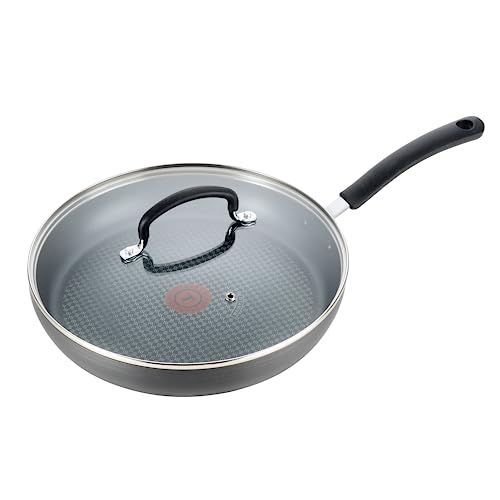
A budget-friendly example of lightweight aluminum cookware for everyday easy-release cooking.
This is a practical lower-cost option for eggs, pancakes, and other foods that benefit from easy release. Its aluminum construction keeps it lighter than many clad stainless pans, but this specific model is not induction-compatible and its nonstick surface is a consumable layer. Confirm the current pan and lid temperature limits and follow the manufacturer’s care instructions.
Aluminum vs. Stainless Steel Bakeware
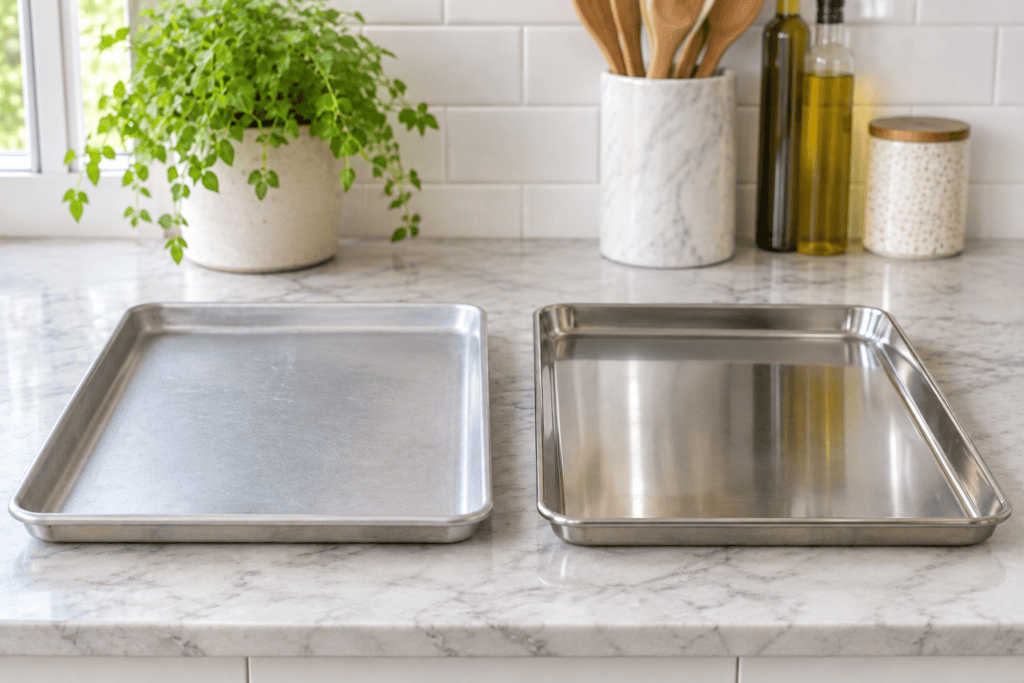
Aluminum is widely used in bakeware because it conducts heat efficiently and helps cakes, cookies, and pastries bake evenly. Light-colored aluminum pans are especially useful when you want controlled browning. Dark nonstick finishes absorb more heat and can brown food faster, so recipes may need adjustments.
Stainless-steel bakeware is durable and corrosion-resistant, but it generally transfers heat less efficiently than aluminum. It can be useful for roasting, food storage, or situations where a sturdy, nonreactive tray is preferred. For cakes, cookies, and many everyday baking jobs, a heavy-gauge aluminum pan is usually the more practical performer.
For acidic foods, the surface matters. Bare aluminum can react with acidic ingredients, while anodized aluminum or a suitable coating reduces direct contact. Do not use damaged or deeply pitted bakeware, and follow the manufacturer’s temperature and cleaning guidance.
Stainless Steel vs. Aluminum Sheet Pans
For standard baking sheets, aluminum is usually the better choice. It heats quickly, distributes heat effectively, and is available in sturdy commercial-style gauges. A heavy-gauge rimmed aluminum sheet pan is a versatile option for roasting vegetables, baking cookies, and cooking proteins.
Best Aluminum Sheet-Pan Example

A straightforward heavy-gauge aluminum option for cookies, roasting, and sheet-pan meals.
The uncoated aluminum body conducts heat efficiently, which is why this style of pan is widely used for cookies, roasting vegetables, and everyday sheet-pan cooking. The galvanized-steel rim adds rigidity; it is not the cooking surface. Avoid prolonged contact with strongly acidic foods and use parchment when appropriate.
Selection note: These examples illustrate different cookware and bakeware constructions, listed specifications, and buyer priorities—not hands-on comparative test results. Product listings and model revisions can change. Before buying, confirm the exact material, food-contact surface, dimensions, induction compatibility, coating, and oven-temperature limits for the version being sold.
Stainless-steel sheet pans are a reasonable alternative if you prioritize corrosion resistance, avoid aluminum food contact, or want a tray that can tolerate certain cleaning routines. However, they may not brown or bake in exactly the same way as aluminum.
If you substitute stainless for aluminum in a recipe, watch the food rather than relying blindly on the same timing.
Do not mistake an aluminized-steel pan for solid aluminum or stainless steel. Aluminized steel is a steel base with an aluminum-silicon coating. It combines a steel structure with a protective aluminum-rich surface and is common in some bakeware. Check the product description carefully.
How Aluminum Compares With Other Cookware Metals
Aluminum vs. Copper vs. Stainless Steel
Copper is an excellent heat conductor and responds quickly to temperature changes, but it is expensive and generally needs a lining because bare copper can react with food. Stainless steel is often used as the lining in modern copper cookware.
Aluminum offers much of the practical heat-conduction advantage at a lower price and lower weight, while stainless steel provides a durable, relatively nonreactive food-contact surface.
For most home cooks, a well-made stainless pan with an aluminum core is a more practical purchase than a premium copper pan. Copper makes sense for cooks who value precise temperature response and are willing to pay for and maintain specialized cookware.
Aluminum vs. Titanium vs. Stainless Steel
These labels describe different things. Aluminum is commonly used as a conductive base or core. Stainless steel is a durable alloy used for many cooking surfaces. Titanium may refer to a titanium-reinforced coating, a titanium-infused nonstick surface, or cookware made from commercially pure titanium. Those products are not equivalent.
Pure titanium cookware is relatively lightweight and corrosion-resistant but is not as conductive as aluminum. Many products marketed as “titanium cookware” are actually aluminum or stainless-steel pans with a titanium-containing coating or surface treatment.
Read the construction details and do not assume a titanium marketing label means the entire pan is solid titanium or that it is naturally nonstick. Our titanium vs. stainless steel cookware comparison explains those distinctions in more detail.
A Few Final Checks Before You Buy
Cookware Buying Checklist
-
Everyday stovetop cooking
Choose the material based on the cooking surface and the foods you prepare most often.
Look forStainless steel for uncoated pans, acidic sauces, searing, deglazing, and long service life.AvoidBare aluminum for prolonged cooking or storage of acidic foods. -
Lightweight, responsive cookware
Aluminum heats quickly and is usually easier to lift and maneuver.
Look forThick-gauge or hard-anodized aluminum with a stable base and clearly stated construction.AvoidVery thin pans that may warp or develop uneven hot spots. -
Bakeware and sheet pans
Heat conductivity is especially important for baking and roasting performance.
Look forHeavy-gauge aluminum for efficient baking and roasting when food-contact conditions are appropriate.AvoidAssuming stainless steel will brown or bake identically to aluminum. -
Stainless steel bakeware
Stainless steel prioritizes corrosion resistance and a sturdy, nonreactive surface.
Look forStainless steel when durability and material preference matter more than maximum conductivity.AvoidChoosing it expecting the same heat response as aluminum. -
Clad cookware
Many stainless pans use aluminum inside the construction to improve heat distribution.
Look forA clad stainless pan with a stainless cooking surface and an enclosed aluminum core.AvoidConfusing an aluminum core with an exposed aluminum cooking surface. -
Cookware condition and safety
Surface condition and construction matter more than broad material marketing claims.
Look forSound handles, a flat base, intact surfaces, and clear care instructions.AvoidPitting, deep scratches, peeling coatings, loose handles, or warped bases.
Before buying, check the actual food-contact layer, core material, thickness, compatibility with your cooktop, oven-safe temperature, handle construction, warranty, and cleaning instructions. Avoid relying on marketing phrases such as “non-toxic,” “chemical-free,” or “professional grade” without a clear material specification.
Aluminum vs. Stainless Steel Cookware FAQs
Is aluminum or stainless steel better for health?
Both can be suitable for most people when they are well made and used correctly. Stainless steel is less reactive with acidic foods than bare aluminum, but some stainless grades can release nickel and chromium. Intact hard-anodized aluminum reduces aluminum transfer compared with ordinary bare aluminum. People with significant nickel sensitivity may need individualized advice about stainless steel.
Is aluminum cookware toxic?
Ordinary aluminum cookware is not automatically toxic. Aluminum exposure from typical cookware use is generally considered low, but acidic or salty foods can increase transfer from uncoated aluminum, particularly when the surface is worn or pitted. Avoid prolonged cooking or storage of these foods in bare aluminum.
Does stainless steel cookware leach metals?
It can release small amounts of metals such as nickel and chromium, especially with acidic foods, long cooking times, and some new cookware. The amount varies with the grade, construction, and use history. For most people, normal use is considered safe; people with strong nickel sensitivity should discuss alternatives with a healthcare professional.
How can I tell if my pan is aluminum or stainless steel?
Use several clues: aluminum is usually lighter and nonmagnetic; stainless steel is usually heavier and may attract a magnet. However, some stainless grades are nonmagnetic, so the magnet test is not definitive. Manufacturer markings and construction details are the most reliable evidence.
Is hard-anodized aluminum safer than stainless steel?
Not universally. Hard anodizing creates a harder, less reactive surface than bare aluminum and reduces transfer into food. Stainless steel is durable and suitable for acidic foods, but it can release nickel and chromium under certain conditions. The better option depends on the condition of the surface and individual sensitivities. For another comparison involving a different food-contact surface, read our ceramic vs. stainless steel cookware guide.
Can I cook tomato sauce in aluminum cookware?
Avoid prolonged cooking or storage of tomato sauce in uncoated aluminum. Acidic foods can increase metal transfer and may discolor or pit the cookware. Use stainless steel, glass, or an intact surface specifically designed for acidic foods instead.
Is aluminum or stainless steel better for frying pans?
Aluminum is lighter and heats faster, making it useful for quick cooking and coated nonstick pans. Stainless steel is better for searing, browning, and pan sauces. A clad stainless pan with an aluminum core combines the strengths of both materials.
Are aluminum or stainless steel sheet pans better?
Heavy-gauge aluminum is usually better for baking because it conducts heat efficiently. Stainless steel is more corrosion-resistant but generally heats less efficiently. Choose based on the recipe, surface finish, and whether you prioritize baking performance or material preference.
Is tri-ply stainless steel cookware made with aluminum?
Often, yes. Many tri-ply pans have a stainless-steel interior, an aluminum core, and a stainless-steel exterior. The aluminum is enclosed inside the pan to improve heat distribution; it is not normally the food-contact surface.
Does a magnet test prove cookware is stainless steel?
No. Many magnetic stainless steels attract a magnet, but common 300-series stainless steels may be nonmagnetic or weakly magnetic. Aluminum is nonmagnetic, but a nonmagnetic result does not prove that the pan is aluminum.
Aluminum vs. Stainless Steel: Final Verdict
- For the most versatile uncoated stovetop pan, choose fully clad stainless steel with an enclosed aluminum core. It handles searing, sauces, and acidic foods well, provided you use the right preheating technique.
- Choose hard-anodized or appropriately coated aluminum when lower weight, quick heat response, or easier food release matters more than having a permanent uncoated cooking surface.
- For cookies, roasting, and most sheet-pan baking, heavy-gauge aluminum is usually the more practical performer.
- If you are sensitive to nickel, do not assume stainless steel is automatically the best choice; check the material details and seek individualized advice when needed.
There is no reason to force one material to do every job. A durable stainless-steel skillet or saucepan can form the core of an everyday cookware setup, while an aluminum nonstick pan and an aluminum sheet pan can fill specific roles. Judge the actual food-contact surface, construction, thickness, manufacturer, and care instructions—not just the material name on the label.
Sources and Further Reading
- Health Canada: The safe use of cookware and bakeware
- MedlinePlus: Cooking utensils and nutrition
- ATSDR: Public Health Statement for Aluminum
- Kamerud et al.: Stainless steel leaches nickel and chromium into foods during cooking
- Release of nickel and chromium in common foods during cooking in stainless steel pots
- Lead contamination and release from some aluminum cookware: 2025 study